
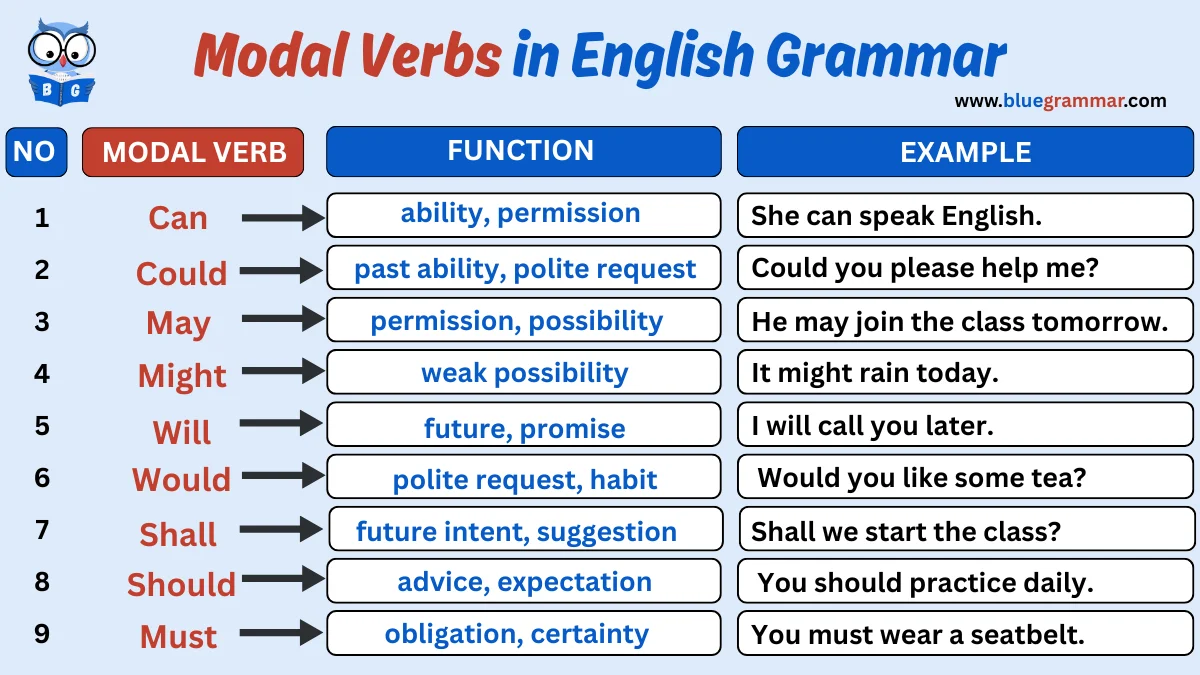
Modal verbs are helping verbs that express ability, permission, possibility, obligation, advice, intention, or certainty. They are always used with the base form of a main verb and never change their form (no -s, -ed, or -ing endings). Below is a clear explanation of the nine most common modal verbs used in English.
1. Modal Verb – Can
Can is used to show ability or to give and ask for permission. It is one of the most commonly used modal verbs in everyday English and sounds informal and natural in conversation.
- Possible Usage: Ability, Permission, Informal requests
- Examples:
Ability: “She can speak English.”
Ability: “I can swim very well.”
Permission: “You can use my phone.”
2. Modal Verb – Could
Could is the past form of can, but it is also used to make polite requests and suggestions. It sounds more respectful and softer than can, especially in formal situations.
- Possible Usage: Past ability, Polite requests, Suggestions
- Examples:
Past Ability: “He could run fast when he was young.”
Polite Request: “Could you please help me?”
Suggestion: “We could try again tomorrow.”
3. Modal Verb – May
May is used to give formal permission and to show possibility. It is more polite and formal than can and is commonly used in written and formal spoken English.
- Possible Usage: Permission, Possibility
- Examples:
Permission: “You may come in.”
Possibility: “He may join the class tomorrow.”
Possibility: “It may rain today.”
4. Modal Verb – Might
Might is used to show a weak or less certain possibility. It suggests that something is possible, but the speaker is not completely sure about the outcome.
- Possible Usage: Weak possibility, Uncertain situations
- Examples:
Weak Possibility: “It might rain today.”
Uncertainty: “She might be at home.”
Uncertainty: “We might meet again.”
5. Modal Verb – Will
Will is used to talk about the future, to make promises, and to show decisions made at the moment of speaking (instant decisions). It is very common in both spoken and written English.
- Possible Usage: Future actions, Promises, Instant decisions
- Examples:
Promise: “I will call you later.”
Future Action: “She will help you.”
Instant Decision: “We will start the class now.”
6. Modal Verb – Would
Would is used to make polite requests, express preferences, and talk about past habits. It sounds more polite and formal than will.
- Possible Usage: Polite requests, Past habits, Preferences
- Examples:
Polite Request: “Would you like some tea?”
Past Habit: “He would walk to school every day.”
Preference: “I would like to help you.”
7. Modal Verb – Shall
Shall is used to talk about future intentions and to make suggestions or offers, especially with I and we. It is more common in British English and formal contexts.
- Possible Usage: Future intention, Suggestions, Offers
- Examples:
Future Intention: “We shall start the class now.”
Suggestion: “Shall we begin the lesson?”
Offer/Intention: “I shall inform you soon.”
8. Modal Verb – Should
Should is used to give advice, make recommendations, and express expectations or moral duties. It tells what is right or best to do in a given situation.
- Possible Usage: Advice, Expectation, Moral duty
- Examples:
Advice: “You should practice daily.”
Moral Duty: “Students should respect teachers.”
Expectation: “He should arrive on time.”
9. Modal Verb – Must
Must is used to express strong obligation, strict rule, or logical certainty. It shows that something is necessary or that the speaker feels very sure about a conclusion.
- Possible Usage: Obligation, Strong necessity, Certainty
- Examples:
Obligation: “You must wear a seatbelt.”
Strong Necessity: “Students must follow the rules.”
Certainty/Deduction: “He must be tired after work.”
Quick Summary Table | 9 Common Modal Verbs
| Modal Verb | Primary Uses | Degree of Formality / Tone |
|---|---|---|
| Can | Present ability, casual permission, direct requests. | Informal / Everyday |
| Could | Past ability, polite requests, soft suggestions. | Polite / Moderately Formal |
| May | Formal permission, moderate possibility. | Formal / Polite |
| Might | Weak or uncertain possibility, tentative ideas. | Tentative / Soft |
| Will | Future facts, promises, instant decisions. | Direct / Neutral |
| Would | Polite requests, preferences, past habits. | Courteous / Formal |
| Shall | Offers, suggestions, formal future intentions (I/We). | Formal / British English |
| Should | Advice, expectations, recommendations. | Constructive / Advisory |
| Must | Strong obligation, rules, high logical certainty. | Firm / Direct |
Pro Tip: Modal verbs never take suffixes like -s, -ed, or -ing, and they are always followed directly by the base form of the verb (e.g., "She can speak", never "She cans speaks").