
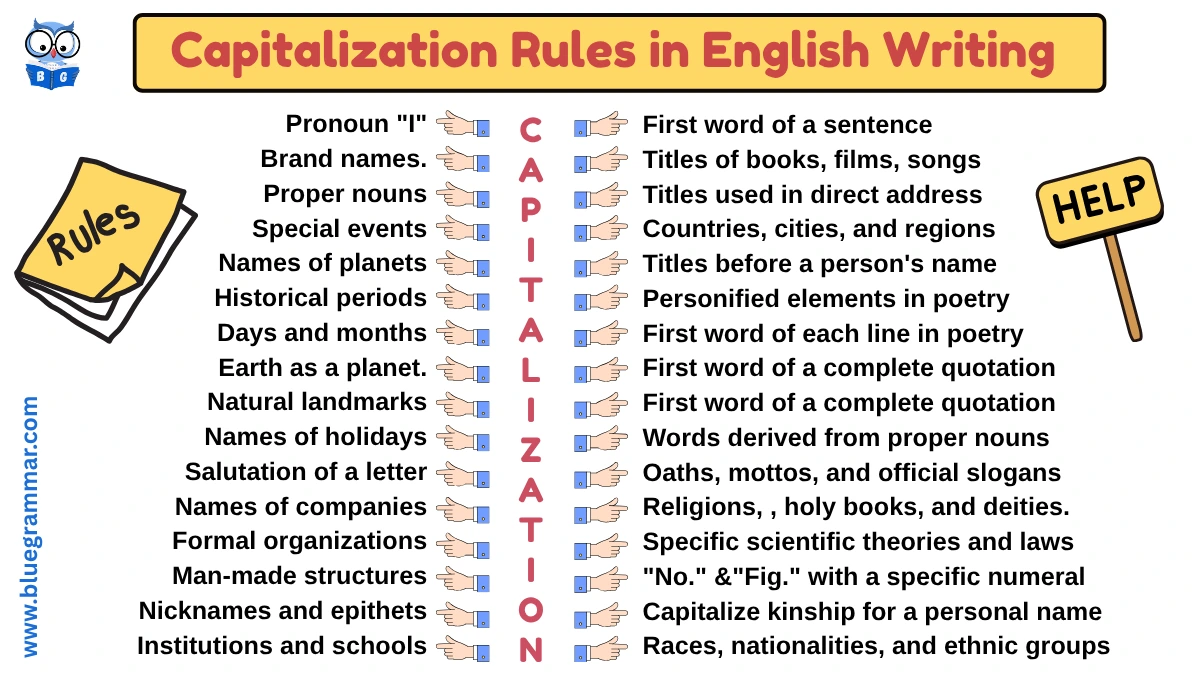
Capitalization rules in English are more nuanced than in many other writing systems. At its core, capitalization means writing the first letter of a word in its uppercase form while keeping the remaining letters lowercase. However, knowing when to capitalize is where most writers — even seasoned ones — trip up. Below is a comprehensive guide to all fifty essential capitalization rules, complete with clear explanations and practical examples.
The Fundamentals
Rule 1: Capitalize the first word of every sentence.
Every sentence begins with a capital letter, regardless of what word it is. This includes sentences that follow a period, exclamation mark, or question mark.
- The meeting starts at nine.
- Where are you going?
Rule 2: Capitalize all proper nouns and adjectives derived from them.
Proper nouns name specific people, places, or things. When these nouns form adjectives, those adjectives carry the capital letter too.
- Henry loves Indian songs.
- She studied Shakespearean drama.
Rule 3: Capitalize the names of companies and corporations.
Every significant word in a company’s official name is capitalized, as the name functions as a proper noun.
- I was appointed as a team manager at Blue Grammar.
Rule 4: Capitalize specific historical periods and events.
Named eras and significant historical events are treated as proper nouns and therefore require capitalization.
- During the Middle Ages, much of English literature was shaped by Chaucer and his successors.
Rule 5: Capitalize brand names.
Trademarked and branded names are proper nouns and always begin with a capital letter.
- Most people use Google as their primary search engine.
Days, Months, Seasons, and Holidays
Rule 6: Capitalize the days of the week and months of the year.
These are considered proper nouns in English, unlike in some other languages.
- Jane’s wedding is in June.
- The meeting is scheduled for Thursday.
- We met on Friday.
- School begins in September.
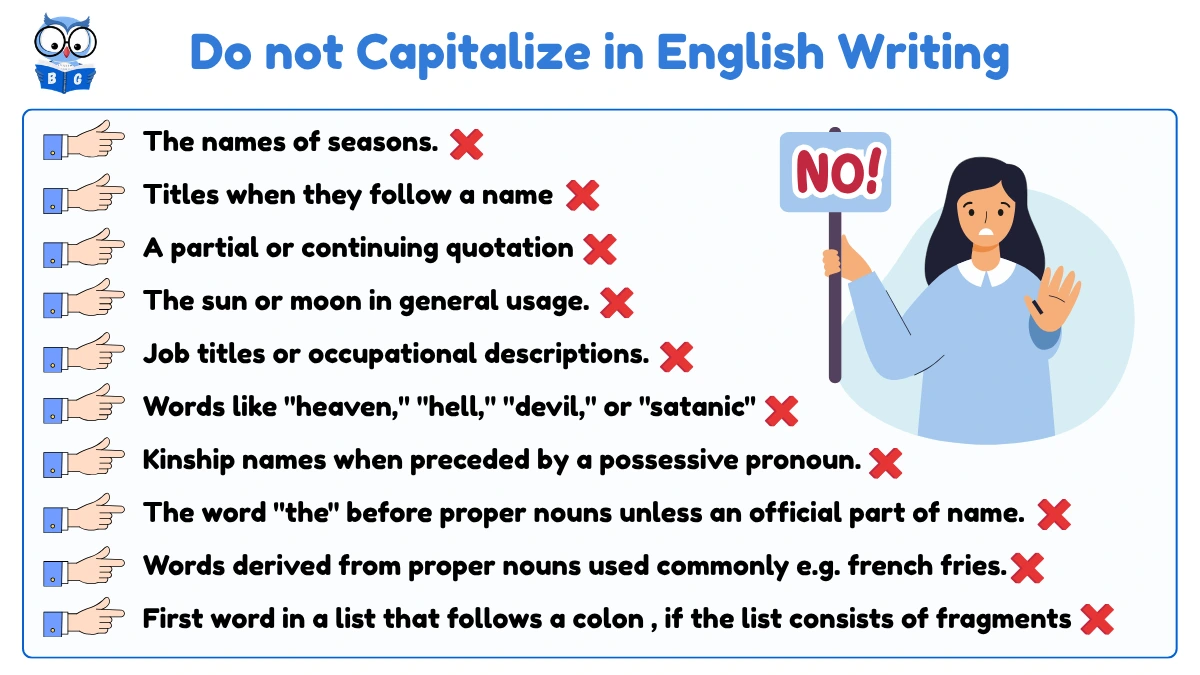
Rule 7: Do not capitalize the names of seasons.
Spring, summer, autumn, and winter are common nouns, not proper ones, and should remain lowercase.
- I love the golden colors of autumn.
Rule 8: Capitalize the names of holidays and special observances.
Official holidays and commemorative days are treated as proper nouns.
- I will give you a surprise on Valentine’s Day.
- Christmas falls on a Wednesday this year.
Rule 9: Capitalize the names of special events and organized occasions.
Large, named events — particularly recurring international ones — are capitalized.
- All Olympic Games were postponed due to the coronavirus pandemic.
Places, Landmarks, and Geography
Rule 10: Capitalize the names of institutions and schools.
Official names of educational and governmental institutions are proper nouns.
- She studied at the Cambridge School System for eight years.
Rule 11: Capitalize the names of man-made structures.
Named buildings, bridges, towers, and other constructed landmarks take capitalization.
- He offered his last prayer at Faisal Mosque before leaving the city.
Rule 12: Capitalize the names of natural and geographical landmarks.
Mountains, rivers, oceans, deserts, and similar natural features carry capitalized proper names.
- She has always dreamed of climbing Mount Everest.
Rule 13: Capitalize names of countries, cities, and regions.
All political and geographic divisions — from continents to neighborhoods — are proper nouns when they carry an official name.
- Paris is considered the fashion capital of the world.
- She grew up in Southeast Asia.
Rule 14: Capitalize directions only when they refer to specific regions, not when indicating compass directions.
North, South, East, and West are capitalized when they name a recognized region but remain lowercase when indicating direction.
- She moved to the South after college.
- Drive north for three miles to reach the town.
Planets, Nature, and Science
Rule 15: Capitalize the names of planets.
Each planet in our solar system carries a proper name and is always capitalized.
- The solar system contains Mercury, Venus, Mars, Jupiter, Saturn, Uranus, Neptune, and Earth.
Rule 16: Capitalize “Earth” only when referring to it as a planet.
When “earth” means soil or the ground in a general sense, it remains lowercase. When it refers to the planet itself, it is capitalized.
- We know that Earth revolves around the Sun.
- She dug her hands into the earth.
Rule 17: Do not capitalize the sun or moon in general usage.
Unlike named planets, the sun and moon are typically not capitalized unless used in a scientific context alongside other capitalized planetary bodies.
- The sun rose early that morning.
- The moon lit up the path.
Rule 18: Capitalize the names of specific scientific theories and laws when named after people.
Eponymous scientific principles take a capital letter from the person’s name they honor.
- Einstein’s Theory of Relativity changed how we understand physics.
- Newton’s Laws of Motion are foundational to classical mechanics.
Capitalization Rules for People, Titles, and Relationships
Rule 19: Capitalize all titles when used directly before a person’s name.
Professional, honorary, and governmental titles are capitalized when they immediately precede a name.
- President Lincoln delivered the speech.
- Professor Ahmed teaches chemistry.
Rule 20: Do not capitalize titles when they follow a name or are used without one in a general sense.
Once a title is separated from the name or used generically, it reverts to lowercase.
- Abraham Lincoln was the president.
- The professor explained the lesson.
Rule 21: Do not capitalize job titles or occupational descriptions.
General occupations and job descriptions — as opposed to formal titles — are common nouns and stay lowercase.
- The company owner Henry Smith accompanied me to the conference.
Rule 22: Capitalize a title when it replaces someone’s first name in direct reference.
When a title is used in place of a first name and refers to a specific individual, it functions as a proper noun.
- Here comes Doctor Elizabeth. Good morning, Professor.
Rule 23: Capitalize titles used in direct address.
When speaking directly to someone using their title, that title is capitalized.
- Thank you, Doctor.
- Could you help me, Professor?
Rule 24: Capitalize kinship names when used alone as a substitute for a personal name.
Words like Mom, Dad, Grandpa, and Aunt are capitalized when they stand in for an actual name and are used without a possessive pronoun.
- I am so happy that Mom decided to come.
- Please ask Dad about it.
Rule 25: Do not capitalize kinship names when preceded by a possessive pronoun or followed by a personal name.
Once a possessive is attached, the kinship term becomes a common noun rather than a name substitute.
- My mom is cooking dinner.
- Tom’s grandpa looks wonderful.
Rule 26: Capitalize all nicknames and epithets in every context.
Nicknames function exactly like proper names and should always begin with a capital letter.
- Thanks, Mom.
- Meet my younger brother, Sunny.
Races, Nationalities, Religions, and Cultures
Rule 27: Capitalize the names of races, nationalities, and ethnic groups.
All racial and ethnic identifiers are treated as proper adjectives or nouns.
- I admire Punjabi people for their warmth and hospitality.
- Many African cultures have rich oral traditions.
Rule 28: Capitalize the names of all religions, their adherents, holy books, and deities.
Faith traditions and the texts and figures central to them are all proper nouns.
- There is no God but Allah.
- The Bible and the Quran are among the most widely read books in history.
Rule 29: Do not capitalize words like “heaven,” “hell,” “devil,” or “satanic” in non-religious or idiomatic usage.
These words are lowercase when used figuratively or in everyday expressions.
- What the hell is this?
- It was a devilishly difficult puzzle.
Rule 30: Capitalize formal organizations, governmental bodies, and associations.
Named institutions, ministries, agencies, and clubs carry proper names that require capitalization.
- My brother received an appointment letter from the Ministry of Defence, Iran.
Capitalization Rules for Quotations, Lists, and Colons
Rule 31: Capitalize the first word of a complete quotation, even when it appears mid-sentence.
If you are introducing a full quoted sentence, the quotation itself begins with a capital letter.
- Sarah said, “We should leave now.”
- He asked, “Are you ready?”
Rule 32: Do not capitalize a partial or continuing quotation that flows into the surrounding sentence.
When a quoted phrase is integrated into the structure of the original sentence, no internal capitalization is needed.
- She described the movie as “extremely entertaining.”
- He called the plan “a complete success.”
Rule 33: Do not capitalize the first word in a list that follows a colon, if the list consists of fragments.
When items after a colon are not complete sentences, they remain in lowercase.
- Please bring the following: a pencil, an eraser, and a chart.
Rule 34: Capitalize the first word after a colon if what follows is a complete sentence.
A full independent clause coming after a colon earns its own capital letter.
- Ali gave me one piece of advice: Always speak the truth and be kind to others.
Titles of Works
Rule 35: In titles of books, films, songs, and other works, capitalize all content words.
Nouns, verbs, adjectives, and adverbs in a title are capitalized; short function words like articles, prepositions, and conjunctions are generally not.
- “A History of the English Language” is a foundational academic text.
- The film “Gone with the Wind” remains a classic.
Rule 36: Always capitalize the first and last word of any title, regardless of its part of speech.
Even if a title begins or ends with a preposition, article, or conjunction, those words must be capitalized.
- “It Happened One Night” was a celebrated film.
- She wrote a piece called “What We Lived For.”
Poetry and Literary Conventions
Rule 37: Capitalize personified elements in poetry.
When a poet attributes human qualities to an inanimate object or abstract concept, that entity is often capitalized to signal its personification.
- The Sun grew angry and poured its fury upon the sea.
Rule 38: Capitalize the first word of each line in traditional poetry.
Conventional poetry follows the rule of beginning every new line with a capital letter, regardless of whether it starts a new sentence.
- Shall I compare thee to a Summer’s day?
- Thou art more lovely and more temperate.
Capitalization in Letters, Emails, and Formal Writing
Rule 39: Capitalize the salutation of a letter or email.
The greeting at the beginning of formal or informal correspondence begins with a capital letter.
- Dear Mr. Harrison, / To Whom It May Concern,
Rule 40: Capitalize only the first word of a letter’s closing.
In closings like “Yours sincerely” or “Best regards,” only the very first word is capitalized.
- Yours sincerely,
- Best regards,
Abbreviations, Acronyms, and Initialisms
Rule 41: Capitalize acronyms and initialisms in their entirety.
When words are abbreviated into their initial letters, all those letters are written in uppercase.
- She works for the FBI. The report was submitted to the WHO.
Rule 42: Capitalize abbreviations of proper nouns.
Shortened forms of proper names retain capitalization.
- He traveled from NYC to LA.
- The conference was held in the UK.
Rule 43: The pronoun “I” is always capitalized.
Unlike other languages where the first-person singular pronoun may be lowercase, English always writes it as a capital letter regardless of its position in the sentence.
- She asked if I would join them.
- Yesterday, I finished the project.
Words Derived from Proper Nouns
Rule 44: Capitalize words derived from proper nouns when the connection to the original noun is still apparent.
When a common word traces directly back to a proper name and retains that association, it stays capitalized.
- She studied Marxist theory.
- The Darwinian model of evolution reshaped biology.
Rule 45: Do not capitalize words derived from proper nouns when they have become fully common through widespread use.
Over time, some words lose their proper-noun status entirely through everyday adoption.
- She used a band-aid for the cut.
- He loves eating french fries.
Specific Grammatical and Structural Rules
Rule 46: Do not capitalize the word “the” before proper nouns unless it is an official part of the name.
In most cases, “the” before a proper noun remains lowercase. However, if “the” is officially part of an organization’s name, it is capitalized.
- We visited the Eiffel Tower.
- She performed with The Rolling Stones.
Rule 47: Capitalize words in headings and subheadings based on the chosen style.
In title case, significant words in headings are capitalized. In sentence case, only the first word and proper nouns are. Consistency within a document is essential.
- Title case: “The Importance of Early Education”
- Sentence case: “The importance of early education”
Rule 48: Capitalize the names of specific courses and academic subjects when they are proper nouns or official course titles.
General fields of study remain lowercase, but when referring to a specific named course, capitalize it.
- She is studying history and economics.
- She is enrolled in Advanced History of Western Civilization.
Rule 49: Capitalize “No.” and “Fig.” when used with a specific numeral in formal or academic writing.
These abbreviations, when followed by a number, refer to a specific, named item and are treated as proper references.
- Please refer to Fig. 3 for the data. The findings are recorded in No. 7 of the series.
Rule 50: Capitalize words in oaths, mottos, and official slogans when they are treated as proper titles.
Formal mottos, pledges, and institutional slogans are regarded as proper titles and are capitalized accordingly.
- The national motto reads: “Faith, Unity, Discipline.”
- She recited the Pledge of Allegiance with her hand on her heart.
Bottom Line
These 50 rules cover the most important capitalization conventions used in modern English writing, from everyday sentence construction to academic, professional, and published writing. While some capitalization rules have evolved over time and others depend on stylistic convention, understanding the logic behind each one — whether it signals a proper name, a title of honor, a new sentence, or a formal structure — makes applying them second nature. The key is consistency, attention to context, and a willingness to look up edge cases when in doubt.