
Punctuation marks may look small, but they play a powerful role in clarity and meaning. Among the most commonly confused are the hyphen (-), en dash (–), and em dash (—). Although they appear similar, each has a distinct purpose in writing.
In this guide, you’ll learn the differences between the hyphen, en dash, and em dash, along with clear explanations, examples, and common mistakes to avoid. Whether you’re a student, writer, or editor, mastering these marks will improve your writing instantly.
What Is a Hyphen (-)?
A hyphen (-) is the shortest of the three marks. It is mainly used to join words or parts of words together to form compound terms. Hyphens improve clarity and prevent confusion, especially when multiple words function as a single adjective.
Hyphens are especially common in compound adjectives (e.g., well-known author) and certain prefixes. Without a hyphen, sentences can become unclear or misleading. For example, “small business owner” and “small-business owner” can have slightly different meanings depending on context.
Common Uses of Hyphens
- Compound adjectives before a noun:
Example: She is a well-known speaker.
Example: It was a high-quality product.
Example: They live in a part-time arrangement. - Numbers and fractions:
Example: Twenty-one students attended.
Example: Two-thirds of the cake is gone.
Example: Ninety-nine problems remained. - Avoiding confusion:
Example: Re-sign (sign again) vs. resign (quit)
Example: Co-operate (older style, sometimes used for clarity)
Example: Recover vs. re-cover - Prefixes (in some cases):
Example: Ex-president
Example: Self-aware
Example: All-inclusive
What Is an En Dash (–)?
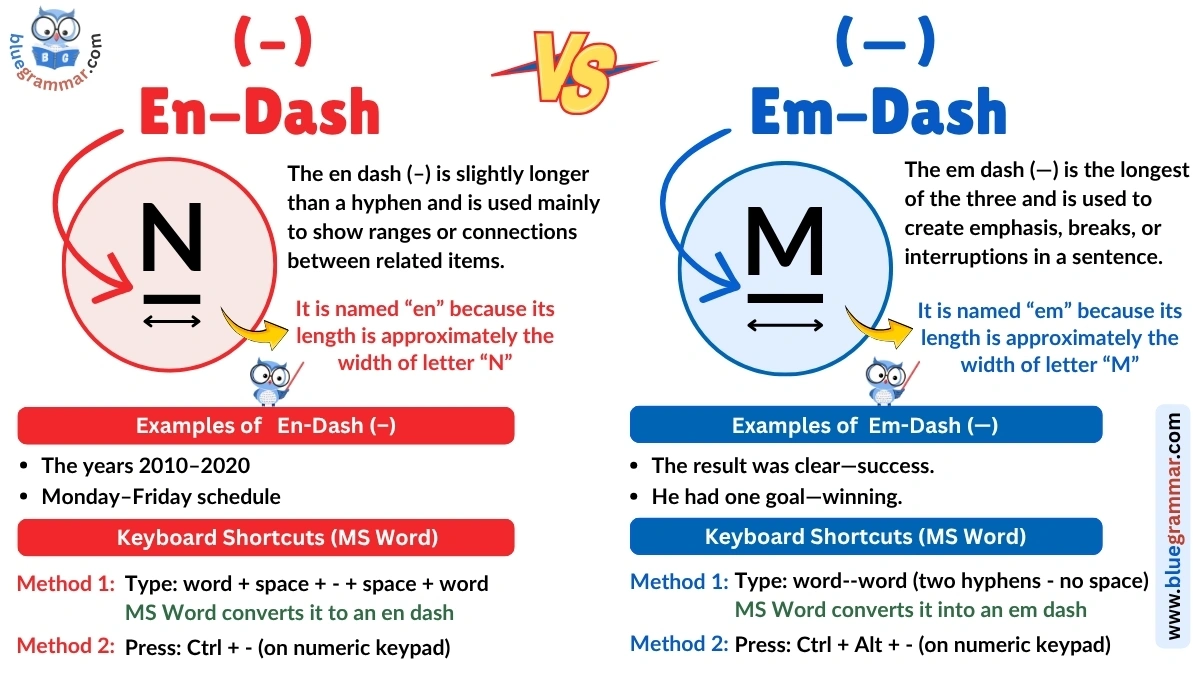
The en dash (–) is slightly longer than a hyphen and is used mainly to show ranges or connections between related items. It is named “en” because its length is approximately the width of the letter “N.”
En dashes are often used in formal writing, academic texts, and publishing. They help express relationships more clearly than a simple hyphen, especially when linking complex or multi-word elements.
Common Uses of En Dashes
- Indicating ranges (numbers, dates, time):
Example: Pages 10–25
Example: The years 2010–2020
Example: Monday–Friday schedule - Showing connections or relationships:
Example: Pakistan–India relations
Example: Teacher–student interaction
Example: Lahore–Karachi flight - Replacing “to” or “and” in certain contexts:
Example: The score was 3–1.
Example: The train runs Islamabad–Rawalpindi.
Example: A London–Paris route - Complex compound adjectives:
Example: A New York–based company
Example: Nobel Prize–winning scientist
Example: Post–World War II era
What Is an Em Dash (—)?
The em dash (—) is the longest of the three and is used to create emphasis, breaks, or interruptions in a sentence. It is more dramatic and flexible than commas, parentheses, or colons.
Em dashes are commonly used in informal and modern writing styles, including blogs, articles, and creative writing. They help add rhythm and tone, making sentences more engaging and expressive.
Common Uses of Em Dashes
- Adding emphasis or extra information:
Example: She finally answered—after hours of silence.
Example: The result was clear—success.
Example: He had one goal—winning. - Indicating interruptions or sudden breaks:
Example: I was about to say—but never mind.
Example: She opened the door—and screamed.
Example: If you think I will—well, think again. - Replacing commas or parentheses:
Example: My brother—who lives abroad—is visiting.
Example: The car—old but reliable—still runs.
Example: His idea—though risky—worked. - Creating dramatic pauses:
Example: And then—nothing happened.
Example: He looked back—too late.
Example: It was the moment—of truth.
Key Differences: Hyphen vs. En Dash vs. Em Dash
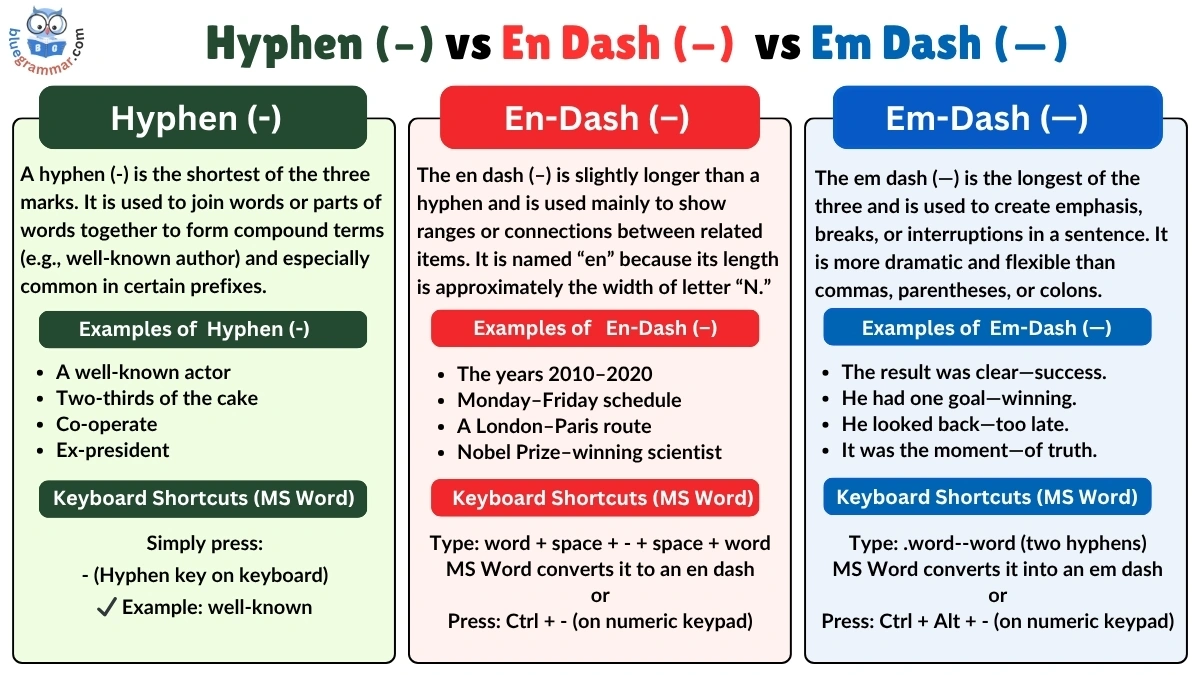
| Feature | Hyphen (-) | En Dash (–) | Em Dash (—) |
|---|---|---|---|
| Length | Shortest | Medium | Longest |
| Main Use | Joins words | Shows range or connection | Adds emphasis or a break |
| Examples | Well-known | 2010–2020 | She left—suddenly |
| Tone | Technical | Formal | Expressive |
Simple Way to Remember:
- Hyphen (-) → joins words
- En dash (–) → connects values or relationships
- Em dash (—) → creates a pause or emphasis
Common Mistakes to Avoid
- Using a Hyphen Instead of an En Dash
❌ 2010-2020
✔ 2010–2020
Note: A hyphen should not be used for ranges. - Overusing Em Dashes
❌ She—went—to—the—store.
✔ She went to the store.
Note: Too many em dashes make writing hard to read. Use them sparingly. - Confusing Compound Adjectives
❌ A high quality product
✔ A high-quality product
Note: Without the hyphen, the meaning may become unclear. - Mixing Up En Dash and Hyphen in Relationships
❌ Pakistan-India relations
✔ Pakistan–India relations
Note: Use an en dash for relationships between entities. - Adding Spaces Incorrectly Around Dashes
Hyphen (-) → No spaces
En dash (–) → Usually no spaces
Em dash (—) → Style varies (no spaces in American English)
How to Insert Hyphen (-), En Dash (–), and Em Dash (—) in Microsoft Word (Shortcuts)
Here are the keyboard shortcuts in Microsoft Word to insert a hyphen, en dash, and em dash:
1. Hyphen (-)
Simply press:
–(Hyphen key on keyboard)- ✔ Example: well-known
2. En Dash (–)
Method 1 (AutoFormat): Type word + space + – + space + word (MS Word automatically converts it to an en dash)
Method 2 (Numeric Keypad): Press Ctrl + – (on numeric keypad)
3. Em Dash (—)
Method 1 (AutoFormat): Type word–word (two hyphens, no spaces; MS Word converts it into an em dash)
Method 2 (Numeric Keypad): Press Ctrl + Alt + – (on numeric keypad)
Quick Tip: These shortcuts work best when AutoFormat As You Type is enabled in Word. On laptops without a numeric keypad, AutoFormat is usually the easiest method.
Summary
Understanding the difference between the hyphen, en dash, and em dash can significantly improve your writing clarity and professionalism. While the hyphen connects words, the en dash links ranges and relationships, and the em dash adds emphasis and flow.
If you use them correctly, your writing will look more polished, structured, and easy to read. Start noticing these punctuation marks in books, articles, and websites—you’ll quickly master their usage.