
Have you ever noticed that some writers place a comma before the last item in a list, while others do not? This extra comma is called the Oxford comma — also known as the serial comma — and it has been one of the most debated punctuation marks in English grammar. Some writers believe it makes sentences clearer, while others think it is unnecessary. In this article, you’ll learn what the Oxford comma is, why some writers ignore it, and when you should use it.
What Is an Oxford Comma?
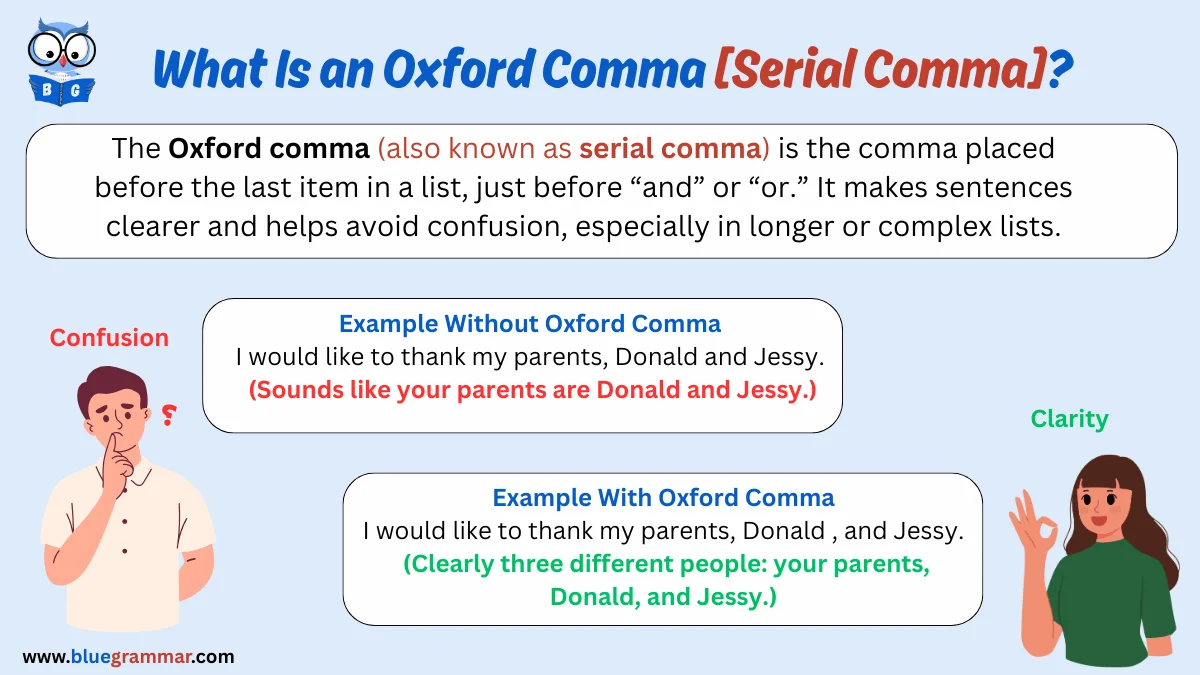
The Oxford comma, also known as the serial comma, is the comma placed before the conjunction (and or or) in a list of three or more items.
Examples:
With the Oxford comma:
I bought apples, oranges, and bananas.
Without the Oxford comma:
I bought apples, oranges and bananas.
The comma after "oranges" is called the Oxford comma.
Why Is It Called the Oxford Comma?
The name comes from Oxford University Press, whose editors traditionally used this punctuation style in their publications. Although it originated there, many writers and publishers around the world still use it today.
Why Do Some Writers Use the Oxford Comma?
Many grammar experts recommend using the Oxford comma because it makes writing more precise and prevents misunderstandings.
1. It Prevents Confusion
Sometimes, leaving out the Oxford comma can completely change the meaning of a sentence.
Without the Oxford Comma:
I’d like to thank my parents, Beyoncé and Joe.
This sentence humorously suggests that the writer’s parents are Beyoncé and Joe.
With the Oxford Comma:
I’d like to thank my parents, Beyoncé, and Joe.
Now the meaning is clear. The writer is thanking three separate people or groups.
2. It Makes Complex Lists Easier to Read
The Oxford comma is especially helpful when one or more items in a list already contain the word and. It clearly separates the final item from the rest of the list.
Without the Oxford comma:
The picnic included sandwiches, fish and chips and fruit.
Readers may wonder whether "fish and chips and fruit" is one item or two separate items.
With the Oxford comma:
The picnic included sandwiches, fish and chips, and fruit.
Now it is clear that the list contains three items:
- sandwiches
- fish and chips
- fruit
The Oxford comma helps readers recognize where one list item ends and the next begins.
3. It Is Preferred in Academic and Legal Writing
In essays, research papers, legal documents, and formal writing, clarity is extremely important. For this reason, many academic style guides recommend using the Oxford comma consistently.
Why Do Some Writers Ignore the Oxford Comma?
Although the Oxford comma improves clarity, not everyone uses it. Here are the main reasons:
1. Some Style Guides Do Not Recommend It
Several newspapers and magazines follow style guides that omit the Oxford comma unless it is needed to avoid confusion. For example, the Associated Press (AP) Stylebook usually leaves it out because newspaper writing aims to be short and concise.
2. It Creates a Simpler Appearance
Some writers believe that an extra comma makes a sentence look crowded.
Compare these examples:
- I packed clothes, shoes, and books.
- I packed clothes, shoes and books.
Both are grammatically correct, and some people simply prefer the cleaner appearance of the second sentence.
3. The Meaning Is Usually Clear
In everyday writing, readers can often understand the sentence without the Oxford comma.
For example: “We bought milk, eggs and bread.”
Most readers know that these are three separate items, so the extra comma is not essential.
Should You Use the Oxford Comma?
There is no universal rule. The best choice depends on your audience and the type of writing.
Use the Oxford Comma if you are writing:
- Academic essays
- College assignments
- Research papers
- Business reports
- Legal documents
- Professional content where clarity is important
You may omit it if you are writing:
- Newspaper articles
- Casual blog posts
- Informal emails
- Social media posts
- Publications that follow AP style
Whatever style you choose, be consistent throughout your writing. Switching between styles in the same article can make your writing look unprofessional.
Oxford Comma Examples
With Oxford Comma
- I like tea, coffee, and juice.
- We invited Ali, Sara, and Ahmed.
- She studies history, literature, and philosophy.
Without Oxford Comma
- I like tea, coffee and juice.
- We invited Ali, Sara and Ahmed.
- She studies history, literature and philosophy.
Both versions are correct unless your style guide says otherwise.
Key Points to Remember
- The Oxford comma is the comma before and or or in a list of three or more items. It is also called the serial comma.
- It helps prevent confusion and makes sentences clearer.
- Academic and legal writing usually prefers it.
- Many newspapers and AP-style publications omit it.
- Neither style is wrong as long as you use it consistently.
Final Thoughts
The Oxford comma may seem like a tiny punctuation mark, but it can make a big difference in how readers understand your writing. While some writers always include it and others leave it out, the most important rule is clarity.
If you’re writing essays, reports, or educational content, using the Oxford comma is generally the safer choice because it reduces ambiguity. No matter which style you follow, stay consistent from beginning to end. Good punctuation is not about following trends — it is about helping your readers understand your message with ease.