
Two of the most common words in the English language — “it” and “there” — often show up in sentences where they have absolutely nothing to say. They refer to no person, no place, no object. They carry no message of their own. And yet, without them, the sentence would simply collapse.
“It is raining.” “There is a problem.” “It seems that no one noticed.” “There were three letters on the table.”
What are these words doing at the front of these sentences? That is exactly what this post will explain.
These two words, in these particular roles, are called dummy subjects — also known as expletive subjects, empty subjects, or prop words. They sit in the subject position of a sentence not because they mean something, but because English syntax requires a subject to be there. Understanding how they work — and the difference between them — is one of those grammar insights that quietly improves both your writing and your reading of English.
What Are Dummy Subjects?
In English grammar, a dummy subject (sometimes called an expletive subject or prop word) is a word that occupies the grammatical position of the subject without carrying any real meaning. English sentences generally require a subject, so when there is no obvious subject available, words such as it and there are used to satisfy this grammatical requirement.
Randolph Quirk, Sidney Greenbaum, Geoffrey Leech, and Jan Svartvik — authors of A Comprehensive Grammar of the English Language (Longman, 1985), one of the most widely cited references in English linguistics — describe these as elements that fill a syntactic slot without contributing semantic content. Their work identifies both “anticipatory it” and “existential there” as the two primary dummy subjects in English.
Why Does English Use Dummy Subjects?
Unlike some languages that allow subjectless sentences, English typically requires an explicit subject. When the real subject is unknown, delayed, or unnecessary, it or there can fill the subject position.
Compare these examples:
- It is important to exercise regularly.
- To exercise regularly is important.
Both sentences are grammatically correct, but the first sounds more natural in modern English.
Similarly:
- There are many reasons to learn English.
In this sentence, there introduces the existence of something rather than referring to a place.
‘It’ as a Dummy Subject
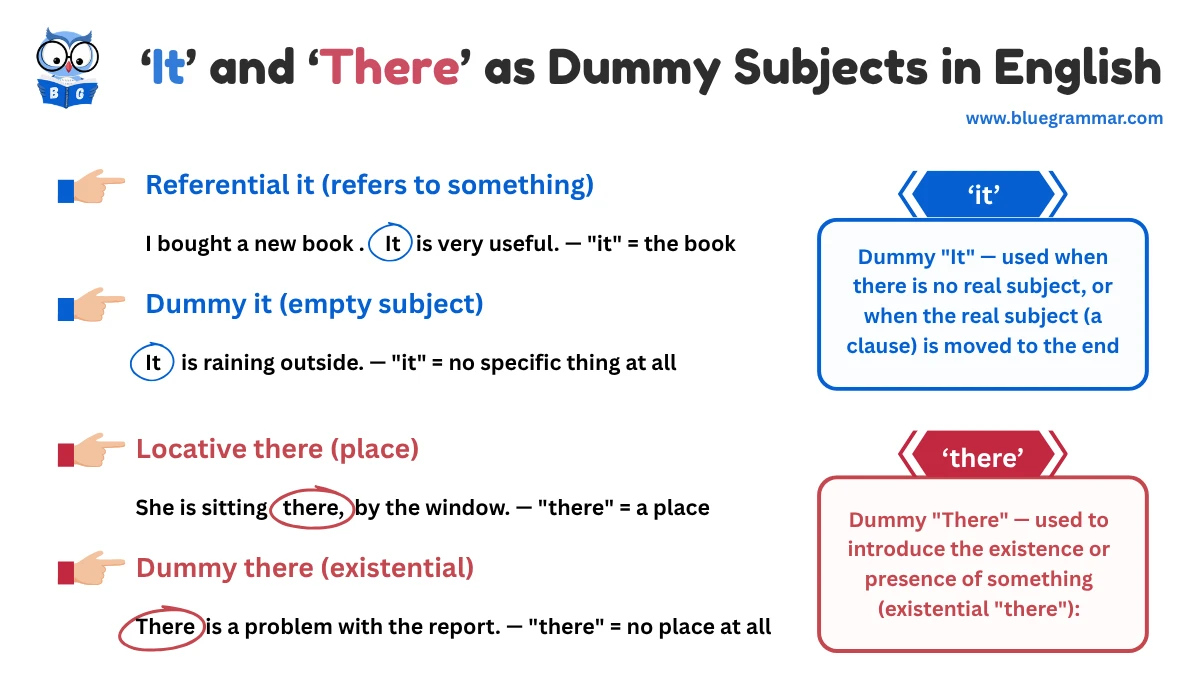
The word “it” plays many roles in English. Sometimes it refers to something specific: “I bought a new phone. It is fast.” But in a large number of sentences, “it” refers to nothing at all — it simply fills the subject slot so the sentence can proceed.
Grammarians have given this usage various names over the years: anticipatory it, prop it, provisional it, empty it, impersonal it, and expletive it. As a 2019 paper published in the International Journal of English Linguistics notes, all of these terms describe the same core function: an element used “to fill a grammatical gap” with no semantic value of its own.
Use 1: Weather, Time, Distance, and Environment
The most familiar use of dummy “it” is in sentences about the weather, time, dates, temperature, and distance. In these sentences, there is no logical actor — nothing is doing the raining or the cooling. “It” simply holds the subject slot open.
- Talking About Weather: We commonly use it when describing weather conditions.
Example: It is raining heavily. - Expressing Time and Dates: Dummy it is frequently used when referring to time.
Example: It is ten o’clock. - Referring to Distance: We also use it to describe distance.
Example: It was a long walk to the village. - Giving Opinions and Evaluations: One of the most common uses of dummy it is to introduce judgments or opinions.
Example: It is important to read regularly.
Use 2: Extraposition (Anticipatory “It”)
This is perhaps the most grammatically significant use of dummy “it.” Extraposition is the process of moving a heavy or complex clause — usually an infinitive phrase or a that-clause — from the subject position to the end of the sentence, replacing it at the front with dummy “it.”
This happens because English strongly prefers to deliver its heaviest information at the end of a sentence — a principle linguists call end-weight. Putting a long clause at the very beginning of a sentence feels front-loaded and unnatural. The dummy “it” solves this elegantly.
- Original (front-heavy): That nobody was listening to him was deeply frustrating.
- With dummy “it”: It was deeply frustrating that nobody was listening to him.
- Infinitive clause: It is important to double-check your work before submitting.
- That-clause: It appears that the deadline has already passed.
- Gerund clause: It is no use arguing about it now.
Use 3: Cleft Sentences
A cleft sentence splits one piece of information into two clauses specifically to throw emphasis on one element. The structure is: It + be + [emphasized element] + relative clause.
- Original: The manager approved the plan.
- Cleft — who: It was the manager who approved the plan.
- Cleft — what: It was the plan that the manager approved.
- Cleft — when: It was last Thursday that the decision was made.
The “it” in a cleft sentence is entirely empty — pure grammatical scaffolding. The real communicative weight falls on what comes immediately after “it was.” Cleft sentences are particularly common in spoken English, journalism, and academic writing as a tool for controlled emphasis.
Use 4: Impersonal Expressions with Adjectives and Verbs
A large category of evaluative and reporting expressions in English uses dummy “it” as a formal subject before adjectives or reporting verbs:
- Evaluation: It is wrong to cheat in an examination.
- Possibility: It is possible that the results have been delayed.
- Necessity: It is essential that every student attends the session.
- Reporting: It has been reported that three people were injured.
- Appearance: It seems that no one was aware of the problem.
‘There’ as a Dummy Subject
While “it” fills a range of functions, dummy “there” has a much more specific job: it introduces the existence or presence of something. Grammarians call this existential “there” — because the sentence is essentially saying that something exists or is present somewhere.
This is not the same “there” that indicates a place (“Put the book there.”). In existential sentences, “there” has no location meaning at all. Compare:
- Locative there (place): She is sitting there, by the window. — “there” = a place
- Dummy there (existential): There is a problem with the report. — “there” = no place at all
According to the Cambridge Dictionary Grammar Reference, existential “there” introduces a noun phrase that is the real, logical subject of the sentence. It is the noun phrase after the verb that carries the actual meaning.
How Existential “There” Works
The basic structure is: There + be + [real subject] + [optional complement or adverbial]
- Basic existence: There is a solution to every problem.
- Plural: There were three messages in his inbox.
- With complement: There is someone waiting outside the door.
- With adverbial: There is a café on the corner of that street.
- Question form: Is there any milk left in the fridge?
- Negative form: There was no sign of rain in the forecast.
Existential “There” with Different Tenses and Verbs
“There” as a dummy subject is not limited to the verb “be.” It can appear with a range of verbs in different tenses:
- Past simple: There was a long queue outside the cinema.
- Future: There will be a meeting on Friday morning.
- Present perfect: There has been a significant change in policy.
- Modal verb: There might be some delay due to the weather.
- Other verbs: There followed a long and heated argument.
‘It’ vs. ‘There’: What Is the Difference?
| Feature | Dummy “It” | Dummy “There” |
|---|---|---|
| Primary function | Fills the subject position in a sentence (weather expressions, extraposition, cleft sentences). | Introduces the existence or presence of someone or something. |
| Real subject | With dummy “it,” the real subject is often a delayed infinitive phrase or that-clause. It is important to study regularly. |
With dummy “there,” the real subject is the noun phrase that comes after the verb. There are many books on the shelf. |
| Verb agreement | Dummy “it” always takes a singular verb. It is raining. |
Dummy “there” follows the number of the noun that comes after the verb. There is a problem. / There are two problems. |
| Can it be replaced? | Dummy “it” cannot usually be replaced with another meaningful subject. | Dummy “there” can often be rewritten without there. There is a dog in the yard. → A dog is in the yard. |
| Common structures | It is + adjective + to-infinitive/that-clauseIt is easy to understand. |
There + be + noun phraseThere were several guests at the party. |
| Typical use | Common in formal writing, academic English, and journalism. | Appears in all registers and is especially frequent in everyday speech. |
Quick Summary
Dummy “It”
Used when there is no real subject, or when the real subject (a clause) is moved to the end:
- Weather, time, distance, temperature: It is raining. / It is noon.
- Extraposition (anticipatory it): It is clear that he was lying.
- Cleft sentences: It was Sara who called.
- Impersonal evaluations: It is necessary to act now.
Dummy “There”
Used to introduce the existence or presence of something (existential “there”):
- Introduces a real noun subject that follows the verb: There is a problem.
- Verb agrees with the real noun, not with “there”: There are three issues.
- Works with various tenses and some non-“be” verbs: There will be / There followed…
- Not the same as locative “there,” which points to a place.
The key difference: Dummy “it” fills a gap when there is no meaningful subject or when a clause is delayed. Dummy “there” specifically announces that something exists or is present.
References
According to English Grammar Today from Cambridge Dictionary, English commonly uses dummy subjects such as it and there when the sentence structure requires a subject but no meaningful subject is present.
British Council LearnEnglish also explains that these forms are frequently used in everyday English, particularly when discussing weather, time, opinions, and existence.
Further Reading
- Cambridge Dictionary. Dummy Subjects
- British Council LearnEnglish. ‘It’ and ‘There’ as Dummy Subjects
- Huddleston, R., & Pullum, G. K. (2002). The Cambridge Grammar of the English Language. Cambridge University Press.