
Confused about which vs. that? Understanding the difference between these two relative pronouns will improve your writing clarity, punctuation skills, and overall grammatical accuracy. Many English learners struggle with them because both introduce extra information about a noun, but their usage and punctuation rules are quite distinct.
In this detailed guide, you will learn:
- The basic difference between which and that
- Their grammatical function
- Restrictive vs. non-restrictive clauses
- Correct punctuation rules
- Common mistakes students make
- Exception cases
- Practical examples
What Is the Function of “Which” and “That”?
Both which and that are relative pronouns. They introduce relative clauses, which give more information about a noun.
Examples
- The book that you gave me is interesting.
- The book, which you gave me, is interesting.
While both sentences are grammatically valid, their meaning and punctuation are completely different.
The Core Difference: Restrictive vs. Non-Restrictive Clauses
This is the most important concept to master when distinguishing between these two words.
A. “That” → Restrictive (Essential Information)
Use that when the information is necessary to identify the noun. Without the clause, the sentence meaning changes completely.
- Example: The students that studied hard passed the exam.
- Meaning: Only the specific students who studied hard passed (not all students).
- If removed: “The students passed the exam.” (The scope changes completely, so the clause is essential.)
Rule: No commas are used with restrictive clauses introduced by that.
B. “Which” → Non-Restrictive (Extra Information)
Use which when the information is extra and non-essential. The sentence meaning stays clear even if you remove the clause.
- Incorrect: The students, which studied hard, passed the exam.
- Correct Example: My car, which is very old, still runs perfectly.
- If removed: “My car still runs perfectly.” (The sentence still makes full sense.)
Rule: Commas are required to enclose non-restrictive clauses introduced by which.
Punctuation Rule
This is where most students make punctuation errors:
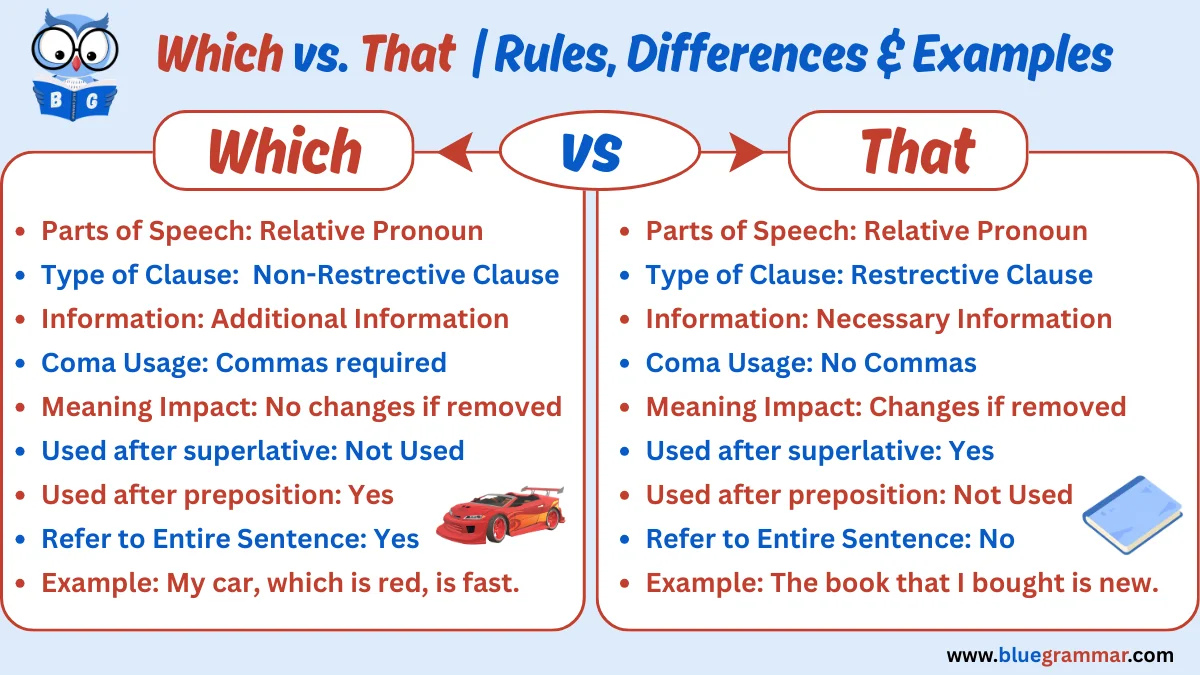
- That: Used in restrictive (essential) clauses → No commas
- Which: Used in non-restrictive (non-essential) clauses → Requires commas
Comparison
- The house that is painted blue is mine. (Identifies one specific house out of many.)
- The house, which is painted blue, is mine. (We already know which house; "painted blue" is just extra detail.)
Meaning Difference (Very Important)
Let’s compare two similar sentences to see how meaning shifts:
| Sentence | Clause Type | Meaning / Interpretation |
|---|---|---|
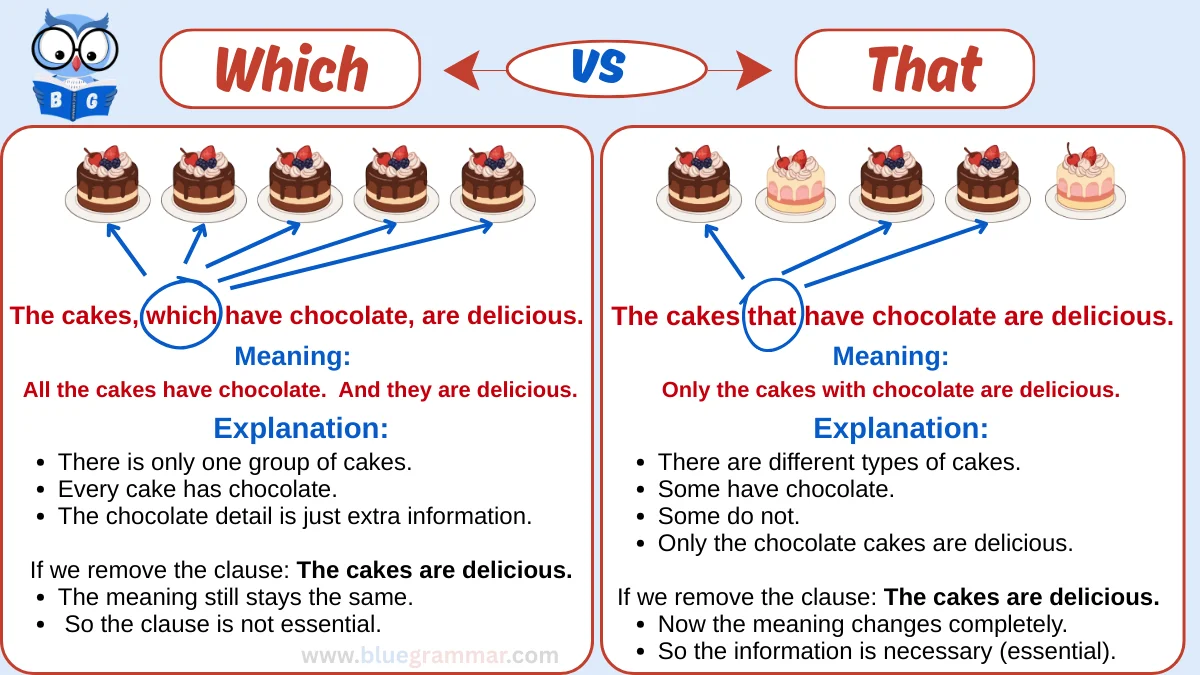
| The cakes that have chocolate are delicious. | Restrictive (No commas) | Only the chocolate cakes are delicious; non-chocolate ones may not be. |
| The cakes, which have chocolate, are delicious. | Non-Restrictive (Commas) | All the cakes being discussed have chocolate, and all of them are delicious. |
When “That” Is Preferred
In modern American English, that is strongly preferred in restrictive clauses, especially in the following structures:
- After superlatives (e.g., the best, the most)
- After indefinites like all, everything, something, anything
- After ordinal numbers (e.g., first, second)
Examples
- She is the best teacher that I have ever met.
- Everything that he said was true.
- This is the first book that I bought.
Using which in these contexts often sounds unnatural.
When “Which” Is Required
Which must be used in the following specific cases:
- After a preposition:
The house in which I live is old. (Not: The house in that I live) - In non-restrictive clauses:
My laptop, which I bought last year, is already slow. - Referring back to an entire sentence/idea:
He failed the exam, which surprised everyone. (Here which refers to the whole situation of him failing.)
Common Mistakes Students Make
Mistake 1: Using commas with “that”
- Incorrect: The book, that I bought, is new.
- Correct: The book that I bought is new.
Mistake 2: Using “which” without commas for non-restrictive meaning
- Confusing: My car which is red is fast.
- Correct: My car, which is red, is fast. (OR: The car that is red is fast.)
Mistake 3: Using “that” directly after a preposition
- Incorrect: The office in that he works is small.
- Correct: The office in which he works is small.
Can “Which” Be Used in Restrictive Clauses?
Yes — but mainly in British English. In general usage:
- American English: Restrictive → that | Non-restrictive → which
- British English: Restrictive → that or which | Non-restrictive → which
For standardized exams and formal academic writing, follow the standard rule: use that for essential clauses and which for extra information.
Advanced Concept: Removing the Relative Pronoun
In restrictive clauses where that acts as the object, it can often be omitted (contact clause):
- The book that I bought is expensive. → The book I bought is expensive.
However, which in non-restrictive clauses can never be removed without ruining sentence structure:
- My car, which is red, is fast. (Removing "which" creates a fragment/error.)
Exam Tip for Students
Ask yourself if the clause is essential to identify the subject:
- Necessary information → Use that (No comma)
- Extra information → Use which (With commas)
Simple Memory Trick:
No comma → THAT
Comma → WHICH
Practice Sentences
Choose the correct relative pronoun (that or which):
- The movie _____ we watched was boring. — that
- My brother, _____ lives in Lahore, is a doctor. — which
- This is the best phone _____ I have used. — that
- The office in _____ she works is large. — which
Conclusion
The difference between which and that relies on understanding essential versus extra information:
- That = Essential information (No commas)
- Which = Extra information (Set off with commas)