
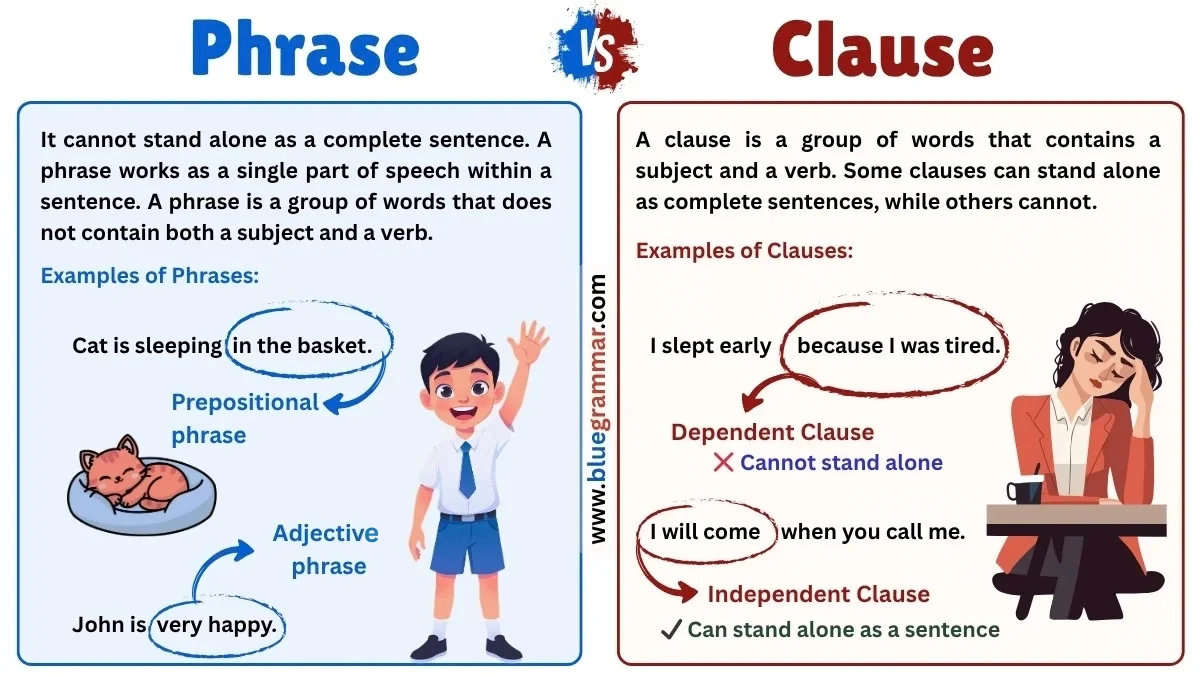
Although both phrases and clauses are groups of words, the real difference lies in how they function inside a sentence. Understanding this distinction helps you avoid sentence errors and build more complex structures correctly.
Instead of memorizing definitions, it is more useful to compare how each behaves in real sentences.
Structure Difference (Core Idea)
The most important difference is structural.
A phrase is a group of words that works together but lacks a full subject-verb combination, while a clause contains both a subject and a verb.
Example
- Sentence with Phrase: She is sitting on the chair.
- Analysis: “on the chair” is a phrase. It gives extra information but has no subject-verb pair.
- Sentence with Clause: She is sitting where the chair is broken.
- Analysis: “where the chair is broken” is a clause. It includes a subject (chair) and verb (is).
Explanation: The phrase only adds detail, but the clause introduces a mini-idea with its own subject and action.
Completeness of Thought
A clause can express a complete or incomplete idea, but a phrase never expresses a complete thought on its own.
Example
- Phrase: After the movie
This is a phrase. It leaves the reader thinking “what happened after the movie?” - Clause: After the movie ended, we went home.
“after the movie ended” is a clause. It gives a clear idea with a subject (movie) and verb (ended), though it still depends on the main clause.
Explanation: A phrase cannot form even a partial statement, while a clause can express a situation or event.
Function in a Sentence
Phrases act as parts of speech, while clauses act as parts of sentences or complete sentences.
Example
- Sentence with Phrase: He wore a shirt with stripes.
“with stripes” is a phrase. It functions like an adjective describing “shirt.” - Sentence with Clause: He wore a shirt that had stripes.
“that had stripes” is a clause. It describes the noun but includes its own subject (that) and verb (had).
Explanation: Both give similar information, but the clause is more detailed and expressive.
Level of Detail
Clauses usually provide more detailed and specific information than phrases.
Example
- Phrase Example: The girl in the room is my cousin.
“in the room” is a phrase. It gives limited information. - Clause Example: The girl who is sitting in the room is my cousin.
“who is sitting in the room” is a clause. It adds more detail with an action.
Explanation: A clause expands the idea by showing action or condition, while a phrase simply describes.
Flexibility in Sentence Formation
Clauses allow you to form complex and compound sentences, while phrases cannot do this alone.
Example
- Phrase: Because of the rain, we stayed inside.
- Clause: Because it was raining, we stayed inside.
Explanation: The clause clearly shows cause with a subject and verb, making the sentence more natural and expressive.
Transformation Between Phrase and Clause
Many phrases can be expanded into clauses, and clauses can be reduced into phrases.
Example
- Phrase Version: The man standing near the door is my teacher.
- Clause Version: The man who is standing near the door is my teacher.
Explanation: “standing near the door” (phrase) becomes “who is standing near the door” (clause). The clause version is more formal and explicit, while the phrase version is shorter.
Dependency
Phrases are always dependent, but clauses can be independent or dependent.
Example
- Phrase: Running in the park (cannot stand alone)
- Independent Clause: She is running in the park. (complete sentence)
- Dependent Clause: When she is running in the park (incomplete and needs a main clause)
Explanation: Clauses are more versatile because they can function independently or dependently.
Quick Comparison Summary
| Feature | Phrase | Clause |
|---|---|---|
| Length & Complexity | Shorter and simpler | More complete and expressive |
| Subject-Verb Pair | Lacks a full subject-verb combination | Contains both a subject and a verb |
| Sentence Role | Acts as a single part of speech | Acts as part of a sentence or a full sentence |
| Meaning Provided | Adds basic detail or modifier | Gives more detailed meaning and context |
Conclusion
The difference between a phrase and a clause is not just grammatical—it affects how clearly and effectively you communicate ideas. Phrases help keep sentences concise, while clauses allow you to add depth and detail.
A good writer knows when to use a short phrase and when to expand it into a clause for better clarity. Practicing this transformation is one of the best ways to improve your grammar and writing skills.