
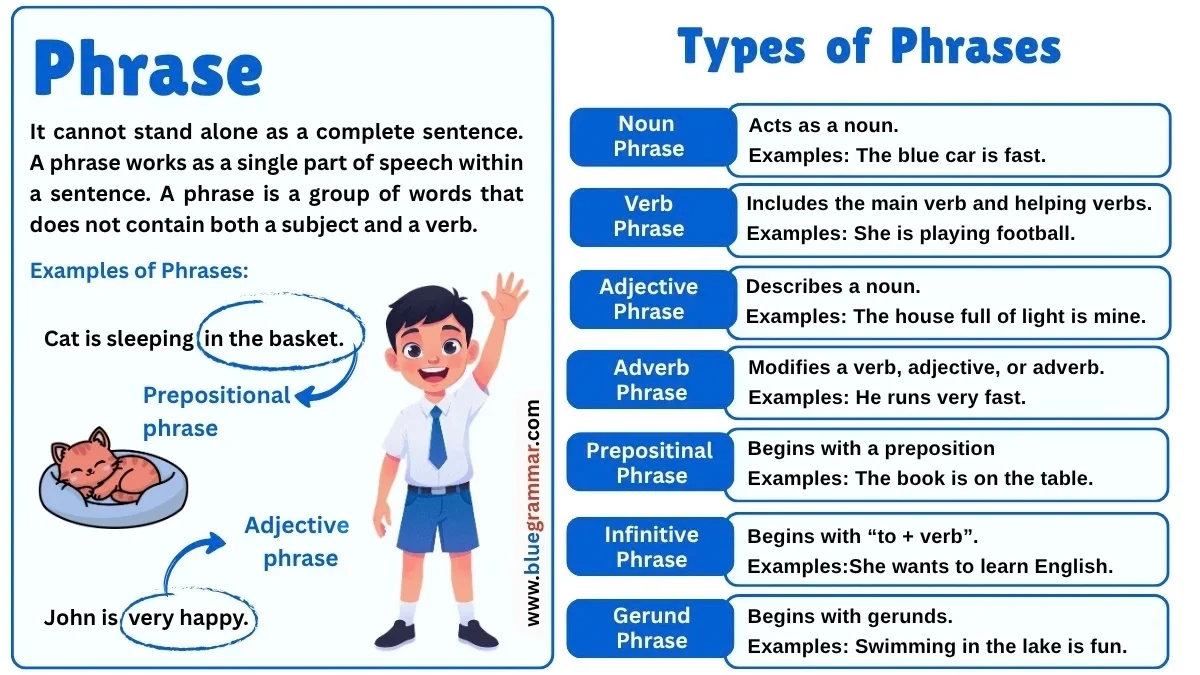
A phrase is a group of words that works together as a unit but does not contain a complete subject-verb combination. Unlike a clause, a phrase cannot stand alone as a full sentence. However, it plays an important role by adding meaning and detail to sentences.
Types of Phrases
In English grammar, phrases are classified based on how they function in a sentence. Understanding these types will help you improve both writing and sentence structure.
1. Noun Phrase
A noun phrase acts as a noun in a sentence. It can be a subject, object, or complement.
Examples
- Sentence: The red car is fast.
- Analysis: “The red car” is the phrase. It is a noun phrase because it names a thing and acts as the subject of the sentence.
- Sentence: She bought a beautiful dress.
- Analysis: “a beautiful dress” is the phrase. It is a noun phrase because it functions as the object of the verb “bought.”
2. Verb Phrase
A verb phrase includes the main verb along with helping (auxiliary) verbs.
Examples
- Sentence: She is reading a book.
- Analysis: “is reading” is the phrase. It is a verb phrase because it shows the action using a helping verb + main verb.
- Sentence: They have completed the task.
- Analysis: “have completed” is the phrase. It is a verb phrase expressing a completed action.
3. Adjective Phrase
An adjective phrase describes or modifies a noun.
Examples
- Sentence: The boy in the blue shirt is my friend.
- Analysis: “in the blue shirt” is the phrase. It is an adjective phrase because it describes “the boy.”
- Sentence: She wore a dress full of colors.
- Analysis: “full of colors” is the phrase. It is an adjective phrase because it gives more information about “dress.”
4. Adverb Phrase
An adverb phrase modifies a verb, adjective, or another adverb. It tells how, when, where, or to what extent something happens.
Examples
- Sentence: He runs very fast.
- Analysis: “very fast” is the phrase. It is an adverb phrase because it tells how he runs.
- Sentence: She spoke in a polite manner.
- Analysis: “in a polite manner” is the phrase. It is an adverb phrase because it describes how she spoke.
5. Prepositional Phrase
A prepositional phrase begins with a preposition and ends with its object.
Examples
- Sentence: The keys are on the table.
- Analysis: “on the table” is the phrase. It is a prepositional phrase because it starts with the preposition “on” and shows location.
- Sentence: We walked through the forest.
- Analysis: “through the forest” is the phrase. It is a prepositional phrase indicating direction.
6. Infinitive Phrase
An infinitive phrase begins with “to + base verb” and can act as a noun, adjective, or adverb.
Examples
- Sentence: She wants to learn English.
- Analysis: “to learn English” is the phrase. It is an infinitive phrase acting as the object of the verb “wants.”
- Sentence: He came to help me.
- Analysis: “to help me” is the phrase. It is an infinitive phrase explaining the purpose of coming.
7. Gerund Phrase
A gerund phrase starts with a verb ending in “-ing” and functions as a noun.
Examples
- Sentence: Swimming in the river is fun.
- Analysis: “Swimming in the river” is the phrase. It is a gerund phrase acting as the subject of the sentence.
- Sentence: She enjoys reading books.
- Analysis: “reading books” is the phrase. It is a gerund phrase acting as the object of the verb “enjoys.”
Key Points to Remember
- A phrase does not contain a complete subject and verb together.
- It functions as a single part of speech.
- Phrases add detail but cannot stand alone as sentences.
- Each type of phrase is named based on its function in the sentence.
Conclusion
Understanding the different types of phrases—such as noun, verb, adjective, adverb, prepositional, infinitive, and gerund phrases—helps you build clearer and more effective sentences. Each type has a specific role, whether it names something, describes it, or explains how an action happens.
By practicing identifying phrases in sentences, you can improve both your grammar and writing skills.