
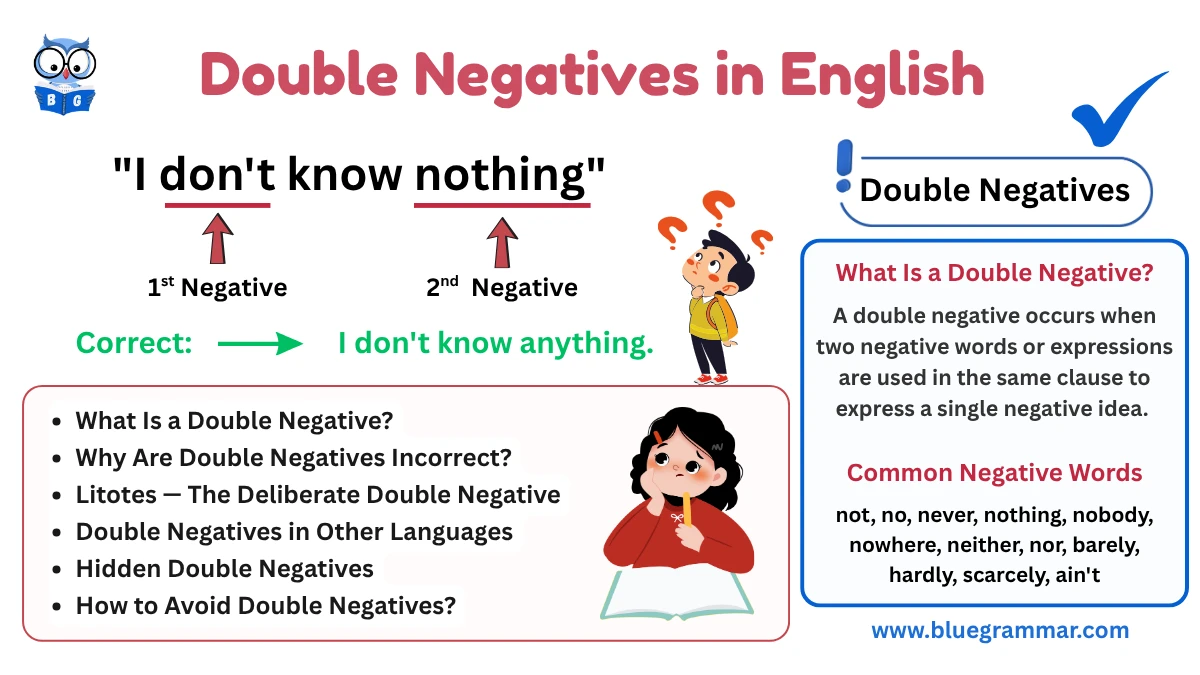
Have you ever heard someone say, “I don’t know nothing” or “She can’t find nowhere to sit”? These are examples of double negatives.
Double negatives are common in everyday speech, but they are usually considered grammatical errors in Standard English. Understanding how they work can help you improve your writing and speaking skills.
In this guide, you will learn the meaning of double negatives, the rules for using them, examples of common mistakes, and how to correct them.
What Is a Double Negative?
A double negative occurs when two negative words or expressions are used in the same clause to express a single negative idea. In English grammar, the key question is always: do those two negatives cancel each other out — producing a positive meaning — or do they reinforce each other, strengthening the negative? The answer depends entirely on the type of double negative and the context in which it appears.
In Standard English, two negatives often cancel each other out logically, resulting in a positive meaning or creating confusion.
Examples of Double Negatives
- Incorrect: I don’t know nothing.
- Correct: I don’t know anything.
- Incorrect: She hasn’t seen nobody.
- Correct: She hasn’t seen anybody.
- Incorrect: We can’t find nothing.
- Correct: We can’t find anything.
In above examples, the corrected sentences use only one negative element.
Common Negative Words in English
Here are some words that often create double negatives when combined incorrectly:
- not
- no
- nobody
- nothing
- nowhere
- neither
- never
- hardly
- scarcely
- barely
Be careful when using these words together. When two of these appear in the same clause, you have a double negative. Whether it is an error or an intentional stylistic choice depends on which type it is.
The Standard English Error (Double Negative – Unintended Positive)
In Standard English, using two negative words in the same clause makes the two negatives cancel out, creating an unintended positive meaning. This is the type most grammar teachers warn you about, and it is the one to avoid in formal or academic writing.
Example
- What was said: She never does nothing.
- What it literally means: She always does something.
- What was meant: She never does anything.
The correction in Standard English is to replace the second negative word with a negative polarity item — a word like anything, anyone, ever, or anywhere, which supports the negative without adding another one.
Why Are Double Negatives Incorrect?
In Standard English grammar, only one negative form is usually needed to express a negative meaning.
Consider this sentence: I didn’t do nothing.
The sentence contains two negatives: didn’t and nothing.
The standard form is: I didn’t do anything.
Using both negatives together can make the sentence unclear or grammatically incorrect in formal writing.
Litotes — The Deliberate Double Negative
This type appears in formal writing, academic prose, and literature — and it is entirely correct. Litotes (pronounced LIE-toh-tees) is a rhetorical figure of speech in which two negatives are used deliberately to produce a measured, understated positive.
Example: “It is not uncommon for students to feel nervous before exams.”
“Not uncommon” does not simply mean “common.” It communicates something more precise: “this happens quite often, though I will not exaggerate.” The double negative creates a tone of careful understatement that a plain positive cannot quite capture.
Examples of Litotes
- Litotes (double negative): It was not a bad performance.
- Plain positive equivalent: It was quite a good performance.
- Litotes (double negative): She is not unintelligent.
- Plain positive equivalent: She is quite intelligent.
- Litotes (double negative): This is not without its challenges.
- Plain positive equivalent: This has some significant challenges.
Notice that in each case the litotes version carries a slightly different shade — one of caution, modesty, or ironic understatement. That is precisely why skilled writers reach for it.
Double Negatives in Other Languages
Many languages, including Spanish and French, use negative concord (using multiple negatives to express one negative idea) as a standard grammatical feature. In these languages, multiple negative elements work together to express a single negative meaning rather than canceling each other out.
In Spanish, this pattern is grammatically required. For example, “No vi a nadie” literally translates as “I did not see nobody,” but its actual meaning is “I did not see anyone.” There is no confusion or logical contradiction because Spanish follows different grammatical rules from Standard English.
Understanding these differences can help English learners recognize why double negatives may seem natural in some languages but are generally avoided in formal Standard English.
When Are Double Negatives Wrong in Standard English?
In Standard English — the variety used in formal writing, education, journalism, and professional life — the rule is clear: avoid pairing two negative words in the same clause when one of them cancels the other.
The rule to remember:
In Standard English, one negative word does the negating. Words like ‘anything,’ ‘anyone,’ ‘anywhere,’ and ‘ever’ support the negation without creating a second one.
Double Negative Examples and Corrections
| Incorrect (Standard English) | Corrected Sentences |
|---|---|
| I didn’t see nobody at the party. | I didn’t see anybody at the party. |
| She never tells nobody anything. | She never tells anybody anything. |
| We haven’t done nothing wrong. | We haven’t done anything wrong. |
| He can’t find it nowhere. | He can’t find it anywhere. |
| Don’t never do that again. | Don’t ever do that again. |
| I won’t say nothing about it. | I won’t say anything about it. |
Hidden Double Negatives
Not all double negatives are as obvious as “I don’t know nothing.” Some creep in quietly, especially when semi-negative words are involved.
Sentences with Hidden Double Negatives
- I hardly did nothing all day. (‘Hardly’ is semi-negative. Fix: ‘I hardly did anything all day.’)
- She scarcely said nothing at the meeting. (‘Scarcely’ is semi-negative. Fix: ‘She scarcely said anything.’)
- Without no experience, it is hard. (‘Without’ carries negation. Fix: ‘Without any experience…’)
How to Avoid Double Negatives
- Look for Negative Words: Check whether your sentence already contains a negative word such as not, never, or no.
- Replace the Second Negative: Use words like any, anyone, anything, or anywhere instead.
Examples
- Incorrect: We don’t need no tickets.
- Correct: We don’t need any tickets.
Practice Exercise
Correct the following sentences.
- I can’t find nowhere to sit.
- She didn’t tell nobody.
- We don’t have no homework.
- He never buys nothing online.
- They aren’t going nowhere.
Frequently Asked Questions
What is a double negative?
A double negative occurs when two negative words are used in the same clause to express one negative idea.
Are double negatives always wrong?
No. Some dialects use double negatives naturally. However, they are generally avoided in standard written English.
Why should I avoid double negatives?
Avoiding double negatives makes your writing clearer, more accurate, and more suitable for academic and professional contexts.
What words commonly create double negatives?
Words such as not, no, nobody, nothing, nowhere, never, and neither often contribute to double negatives.
Conclusion
Double negatives are a common source of confusion for English learners. In standard English, it is best to use only one negative form in a clause. By recognizing negative words and revising your sentences carefully, you can avoid common mistakes and communicate more effectively.
The next time you write a sentence, check whether you have accidentally included two negatives. A small correction can make your English much clearer and more professional.
References & Further Reading
- Lowth, R. (1762). A Short Introduction to English Grammar. London: A. Millar.
- Quirk, R., Greenbaum, S., Leech, G., & Svartvik, J. (1985). A Comprehensive Grammar of the English Language. London: Longman.
- Huddleston, R., & Pullum, G. K. (2005). A Student’s Introduction to English Grammar. Cambridge: Cambridge University Press.
- Yale Grammatical Diversity Project. Negative Concord.