
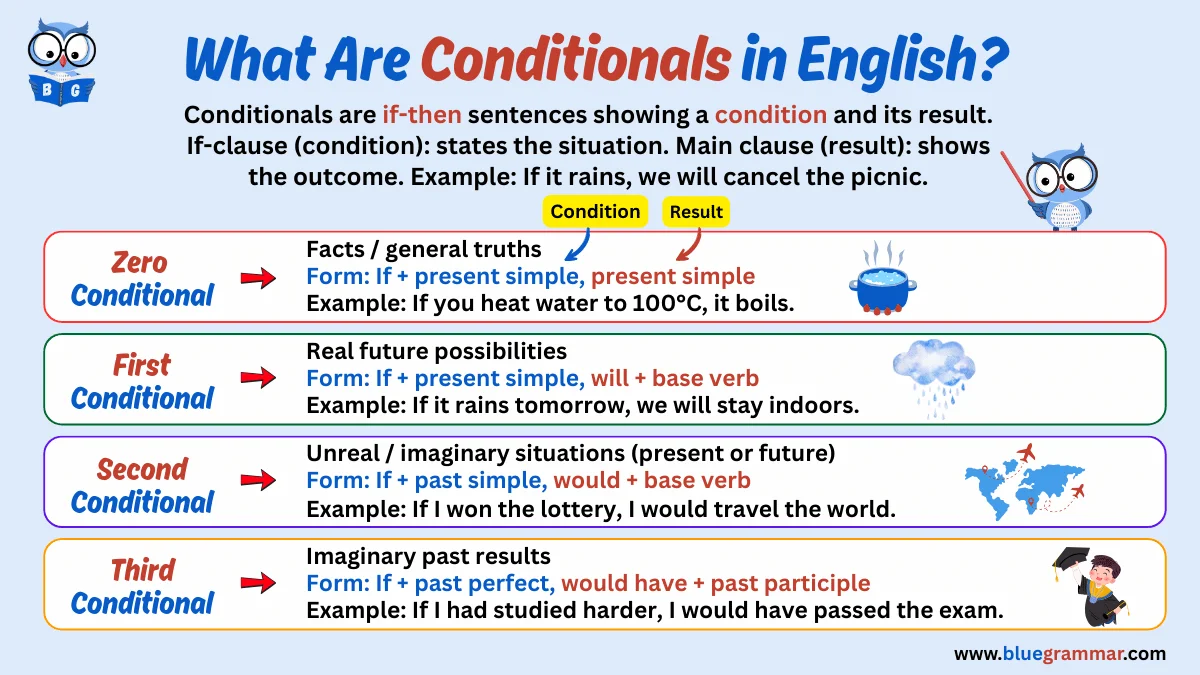
Conditionals are an essential component of English grammar used to express cause-and-effect relationships in the form of if–then situations. They enable speakers and writers to describe real events, possible future outcomes, hypothetical scenarios, and imagined past situations. A clear understanding of conditionals enhances one’s ability to communicate ideas about probability, consequences, and alternative realities with precision.
This article explains the concept of conditionals, outlines their structure, and examines the different types with detailed explanations and examples.
What Are Conditionals?
Conditionals are sentences that consist of two main parts:
- The if-clause (conditional clause): expresses the condition
- The main clause (result clause): expresses the outcome of that condition
Example
- Sentence: If it rains, we will cancel the picnic.
- Analysis: “If it rains” is the condition, and “we will cancel the picnic” is the result. The result depends entirely on whether the condition is fulfilled.
Types of Conditionals in English Grammar
English conditionals are generally classified into four main types: zero, first, second, and third conditionals. Each type reflects a different degree of possibility, time reference, and level of reality.
The zero conditional is used to express general truths and scientific facts—situations that are always true when the condition is met. The first conditional refers to real and possible future situations, indicating likely outcomes based on a present condition. In contrast, the second conditional is used for hypothetical or unlikely situations in the present or future, often expressing imagination, wishes, or unreal scenarios. Finally, the third conditional deals with unreal situations in the past, describing events that did not happen and their imagined consequences.
Overview of Conditional Structures
| Conditional Type | If-Clause Structure | Main Clause Structure | Function / Realness |
|---|---|---|---|
| Zero Conditional | If + Present Simple | Present Simple | General truths & scientific facts (Always true) |
| First Conditional | If + Present Simple | will + base verb | Real / possible future outcomes (Likely) |
| Second Conditional | If + Past Simple | would + base verb | Hypothetical / unreal present/future (Unlikely) |
| Third Conditional | If + Past Perfect | would have + past participle | Unreal past / imagined consequences (Regret/Impossible) |
1. Zero Conditional
The zero conditional is used to express universal truths, general facts, and scientific principles. The result is always true whenever the condition occurs.
Structure: If + present simple, present simple
Example
- Sentence: If you heat water to 100°C, it boils.
- Explanation: This sentence expresses a scientific fact. The result (it boils) always happens when the condition (you heat water to 100°C) is met.
2. First Conditional
The first conditional is used to describe real and possible situations in the future. It indicates a likely result if a certain condition is fulfilled.
Structure: If + present simple, will + base verb
Example
- Sentence: If it rains tomorrow, we will stay indoors.
- Explanation: This sentence refers to a possible future event. If the condition occurs, the result is expected to follow.
3. Second Conditional
The second conditional is used for unreal, hypothetical, or unlikely situations in the present or future. It often reflects imagination, dreams, or situations contrary to reality.
Structure: If + past simple, would + base verb
Example
- Sentence: If I won the lottery, I would travel the world.
- Explanation: Winning the lottery is unlikely, so the sentence expresses an imagined situation and its possible outcome.
4. Third Conditional
The third conditional is used to describe unreal situations in the past—events that did not happen—and to imagine their possible results.
Structure: If + past perfect, would have + past participle
Example
- Sentence: If I had studied harder, I would have passed the exam.
- Explanation: The speaker did not study harder, and therefore did not pass. The sentence reflects regret or a hypothetical past outcome.
Why Are Conditionals Important?
Conditionals play a crucial role in effective communication. They allow speakers to:
- express possibilities and probabilities
- make predictions about future events
- discuss hypothetical or imaginary situations
- reflect on past actions and their consequences
They are widely used in both spoken and written English, from everyday conversations to formal and academic contexts.
Final Thoughts
A thorough understanding of conditionals in English grammar significantly improves clarity and expression. By practicing different types of conditional sentences, learners can develop greater confidence in discussing real and imagined situations. Regular use of conditionals in writing and speech will lead to more accurate and effective communication.