
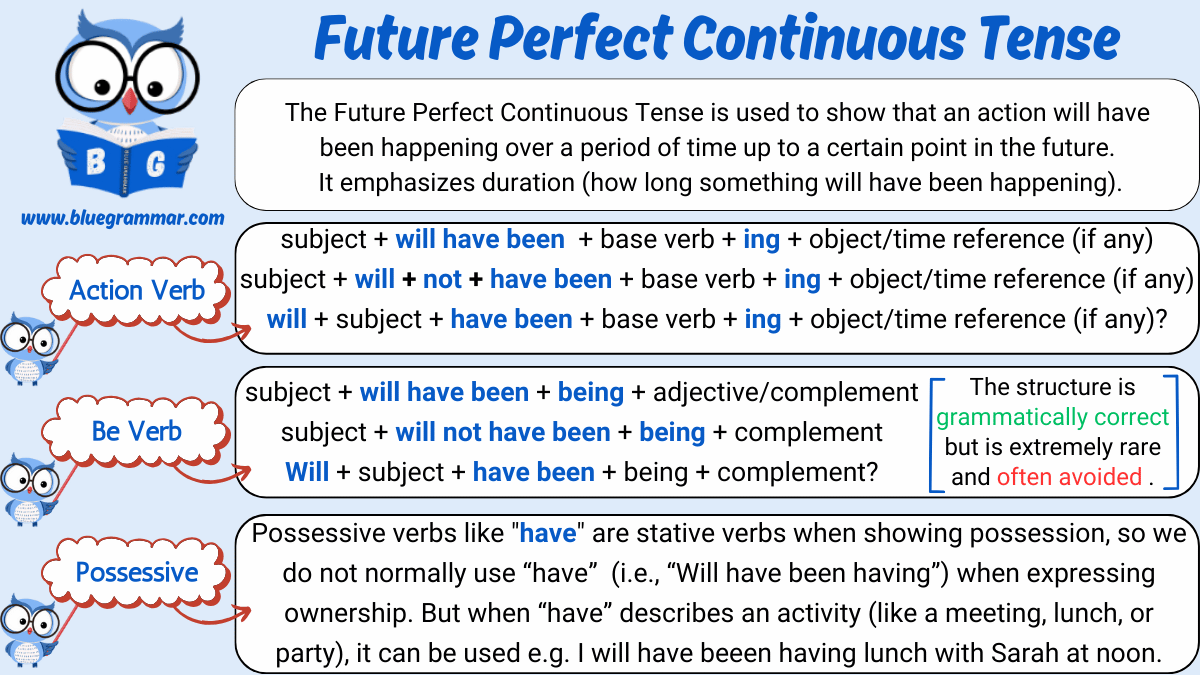
The Future Perfect Continuous Tense is one of the most advanced tenses in English grammar. We use it to describe actions or events that will have been continuing for a period of time before a specific time or another action in the future. It emphasizes both the duration and the continuity of an action up to a future point. Whether you are talking about work, study, travel, or any ongoing activity, the Future Perfect Continuous Tense helps you express how long an action will have been happening before it reaches a future moment. In this guide, you will learn the rules, sentence structure, signal words, and plenty of examples of the Future Perfect Continuous Tense. You will also find common mistakes, practice exercises, and free printable worksheets to help you master this important tense.

When Do We Use the Future Perfect Continuous Tense?
We use the Future Perfect Continuous Tense to describe actions or events that will have been continuing for a period of time before a specific time or another action in the future. It emphasizes the duration of an ongoing action rather than its completion.
1. To Show the Duration of an Action Before a Specific Future Time
We use the Future Perfect Continuous Tense to describe an action that will have been continuing for a certain length of time before a future point.
Example: By next July, she will have been working here for five years.
2. To Show the Duration of an Action Before Another Future Action
We use the Future Perfect Continuous Tense when an action will have been in progress for some time before another future action takes place.
Example: By the time you arrive, I will have been waiting for two hours.
3. To Emphasize the Length of an Ongoing Activity
We use the Future Perfect Continuous Tense to emphasize how long an activity will have continued before a future time.
Example: They will have been studying all day by the time the exam begins.
4. To Describe Long-Term Projects or Activities
We use the Future Perfect Continuous Tense for projects, jobs, studies, or activities that will have continued over a long period before a future date.
Example: By December, we will have been building the new school for two years.
5. To Make Predictions Based on Ongoing Future Actions
We use the Future Perfect Continuous Tense to predict how long an action will have been happening before a particular future moment.
Example: Next month, he will have been driving for twenty years.
Signal Words of the Future Perfect Continuous Tense
Signal words are words and phrases that often indicate the use of the Future Perfect Continuous Tense. They usually show the duration of an action before a specific future time or another future event.
Common Signal Words
The following signal words are frequently used with the Future Perfect Continuous Tense:
- For – She will have been working here for five years.
- Since – By next June, he will have been living here since 2022.
- By – By next month, they will have been studying for six months.
- By then – We will have been waiting for two hours by then.
- By tomorrow – I will have been writing the report for three days by tomorrow.
- By next week – She will have been practicing the piano for a year by next week.
- By the time – By the time you arrive, I will have been cooking for an hour.
- Before – They will have been traveling for two days before they reach Paris.
- Until then – He will have been working continuously until then.
- All day / all week / all month – We will have been preparing all week.
Common Time Expressions
The following time expressions are also commonly used with the Future Perfect Continuous Tense:
- For two hours – I will have been waiting for two hours by noon.
- For five years – She will have been teaching for five years by July.
- Since 2024 – They will have been living here since 2024.
- By 8:00 p.m. – He will have been studying for four hours by 8:00 p.m.
- By the end of the year – We will have been working on this project for two years by the end of the year.
- By next summer – She will have been training for twelve months by next summer.
- Before the meeting starts – I will have been preparing for several hours before the meeting starts.
- By the time you arrive – They will have been waiting for an hour by the time you arrive.
- For a long time – He will have been searching for a solution for a long time.
- Throughout the day – The workers will have been repairing the road throughout the day.
Note: Signal words help identify the Future Perfect Continuous Tense, but they are not required in every sentence. The context often makes it clear that an action will have been continuing up to a future point.
Forms of the Future Perfect Continuous Tense
The Future Perfect Continuous Tense is used in three common forms, depending on the type of verb in the sentence. Each form follows its own sentence structure and is used to describe actions or states that will have been continuing up to a specific future time.
1. Future Perfect Continuous with Action Verbs
Action verbs describe activities that will have been continuing for a period of time before a future point or another future action.
Examples:
- She will have been studying for three hours by 9:00 p.m.
- They will have been working on the project for six months by December.
- I will have been driving for five hours before I reach Lahore.
2. Future Perfect Continuous with the Verb "To Be"
The Future Perfect Continuous form of the verb "to be" is will have been being. Although it is grammatically correct, it is extremely rare and is usually avoided in modern English. Native speakers normally use a more natural sentence structure instead.
Examples:
- The patient will have been being monitored for three hours by noon. (rare)
- She will have been being interviewed for over an hour by then. (rare)
- The machine will have been being tested since morning. (rare)
3. Future Perfect Continuous with the Verb "Have"
The Future Perfect Continuous form will have been having is used only when have means experiencing, taking part in, eating, drinking, or doing something. It is not used to express possession or ownership.
Examples:
- She will have been having piano lessons for six months by July.
- They will have been having meetings every week for a year by December.
- We will have been having lunch together every Friday for months by then.
In the following sections, you will learn how to form positive, negative, and interrogative sentences for each of these three forms, along with their rules, structures, and examples.
Future Perfect Continuous Tense with Action Verbs
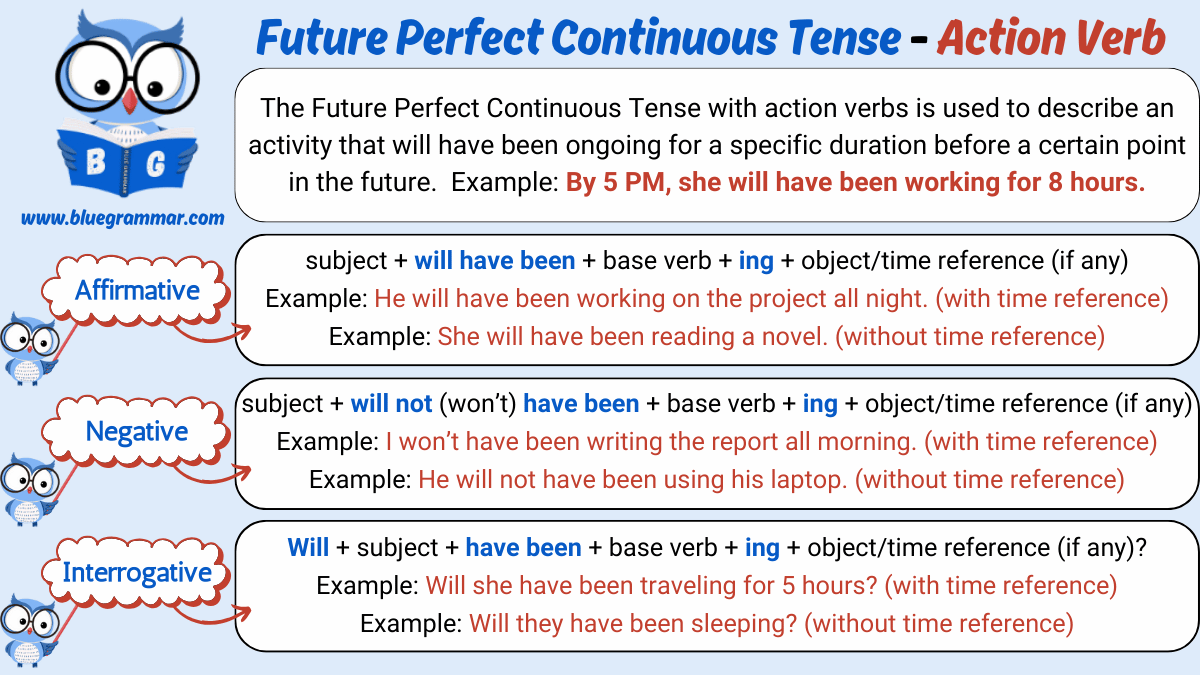
The Future Perfect Continuous Tense with action verbs is used to describe actions that will have been continuing for a period of time before a specific time or another action in the future. It emphasizes the duration of the action rather than its completion. Action verbs express what a person, animal, or thing will be doing, such as study, work, play, travel, and write.
Positive Sentences
In positive sentences, use will have been followed by the -ing form (present participle) of the main verb.
Structure:
Subject + will have been + Verb (-ing) + Object + Time Expression
Examples:
- I will have been studying for three hours by 9:00 p.m.
- She will have been working here for five years by next July.
- They will have been playing football for two hours by noon.
- He will have been writing the report all morning by lunchtime.
- We will have been traveling for ten hours before we reach Karachi.
Negative Sentences
In negative sentences, use will not have been (won't have been) followed by the -ing form of the main verb.
Structure:
Subject + will not have been + Verb (-ing) + Object + Time Expression
Examples:
- I will not have been studying for three hours by 9:00 p.m.
- She will not have been working here for five years by next July.
- They will not have been playing football for two hours by noon.
- He will not have been writing the report all morning.
- We will not have been traveling for ten hours before we arrive.
Interrogative Sentences
In interrogative sentences, place will before the subject, followed by have been and the -ing form of the main verb.
Structure:
Will + Subject + have been + Verb (-ing) + Object + Time Expression?
Examples:
- Will you have been studying for three hours by 9:00 p.m.?
- Will she have been working here for five years by next July?
- Will they have been playing football for two hours by noon?
- Will he have been writing the report all morning?
- Will we have been traveling for ten hours before we arrive?
Using "-ing" Verbs in the Future Perfect Continuous Tense
In the Future Perfect Continuous Tense, the helping verbs will have been are always followed by the -ing form (present participle) of the main verb. The main verb never changes according to the subject.
Examples:
- study → will have been studying
- work → will have been working
- play → will have been playing
- travel → will have been traveling
- write → will have been writing
Remember: Always use the -ing form of the verb after will have been and will not have been. Never use the base form (V1), past form (V2), or past participle (V3) after will have been.
Examples:
- She will have been studying for three hours.
- She will not have been studying for three hours.
- Will she have been studying for three hours?
Future Perfect Continuous Tense with the Verb "To Be"
The Future Perfect Continuous form of the verb "to be" is will have been being. Although it is grammatically correct, it is extremely rare and is usually avoided in modern English. Native speakers normally choose a simpler and more natural sentence structure instead.
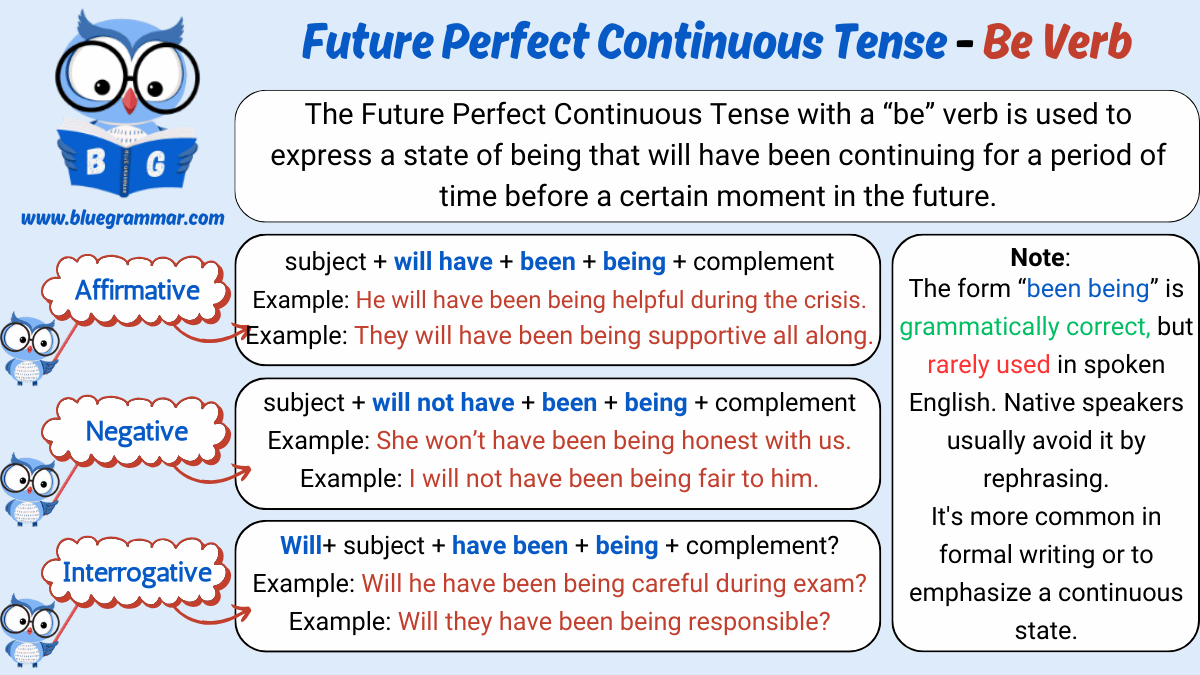
The form will have been being is occasionally used to emphasize that a temporary state or condition will have continued for a period of time before a specific future point. However, such usage is uncommon and is mostly found in formal or technical writing.
Positive Sentences
Structure:
Subject + will have been being + Complement + Time Expression
The complement may be a noun, pronoun, adjective, or prepositional phrase.
Examples:
- The patient will have been being monitored for three hours by noon. (rare)
- She will have been being interviewed for over an hour by then. (rare)
- The machine will have been being tested since morning. (rare)
Negative Sentences
Structure:
Subject + will not have been being + Complement + Time Expression
Examples:
- The patient will not have been being monitored for three hours by noon. (rare)
- She will not have been being interviewed for over an hour by then. (rare)
- The machine will not have been being tested since morning. (rare)
Interrogative Sentences
Structure:
Will + Subject + have been being + Complement + Time Expression?
Examples:
- Will the patient have been being monitored for three hours by noon? (rare)
- Will she have been being interviewed for over an hour by then? (rare)
- Will the machine have been being tested since morning? (rare)
When Is "Will Have Been Being" Used?
The form will have been being is generally limited to formal, technical, or academic contexts where it is necessary to emphasize that a temporary state has been continuing up to a future point. In everyday English, native speakers almost always replace it with a more natural sentence structure.
Examples:
- Rare: The patient will have been being monitored for three hours by noon.
- More Natural: The patient will have been under observation for three hours by noon.
- More Natural: The doctors will have been monitoring the patient for three hours by noon.
Remember: Although will have been being is grammatically correct, it is extremely rare in modern English. In most situations, use a simpler and more natural sentence structure instead.
Future Perfect Continuous Tense with the Verb "Have" (Using Will Have Been Having)
The Future Perfect Continuous form of the verb have is will have been having. It is used only when have means experiencing, taking part in, eating, drinking, or doing something. It is not used to express possession or ownership. When talking about possession, use the Future Perfect Tense (will have had) instead.
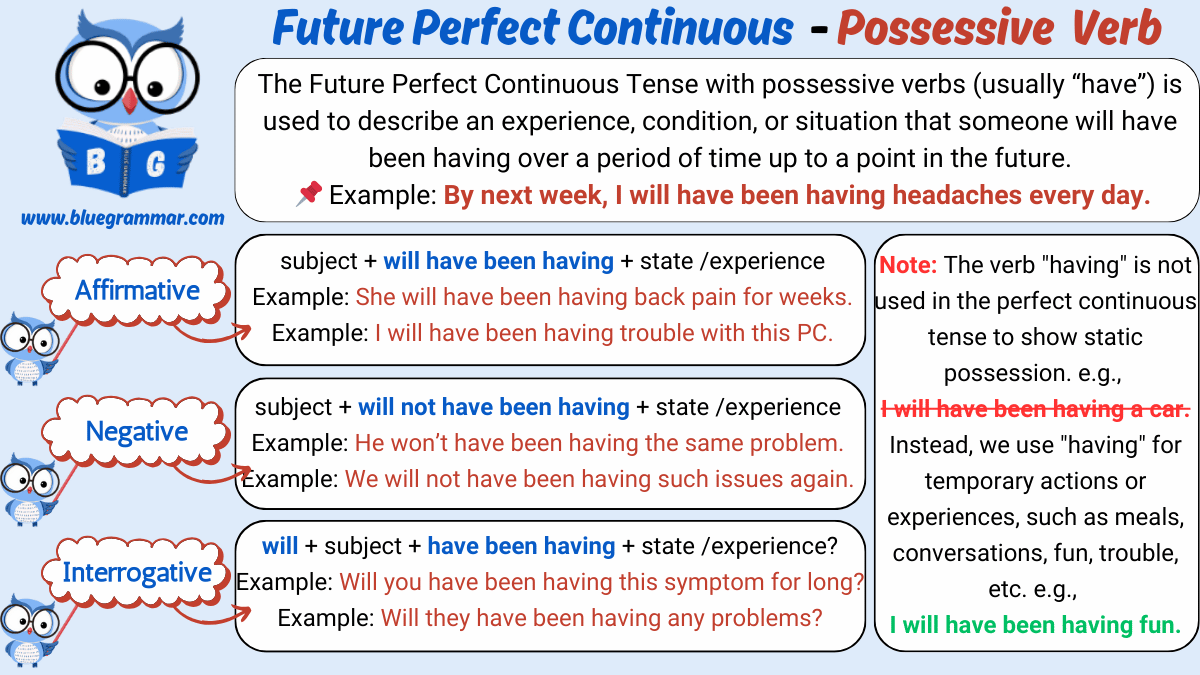
The form will have been having emphasizes that an activity or experience involving the verb have will have been continuing for a period of time before a specific future point.
Positive Sentences
Structure:
Subject + will have been having + Object or Complement + Time Expression
Examples:
- She will have been having piano lessons for six months by July.
- They will have been having meetings every week for a year by December.
- We will have been having lunch together every Friday for several months by then.
- He will have been having driving lessons for three months by next week.
- I will have been having physiotherapy sessions for six weeks by Friday.
Negative Sentences
Structure:
Subject + will not have been having + Object or Complement + Time Expression
Examples:
- She will not have been having piano lessons for six months by July.
- They will not have been having meetings every week for a year by December.
- We will not have been having lunch together every Friday for several months by then.
- He will not have been having driving lessons for three months by next week.
- I will not have been having physiotherapy sessions for six weeks by Friday.
Interrogative Sentences
Structure:
Will + Subject + have been having + Object or Complement + Time Expression?
Examples:
- Will she have been having piano lessons for six months by July?
- Will they have been having meetings every week for a year by December?
- Will we have been having lunch together every Friday for several months by then?
- Will he have been having driving lessons for three months by next week?
- Will I have been having physiotherapy sessions for six weeks by Friday?
Common Uses of "Will Have Been Having"
The form will have been having is used when have refers to an ongoing experience or activity rather than possession.
Lessons or Classes
Examples:
- She will have been having piano lessons for six months by July.
- The students will have been having English classes for a year by December.
Meetings or Discussions
Examples:
- They will have been having weekly meetings for several months by then.
- We will have been having regular discussions throughout the project.
Meals or Refreshments
Examples:
- He will have been having healthy breakfasts for three months by June.
- They will have been having lunch together every Friday by then.
Medical Treatment or Appointments
Examples:
- I will have been having physiotherapy sessions for six weeks by Friday.
- She will have been having counseling sessions for several months by then.
Ongoing Experiences
Examples:
- They will have been having a wonderful time on their vacation for two weeks by Sunday.
- We will have been having driving practice every weekend for three months by next week.
Remember: Use will have been having only when have means experiencing, eating, drinking, taking lessons, attending meetings, or taking part in an activity. Do not use it to express possession or ownership. For possession, use will have had instead.
Examples:
- She will have been having piano lessons for six months by July. ✓
- She will have had her piano for six months by July. ✓
- She will have been having her piano for six months by July. ✗ (Incorrect for possession)
Examples of the Future Perfect Continuous Tense
The following examples demonstrate how the Future Perfect Continuous Tense is used in different situations. They include sentences with action verbs, the verb "to be" (will have been being), and the verb "have" (will have been having).
Actions Continuing Before a Specific Future Time
- I will have been studying for three hours by 9:00 p.m.
- She will have been working here for five years by next July.
- They will have been playing football for two hours by noon.
- He will have been writing the report all morning by lunchtime.
- We will have been traveling for ten hours before we arrive.
Actions Continuing Before Another Future Action
- I will have been waiting for two hours by the time you arrive.
- She will have been cooking for an hour before the guests arrive.
- They will have been studying for weeks before the examination begins.
- He will have been driving for five hours before he reaches Lahore.
- We will have been discussing the proposal before the manager joins us.
Long-Term Activities and Projects
- She will have been teaching at this school for ten years by 2030.
- They will have been building the bridge for two years by December.
- I will have been learning English for five years by next summer.
- He will have been training for the competition for six months by then.
- We will have been working on this project for over a year by the end of December.
Examples with the Verb "To Be"
- The patient will have been being monitored for three hours by noon. (rare)
- She will have been being interviewed for over an hour by then. (rare)
- The machine will have been being tested since morning. (rare)
Examples with the Verb "Have"
- She will have been having piano lessons for six months by July.
- They will have been having weekly meetings for a year by December.
- We will have been having lunch together every Friday for several months by then.
- He will have been having driving lessons for three months by next week.
- I will have been having physiotherapy sessions for six weeks by Friday.
Common Mistakes in the Future Perfect Continuous Tense
Learners often make mistakes when using the Future Perfect Continuous Tense, especially with the helping verbs will have been, the -ing form of the main verb, and the verbs "to be" and "have". Understanding these common errors will help you write and speak English more accurately.
1. Using the Wrong Verb Form After "Will Have Been"
After will have been or will not have been, always use the -ing form (present participle) of the main verb.
Incorrect: She will have been study for three hours.
Correct: She will have been studying for three hours.
Incorrect: They will have been play football.
Correct: They will have been playing football.
2. Omitting "Been" After "Will Have"
The helping verb been is required before the -ing form of the main verb.
Incorrect: He will have working all day.
Correct: He will have been working all day.
Incorrect: We will have travelling for five hours.
Correct: We will have been traveling for five hours.
3. Using the Wrong Word Order in Questions
In interrogative sentences, place will before the subject.
Incorrect: She will have been studying for three hours?
Correct: Will she have been studying for three hours?
Incorrect: They will have been working all day?
Correct: Will they have been working all day?
4. Using "Will Have Been Having" to Express Possession
Use will have been having only when have means experiencing or taking part in an activity. To express possession or ownership, use will have had.
Incorrect: She will have been having a new car for two years.
Correct: She will have had a new car for two years.
Correct: She will have been having piano lessons for six months.
5. Overusing "Will Have Been Being"
The form will have been being is grammatically correct but extremely rare. In most situations, use a simpler and more natural sentence structure.
Rare: The patient will have been being monitored for three hours by noon.
More Natural: The doctors will have been monitoring the patient for three hours by noon.
6. Using Stative Verbs in the Future Perfect Continuous Tense
Stative verbs such as know, believe, understand, love, own, and belong are not normally used in continuous tenses.
Incorrect: I will have been knowing the answer for an hour.
Correct: I will have known the answer for an hour.
Incorrect: She will have been owning the house for five years.
Correct: She will have owned the house for five years.
Tip: Before writing or speaking in the Future Perfect Continuous Tense, always check:
- Did you use will have been correctly?
- Did you use the -ing form after will have been?
- Did you avoid using stative verbs in the Future Perfect Continuous Tense?
- Did you use will have been having only for experiences or activities, not possession?
- Did you avoid using will have been being unless it was absolutely necessary?
Practice Exercise
Test your understanding of the Future Perfect Continuous Tense by completing the following exercises. Check your answers after completing all the questions.
Exercise 1: Fill in the Blanks
Complete each sentence with the correct form of the verb in brackets.
- She ________ for three hours by 9:00 p.m. (study)
- They ________ on the project for six months by December. (work)
- He ________ for five hours before reaching Lahore. (drive)
- We ________ English for two years by next June. (learn)
- I ________ the report all morning by lunchtime. (write)
- The children ________ football for two hours by noon. (play)
- She ________ piano lessons for six months by July. (have)
- They ________ weekly meetings for a year by December. (have)
- The patient ________ for three hours by noon. (be)
- We ________ for the competition for six months by then. (train)
Exercise 2: Make the Sentences Negative
Rewrite the following sentences in the negative form.
- She will have been studying for three hours by 9:00 p.m.
- They will have been working on the project for six months.
- He will have been driving for five hours.
- We will have been learning English for two years.
- She will have been having piano lessons for six months.
Exercise 3: Change the Sentences into Questions
Rewrite the following sentences as interrogative sentences.
- She will have been studying for three hours by 9:00 p.m.
- They will have been working on the project for six months.
- He will have been driving for five hours.
- We will have been learning English for two years.
- She will have been having piano lessons for six months.
Exercise 4: Choose the Correct Answer
Choose the correct option.
- She ________ for three hours by 9:00 p.m.
a) will study
b) will have studied
c) will have been studying - ________ they have been working on the project for six months by December?
a) Do
b) Will
c) Are - He ________ for five hours before reaching Lahore.
a) will drive
b) will have driven
c) will have been driving - We ________ English for two years by next June.
a) will have been learning
b) will learn
c) will have learned - She ________ piano lessons for six months by July.
a) will have had
b) will have been having
c) will be having
Exercise 5: Correct the Mistakes
Find and correct the mistake in each sentence.
- She will have been study for three hours by 9:00 p.m.
- They will have working on the project for six months.
- He will have been having a new car for two years.
- I will have been know English for five years.
- The patient will have been being monitored for three hours by noon.
Tip: Try to complete the exercises without looking at the rules. Once you finish, compare your answers with the explanations or continue practicing with our free printable Future Perfect Continuous Tense worksheets for extra practice.
Short Summary
The Future Perfect Continuous Tense is used to describe actions or events that will have been continuing for a period of time before a specific future time or another future action. It emphasizes the duration and continuity of an action rather than its completion. The tense is formed with will have been + verb (-ing). It also has special forms with the verbs "to be" (will have been being—grammatically correct but extremely rare) and "have" (will have been having—used only when have means experiencing or doing something, not possession). By learning the correct sentence structures and practicing regularly, you can confidently use the Future Perfect Continuous Tense in both spoken and written English.
Download Free Future Perfect Continuous Tense Worksheets
Strengthen your understanding of the Future Perfect Continuous Tense with our free printable worksheets. These worksheets are designed for students, teachers, parents, and English language learners and include a variety of exercises to help you practice sentence formation, verb forms, and correct tense usage.
You can download and print the worksheets for classroom activities, homework, self-study, revision, or test preparation.
Visit our page Future Tense Worksheets to download A4 size printable worksheets.