What Does “etc.” Mean?
The abbreviation etc. is short for the Latin phrase et cetera, which literally translates to “and other similar things” or “and so forth.” It has been used in English writing for centuries as a convenient shorthand to signal that a list continues beyond the items already mentioned.
According to major style guides including The Chicago Manual of Style and Merriam-Webster, etc. is perfectly acceptable in formal and informal writing — provided it is used correctly. Misusing it, however, can make your writing appear careless or confusing.
Quick Fact: “Et cetera” comes from Latin — et means “and,” and cetera means “the rest.” So “and etc.” literally means “and and the rest,” which is why it’s redundant.
Why Does Correct Use of “Etc.” Matter?
Incorrect use of etc. is one of the most common grammar mistakes in English writing — especially among learners. Poor placement, unnecessary repetition, or using it in the wrong context can:
- Make sentences unclear or ambiguous
- Undermine your credibility in formal writing
- Confuse readers about what “other things” you mean
- Cause errors in academic papers, business documents, and exams
Mastering this small abbreviation has an outsized impact on the overall quality of your written English.
11 Rules for Using “Etc.” Correctly
Rule 1: Use Etc. Only When Listing Similar Items
The most fundamental rule: etc. should only follow a list of items that belong to the same category. Since it means “other similar things,” readers must be able to predict what those other things are. If the items are unrelated, etc. creates confusion.
- ✔ Correct: We sell stationery items such as pens, pencils, markers, etc.
- ✔ Correct: She enjoys outdoor activities like hiking, camping, cycling, etc.
- ❌ Incorrect: I bought apples, notebooks, and shoes, etc.
- ❌ Incorrect: He packed a shirt, a hammer, and a book, etc.
In the incorrect examples, the listed items belong to completely different categories, so the reader has no way to guess what “other similar things” might be.
Rule 2: Always List at Least Two Items Before Using Etc.
A single item does not establish a pattern. You need at least two examples before using etc., so the reader understands the category you are referring to.
- ✔ Correct: The bag contains books, notebooks, files, etc.
- ✔ Correct: She speaks Urdu, English, Arabic, etc.
- ❌ Incorrect: I like fruits such as apples, etc.
- ❌ Incorrect: He plays sports like football, etc.
With only one item, there is no clear pattern — the reader cannot determine what “other similar things” the writer has in mind.
Rule 3: Never Write “And Etc.”
This is one of the most common etc. mistakes. Writing “and etc.” is redundant because et cetera already contains the word et, which means “and.” Adding another “and” is like writing “and and the rest.”
- ✔ Correct: Bring pencils, erasers, rulers, etc.
- ✔ Correct: The course covers grammar, vocabulary, punctuation, etc.
- ❌ Incorrect: Bring pencils, erasers, rulers, and etc.
- ❌ Incorrect: The list includes cats, dogs, birds, and etc.
Rule of thumb: Use either “and” OR “etc.” at the end of a list — never both.
Rule 4: Do Not Use Etc. When the List Is Already Complete
If you have mentioned every item in a group, adding etc. is misleading — it implies there are more items when there are not. This can confuse readers and create false impressions.
- ✔ Correct: The traffic light has three colors: red, yellow, and green.
- ✔ Correct: The week has seven days.
- ❌ Incorrect: The traffic light has red, yellow, green, etc.
- ❌ Incorrect: The week has Monday, Tuesday, Wednesday, etc. (if you mean all seven)
Reserve etc. only for genuinely open-ended or non-exhaustive lists.
Rule 5: Always Put a Period After Etc.
Since “etc.” is an abbreviation, it must always end with a period. This is a non-negotiable rule of standard English punctuation, and it applies in both formal and informal writing.
- ✔ Correct: Students should bring notebooks, pens, calculators, etc.
- ✔ Correct: He bought tools like hammers, nails, screws, etc.
- ❌ Incorrect: Students should bring notebooks, pens, calculators, etc
- ❌ Incorrect: He bought tools like hammers, nails, screws, etc…
Additional note: Do not follow etc. with an ellipsis (three dots). The period in etc. serves as terminal punctuation. Writing “etc…” is a double error.
Sentence-ending tip: When etc. falls at the end of a sentence, one period is sufficient — you do not need to add a second period.
Rule 6: Place Etc. at the End of a List
Etc. belongs at the end of a list, not in the middle or at the beginning of a sentence. Placing it elsewhere breaks the logic of the sentence and confuses readers.
- ✔ Correct: We visited Lahore, London, Dubai, etc.
- ✔ Correct: The shop sells shirts, trousers, jackets, etc.
- ❌ Incorrect: We visited Lahore, etc., Karachi, Islamabad.
- ❌ Incorrect: The shop sells etc. shirts and trousers.
When etc. appears mid-sentence, readers do not know which category is being extended. Always let the list build first, then close it with etc.
Rule 7: Avoid Using Etc. with Names of People
Using etc. after a list of people’s names — especially named individuals — is considered informal, vague, or even disrespectful in many contexts. It is better to use the phrase “and others” when referring to people.
- ✔ Correct: Many teachers attended the seminar.
- ✔ Correct: Scientists like Einstein, Newton, and others changed history.
- ❌ Incorrect: Quaid-e-Azam, Allama Iqbal, etc. are national heroes.
- ❌ Incorrect: Einstein, Newton, Curie, etc. changed history.
This rule applies especially in formal, academic, or respectful writing. Using etc. with people can make it seem like you cannot be bothered to name them properly.
Rule 8: Never Pluralize or Capitalize Etc. (Mid-Sentence)
The abbreviation etc. has a fixed form. It should never be pluralized as “etcs.” and should only be capitalized if it starts a sentence — which is itself considered poor style and should be avoided by restructuring the sentence.
- ✔ Correct: You can add images, videos, charts, etc.
- ✔ Correct: The list includes books, magazines, newspapers, etc.
- ❌ Incorrect: You can add images, videos, charts, etcs.
- ❌ Incorrect: The list includes books, magazines, newspapers, Etc.
Note: In title case capitalization, where every word is capitalized, “Etc.” with a capital E may be acceptable. In running body text, always use lowercase.
Rule 9: Avoid Unnecessary Repetition with Etc.
Using etc. alongside introductory phrases like such as, for example, like, or including can be redundant because both already signal that the list is incomplete. However, in casual or informal writing, “such as … etc.” is sometimes acceptable and widely used. The key is to avoid obvious double signaling that makes your sentence feel clumsy or repetitive.
Correct (Preferred):
- I like fruits such as apples, bananas, and mangoes.
- She bought items: books, pens, stationery, etc.
Acceptable in Informal Writing:
- He enjoys outdoor sports such as hiking, cycling, etc.
Avoid in Formal Writing (Redundant):
- I like fruits such as apples, bananas, etc. (redundant in formal writing)
- The bag contains items including books, pens, etc.
General guidance:
- In formal or academic writing, choose one signal — either the introductory phrase or etc., not both.
- In informal writing, “such as … etc.” is generally understood and tolerated, but cleaner writing avoids it.
Rule 10: Use Etc. Only Once Per Sentence
Using etc. more than once in a single sentence fragments the meaning and makes the writing feel repetitive and careless. One instance of etc. is sufficient to indicate that a list is open-ended.
- ✔ Correct: The syllabus includes grammar, writing, vocabulary, etc.
- ✔ Correct: He bought snacks like chips, biscuits, chocolates, etc.
- ❌ Incorrect: The syllabus includes grammar, etc., writing, etc., vocabulary.
- ❌ Incorrect: He bought chips, etc., and biscuits, etc.
If your sentence requires two separate etc.’s, that is a sign you should restructure the sentence entirely or split it into two.
Rule 11: Avoid Etc. in Formal Writing Where Precision Is Required
In legal, academic, scientific, or official writing, etc. should be avoided whenever readers need a complete and exact list. In such contexts, a vague “and so on” can create ambiguity, loopholes, or misunderstandings — sometimes with serious consequences.
- ✔ Correct: Required documents include a passport, CNIC, two photographs, and proof of address.
- ✔ Correct: The contract covers damages, legal fees, court costs, and compensation for lost income.
- ❌ Incorrect: Required documents include passport, CNIC, photographs, etc.
- ❌ Incorrect: The contract covers damages, legal fees, etc.
In a legal document, listing “damages, legal fees, etc.” could be disputed in court because “etc.” has no precise legal meaning. Similarly, in an official application, an incomplete list may cause the applicant to submit the wrong documents. When the stakes are high, spell everything out.
Pro Tip: If you are unsure whether etc. is appropriate, ask yourself: “Would a missing item from this list cause a problem?” If yes, avoid etc. and write the complete list.
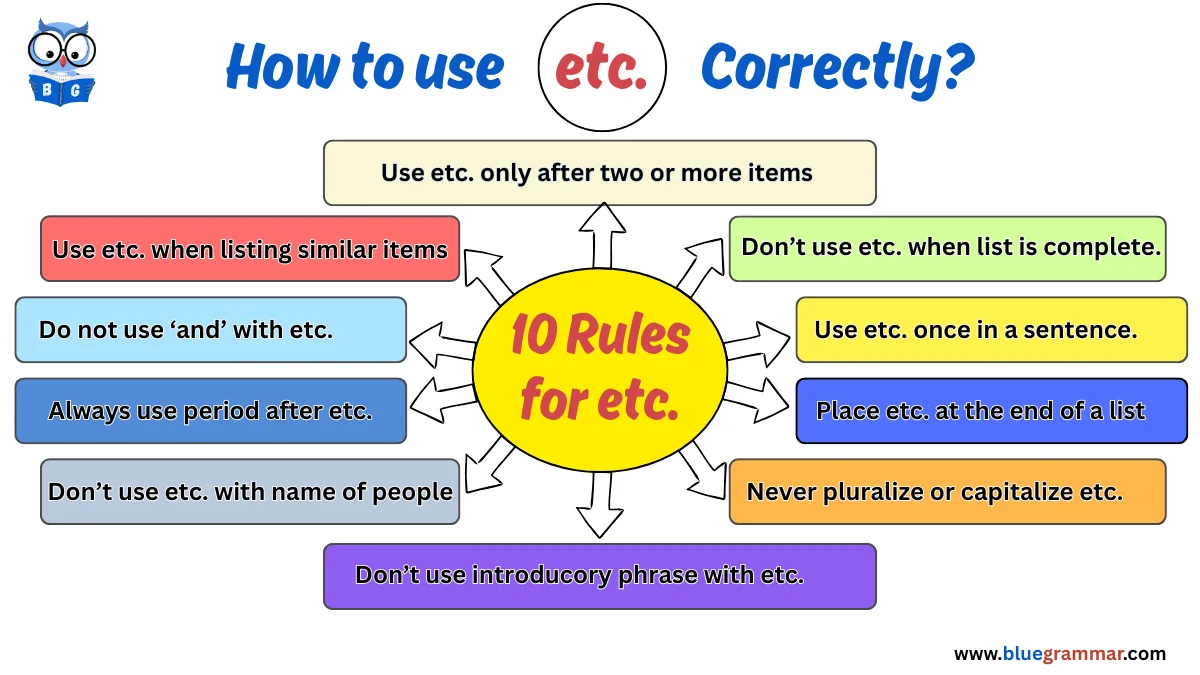
Quick Reference: Etc. Rules at a Glance
- Only list similar items in the same category
- Always list at least two items before etc.
- Never write “and etc.” — it’s redundant
- Don’t use etc. when the list is complete
- Always add a period after etc.
- Place etc. at the end of a list
- Avoid etc. with names of people
- Never pluralize or capitalize etc. mid-sentence
- Don’t combine etc. with “such as,” “like,” or “for example”
- Use etc. only once per sentence
- Avoid Etc. in Formal Writing Where Precision Is Required
Etc. vs. Other Abbreviations: What’s the Difference?
Writers sometimes confuse etc. with similar Latin abbreviations. Here is a quick breakdown:
- etc. (et cetera) — means “and other similar things”; used to close an open-ended list of items
- e.g. (exempli gratia) — means “for example”; used to introduce representative examples
- i.e. (id est) — means “that is” or “in other words”; used to clarify or restate
- et al. (et alii) — means “and others”; used when citing multiple authors in academic references
Common confusion: Many writers use e.g. and etc. interchangeably — they are not the same. E.g. introduces examples from a broader group; etc. closes a list and implies more items exist. Using both together (“e.g., apples, bananas, etc.”) is the redundancy error covered in Rule 9.
Alternatives to “Etc.” in Formal Writing
Some style guides — including APA — discourage etc. in formal academic writing because it can be vague. In those contexts, consider these alternatives:
- “and so on” — informal but clear
- “and the like” — slightly formal
- “among others” — good for academic writing
- “and similar items/factors/elements” — most formal
- “and others” — best when referring to people
Example: Instead of “The report covers sales, marketing, logistics, etc.”, write “The report covers sales, marketing, logistics, and related functions.”
Frequently Asked Questions About Etc.
Q: Is it correct to put a comma before etc.?
A: Yes. In American English, a comma before etc. is standard practice: “She bought apples, oranges, grapes, etc.” In British English, the comma is sometimes omitted, but including it is never wrong.
Q: Can I use etc. in academic or formal writing?
A: It depends on the style guide. MLA and Chicago generally allow it. APA discourages it. When in doubt, use a more descriptive alternative like “and related factors.”
Q: Is “and so on” the same as etc.?
A: Yes — “and so on” is the English-language equivalent of etc. and is often preferred in formal writing or speech.
Q: Can etc. be used in a question?
A: Yes. “Do you enjoy tennis, swimming, hiking, etc.?” The question mark replaces the sentence-ending period, but the period inside etc. remains.
Final Thoughts
Mastering the correct use of etc. is a small but meaningful step toward cleaner, more professional English writing. The core idea is simple: etc. means “and other similar things,” so use it only when your list is genuinely open-ended and the pattern of items is clear enough that readers can fill in the blanks themselves.
Follow the 11 rules above, avoid the common pitfalls, and your writing will be clearer, more precise, and more credible — whether you’re drafting an email, writing an essay, or preparing for an English exam.
References
-
Merriam-Webster Dictionary — Definition and usage of et cetera
https://www.merriam-webster.com/dictionary/et%20cetera -
The Chicago Manual of Style Online — Guidelines on abbreviations and etc. in formal writing
https://www.chicagomanualofstyle.org -
Purdue OWL (Online Writing Lab) — Academic writing conventions and use of Latin abbreviations
https://owl.purdue.edu/owl/general_writing/grammar/abbreviations.html -
APA Style Blog — American Psychological Association — Why APA discourages etc. in formal academic writing
https://apastyle.apa.org