
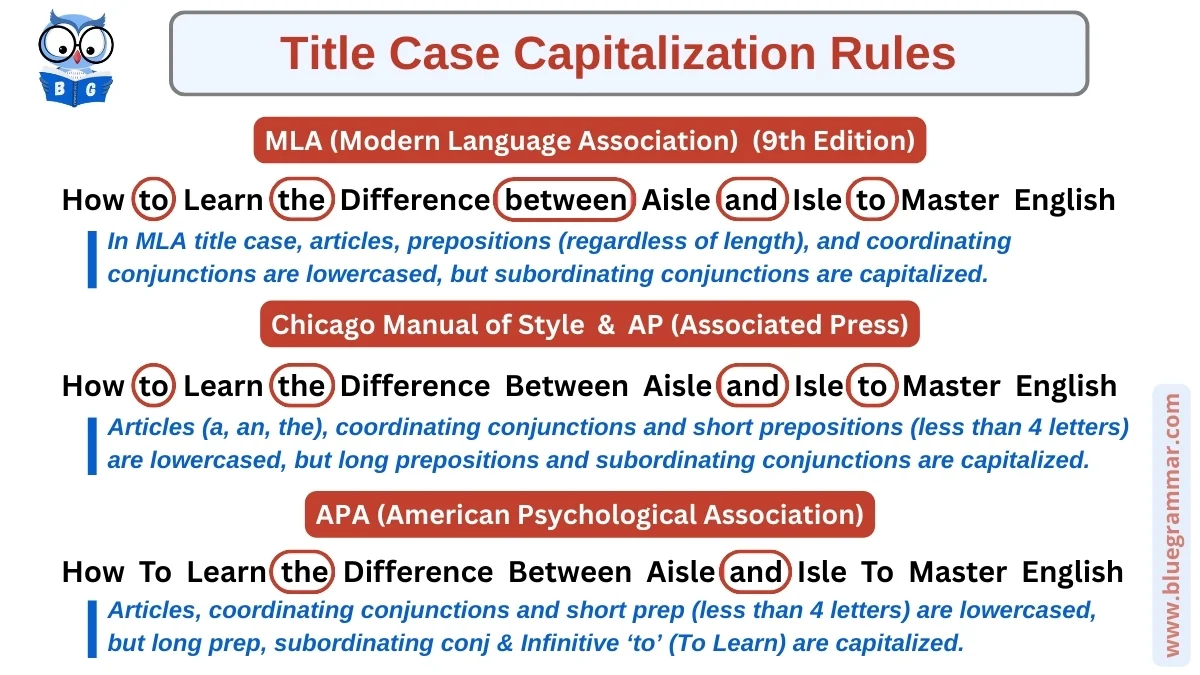
Different writing fields follow different title case capitalization rules. While the rules look similar, each style guide has its own logic and priorities.
The six major title case capitalization styles are:
- Modern Language Association (MLA)
- Chicago Manual of Style (Chicago / CMOS)
- American Psychological Association (APA)
- Associated Press (AP)
- American Medical Association (AMA)
- The Bluebook (BB)
Below is a detailed explanation of each style — what it is, where it’s used, its capitalization philosophy, rules, and examples.
MLA Style (Modern Language Association)
MLA is primarily used in literature, humanities, language studies, arts, and cultural studies. It is common in essays, research papers, and student writing in English departments. MLA uses standard title case, focusing on capitalizing important or “major” words. The goal is clarity and grammatical importance rather than word length.
What MLA Capitalizes in a Title?
- First and last word of the title
- Nouns (Teacher, Freedom, History)
- Pronouns (He, She, It)
- Verbs (Is, Become, Run)
- Adjectives (Modern, Ancient)
- Adverbs (Quickly, Very)
- Words 4+ letters (Lowercase if prep.)
- Subordinating conjunctions (Because, Although, If)
What MLA Does NOT Capitalize?
- Articles (a, an, the)
- Coordinating conjunctions (and, but, or, nor, for, so, yet)
- Prepositions (Always lowercase, both short and long prep.)
Examples of MLA Style:
- Title: the impact of social media on modern education
- MLA Style: The Impact of Social Media on Modern Education
Chicago Manual of Style (CMOS)
Chicago Manual of Style is common in book publishing, history writing, academic books, and professional manuscripts. It is widely respected in publishing industries. Chicago follows headline-style capitalization with more technical detail than MLA. It emphasizes grammatical role and word importance.
What Chicago Capitalizes in a Title?
- First and last words
- All major words (nouns, verbs, adjectives, adverbs, pronouns)
- Long Prepositions (with five or more letters)
- Long conjunctions (with five or more letters)
What Chicago Does NOT Capitalize?
- Articles
- Coordinating conjunctions
- Subordinating conjunctions
- Short prepositions (of, in, on, to)
Example of Chicago Manual of Style:
- Chicago Style: The Impact of Social Media on Modern Education
Key Difference: Chicago may capitalize longer prepositions like “Between” but not short ones like “of.”
APA Style (American Psychological Association)
APA is dominant in psychology, education, social sciences, research journals, and scientific writing. It is one of the most widely used academic styles worldwide. APA uses title case for paper titles but uses sentence case in reference lists. APA focuses heavily on clarity and consistency in research.
What APA Capitalizes (in Titles)?
- First word of title
- Last word of title
- All major words (nouns, verbs, adjectives, adverbs, pronouns)
- Words of four letters or more
- Both parts of hyphenated major words
- Conjunctions (4+ letters)
- Prepositions (4+ letters)
- Infinitive ‘to’ (To Learn)
APA Does NOT Capitalize:
- Short articles (a, an, the)
- Short conjunctions
- Short prepositions (in, on, to)
Examples of APA Style:
- APA Example (Title Case): The Impact of Social Media on Modern Education
- APA Example (Sentence Case): The impact of social media on modern education
This sentence-case rule makes APA unique among major styles.
AP Style (Associated Press)
AP style is used in newspapers, online journalism, news websites and media organizations. AP focuses on simplicity and readability for the general public. It avoids overly technical rules.
AP Capitalizes:
- First and last word
- All major words (nouns, verbs, adjectives, adverbs, pronouns)
- Words of four letters or more
- Conjunctions (4+ letters)
- Prepositions (4+ letters)
AP Does NOT Capitalize:
- Articles
- Short conjunctions
- Short prepositions
AP Example:
- AP Style: The Impact of Social Media on Modern Education
Note: AP is simpler than Chicago and APA in handling prepositions.
AMA Style (American Medical Association)
AMA style is common in medicine, nursing, public health, clinical research, and biomedical journals. AMA closely follows Chicago-style headline capitalization but is tailored for medical publishing. Precision and uniformity are important.
AMA Capitalizes:
- First and last words
- Nouns, pronouns, verbs
- Adjectives and adverbs
- Subordinating conjunctions
- Prepositions with four or more letters
AMA Does NOT Capitalize:
- Articles
- Short prepositions (of, in, on)
- Coordinating conjunctions
AMA Example:
- AMA Style: The Impact of Social Media on Modern Education
AMA is very similar to Chicago, but its rules are applied specifically in medical journals.
Bluebook (Legal Style)
Bluebook is used in law schools, legal journals, court documents, and legal research writing. It is the standard for legal citation in the United States. Bluebook follows headline-style capitalization similar to Chicago but includes additional legal-specific rules — especially for case names and statutes.
Bluebook Capitalizes:
- First and last words
- All major words
- Nouns, verbs, adjectives, adverbs
- Important legal terms
Bluebook Does NOT Capitalize:
- Articles
- Short prepositions
- Coordinating conjunctions
Bluebook Examples:
- Bluebook Style: The Impact of Social Media on Modern Education
- Legal Case Name: Brown v. Board of Education (“v.” remains lowercase and abbreviated.)
Comparison Sheet of Title Case Capitalization Rules
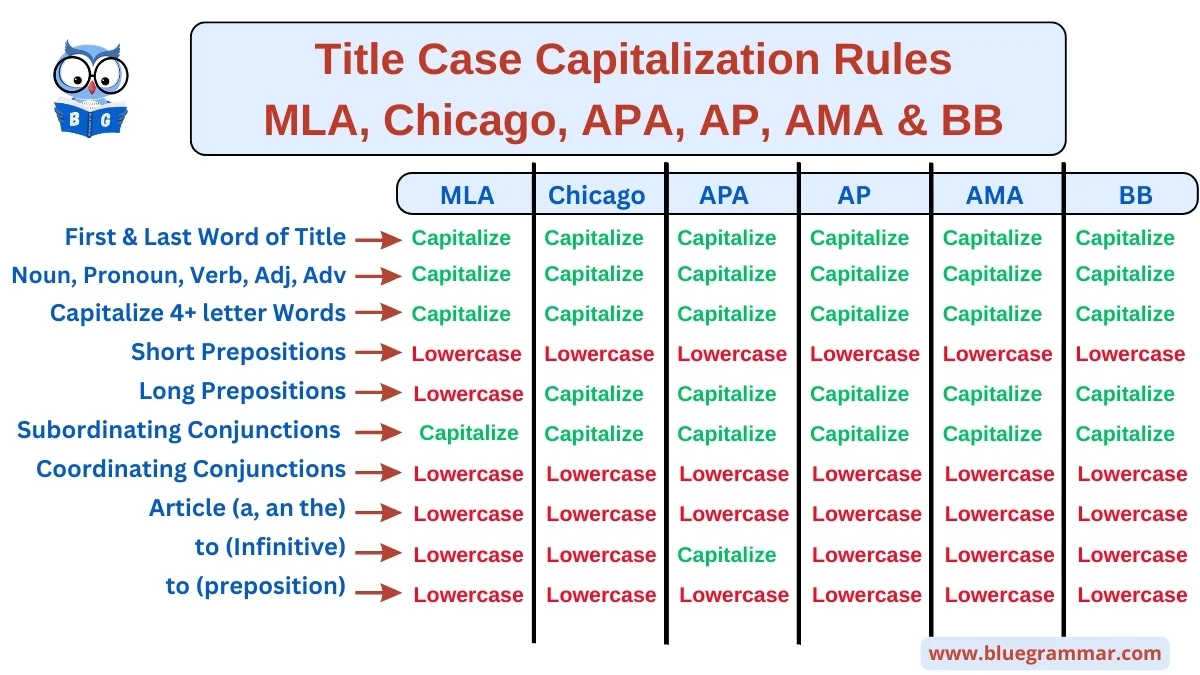
Example phrase converted across styles:
- MLA: How to Learn Grammar and Vocabulary before Exams in School According to Experts
- Chicago Manual of Style: How to Learn Grammar and Vocabulary Before Exams in School According to Experts
- APA: How To Learn Grammar and Vocabulary Before Exams in School According to Experts
- AP: How to Learn Grammar and Vocabulary Before Exams in School According to Experts
- AMA: How to Learn Grammar and Vocabulary Before Exams in School According to Experts
- The Bluebook: How to Learn Grammar and Vocabulary Before Exams in School According to Experts