
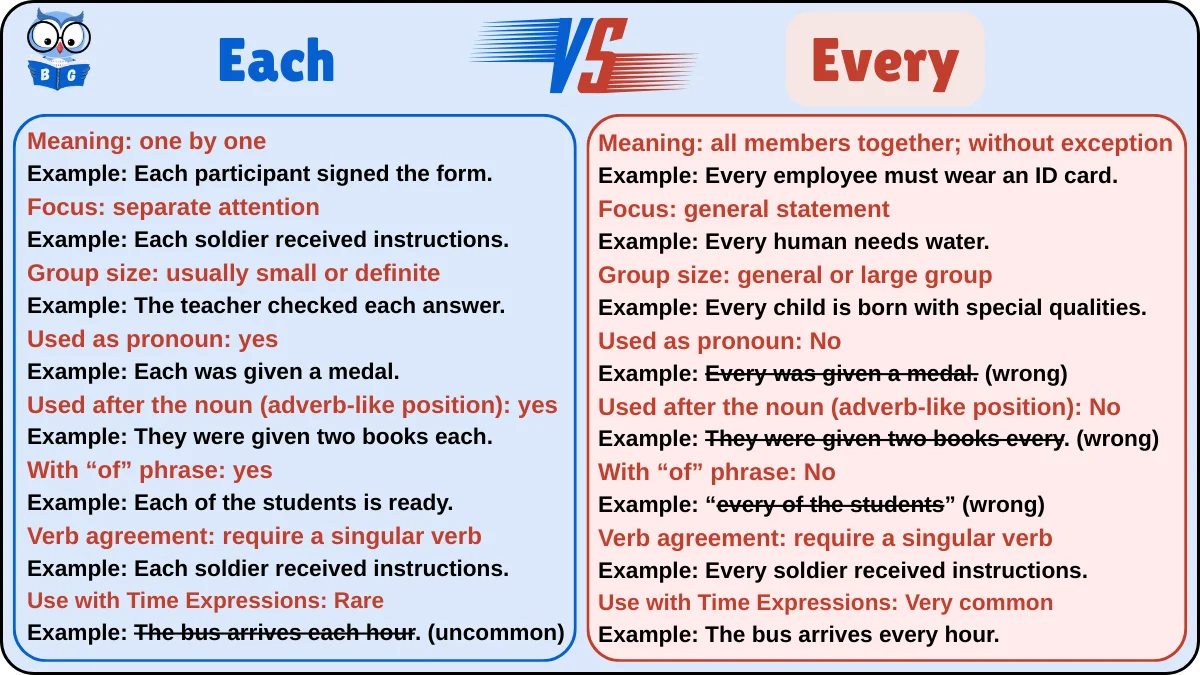
Although each and every are often treated as synonyms in everyday usage, they are not interchangeable in many contexts. Both are distributive determiners: they refer to all members of a group, but they distribute reference differently. The difference is not about number; it is about how the speaker thinks about the group.
- Each: One person/thing considered separately
- Every: All persons/things considered together
Understanding this idea will solve most mistakes students make.
Basic Use of Each and Every
Both each and every belong to the category of distributive determiners/quantifiers in English grammar.
They:
- occur before singular countable nouns
- require a singular verb
- refer to more than one entity semantically
Examples
- Sentence: Each candidate is interviewed separately.
- Sentence: Every candidate is interviewed before selection.
Although they refer to multiple candidates, English treats the noun phrase as grammatically singular.
The Main Difference Between Each and Every
Each: Focus on Individual Members
Each focuses on members separately. The speaker mentally isolates one member at a time. It implies individual attention, separateness, and identity.
- Example: Each participant signed the form.
- Interpretation: The action occurred individually; we imagine separate signing events.
It often appears in situations involving:
- responsibility
- physical action
- personal interaction
- careful examination
Examples
- The nurse examined each patient.
- The teacher checked each answer.
- Each soldier received instructions.
Here the action is repeated for every individual.
Every: Focus on the Whole Group
Every views the group as a whole set. It does not emphasize individual identity but universal applicability.
- Example: Every participant signed the form.
- Interpretation: Signing is presented as a general fact applying to the entire group, not separate events.
Common uses:
- general truths
- routines
- repeated time expressions
- rules and regulations
Examples
- Every human needs water.
- The bus leaves every hour.
- Every employee must wear an ID card.
Each vs. Every | Comparison
| Determiner | Example Sentence | Meaning / Focus |
|---|---|---|
| Each | The manager spoke to each employee. | He talked to them separately (individual attention). |
| Every | The manager spoke to every employee. | General statement: nobody was left out (total coverage). |
| Each | Each child received a gift. | Gifts were given one by one (distribution fairness). |
| Every | Every child received a gift. | All children received gifts (general coverage). |
Emphasis Difference
Compare carefully:
- Each child was given a chocolate. | Emphasis on distribution fairness.
- Every child was given a chocolate. | Emphasis on total coverage (no child left).
Each as Pronoun and Adverb
Each has wider grammatical flexibility than every.
Pronoun
- Each was given a medal.
Post-position (after the noun or object)
- The students each received a medal.
- They were given two books each.
Note: Every cannot be used as a pronoun or adverb.
- Incorrect: The students every received a medal.
Size of the Group
Each is commonly used for small or definite groups (minimum of two):
- Each of the two brothers is tall.
- Each of the five questions is important.
Every is usually used for larger or general groups (minimum of three).
“Each of” and “Every one of”
- Incorrect: Every of the two boys
- Correct: Each of the two boys
We can say:
- Each of the students is ready.
- Every one of the students is ready.
But:
- Incorrect: Every of the students is ready.
Use with Time Expressions
Every is regularly used to express routine or repeated time.
- Every day
- Every week
- Every month
- Every year
- Every morning
- Every time
Examples
- I exercise every day.
- The bus arrives every hour.
“Each day” is grammatically correct but more formal and less common in daily speech.
Verb Agreement of Each and Every
Both words always take a singular verb.
- Each student has a locker.
- Every student has a locker.
Even though many people are included, English grammar treats them as singular.
Conclusion
The difference between each and every depends on the speaker’s focus. Use each when you think about people or things separately. Use every when you make a general statement about the whole group. Both refer to all members, but the point of view changes the word choice. Understanding this small difference will make your English clearer and more natural.