
Many students struggle to understand the difference between restrictive and non-restrictive clauses. The confusion usually comes from comma usage, the use of which vs that, and meaning changes in a sentence. If you don’t understand this concept clearly, your writing can become unclear or even grammatically incorrect.
In this complete guide, you will learn:
- What a clause is and main types
- What restrictive clauses are
- What non-restrictive clauses are
- Key differences between them
- Comma rules
- Common mistakes
- Easy tricks to remember
What Is a Clause?
A clause is a group of words that contains a subject + a verb. Clauses can be independent (complete meaning) or dependent (need extra information).
Examples
- She is reading. (Independent)
- Because he was tired (Dependent)
Types of Clauses in English Grammar
Clauses are mainly divided into two major types: independent clauses (main clauses) and dependent clauses (subordinate clauses).
- Independent Clause: Expresses a complete thought and can stand alone as a sentence.
- Dependent Clause: Does not express a complete thought and cannot stand alone as a sentence. It needs an independent clause to complete its meaning (e.g., “She went home because she was tired.”).
Examples
- Independent Clause: She finished her homework.
- Dependent Clause: Because she was tired.
Dependent clauses are further divided into three types: noun clause, adjective clause, and adverb clause. Unlike dependent clauses, independent clauses are not divided into further sub-types. However, they can be joined together using coordinating conjunctions (and, but, or, so, yet, for, nor) to form compound sentences.
Where Do Restrictive and Non-Restrictive Clauses Fit?
Restrictive and non-restrictive clauses are types of adjective clauses (relative clauses). They describe a noun and give more information about it.
They usually begin with relative pronouns: who, whom, whose, which, and that.
Examples
- The book that I bought is new.
- My friend, who lives in Lahore, is visiting.
What Is a Restrictive Clause?
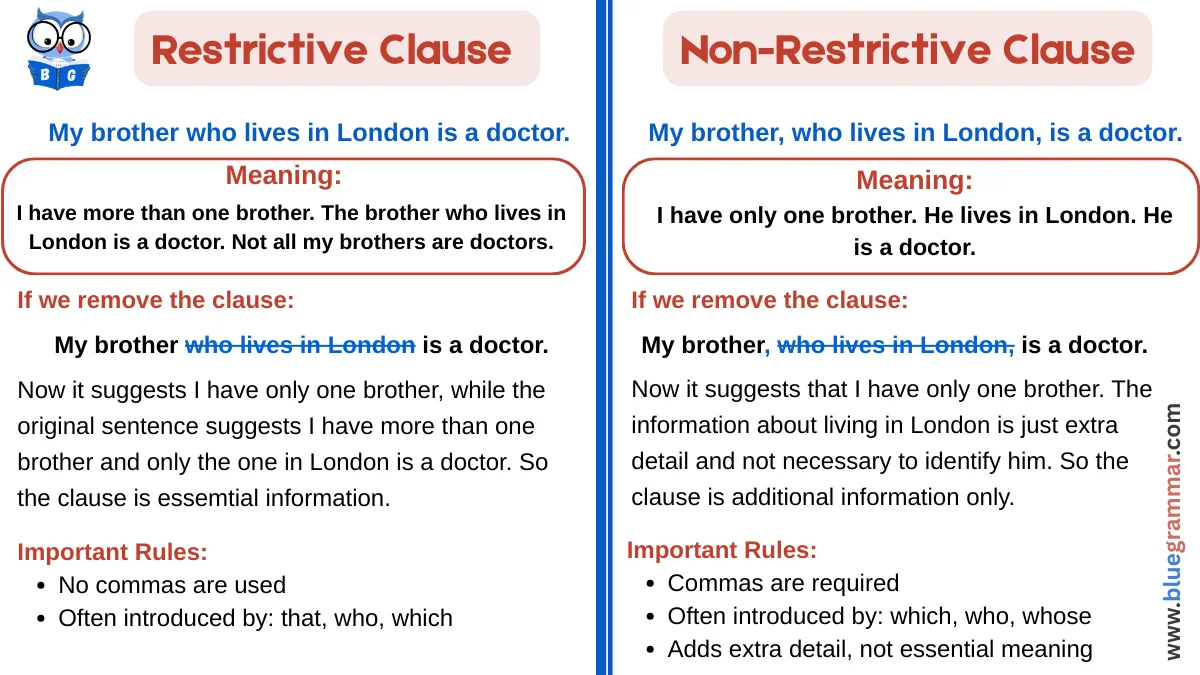
A restrictive clause (also called a defining clause) gives essential information about a noun. Without it, the meaning of the sentence changes completely.
- Example: The students who studied hard passed the exam.
- Meaning: Only the students who studied hard passed. Not all students passed.
- If removed: “The students passed the exam.” (Now the meaning is broad and completely different.)
Important Rules:
- No commas are used.
- Often introduced by: that, who, which.
- Common in formal and academic writing.
What Is a Non-Restrictive Clause?
A non-restrictive clause (also called a non-defining clause) gives extra information. The sentence still makes full sense if the clause is removed.
- Example: My brother, who lives in Karachi, is a doctor.
- If removed: “My brother is a doctor.” (The essential meaning remains unchanged.)
Important Rules:
- Commas are required.
- Often introduced by: which, who, whose.
- Adds extra detail, not essential meaning.
Compare These Two Sentences
Notice how a comma completely changes the meaning of a sentence:
| Sentence | Clause Type | Meaning / Interpretation |
|---|---|---|
| The cars that are electric are expensive. | Restrictive (No commas) | Only electric cars are expensive (out of all cars). |
| The cars, which are electric, are expensive. | Non-Restrictive (Set off by commas) | All the cars being discussed are electric, and all of them are expensive. |
Why This Concept Is Important
Understanding restrictive and non-restrictive clauses helps you:
- Use commas correctly
- Understand when to use which vs that
- Write more clearly
- Avoid exam mistakes
- Improve academic writing
This topic is heavily tested in standardized and competitive exams like IELTS.
Common Mistakes Students Make
1. Using commas with restrictive clauses
- Incorrect: The book, that I bought, is expensive.
- Correct: The book that I bought is expensive.
2. Forgetting commas in non-restrictive clauses
- Incorrect: My car which is red is fast.
- Correct: My car, which is red, is fast.
3. Confusing meaning
Students often think commas are optional. They are not; commas directly alter sentence meaning.
When to Use “That” and “Which”
This is where relative pronouns connect to clause types:
- Restrictive clause: Usually use that (no commas).
- Non-restrictive clause: Use which (with commas).
Examples
- The book that I bought is new.
- The book, which I bought yesterday, is new.
Simple Trick to Identify the Clause Type
Ask yourself:
Is this information necessary to identify the noun?
- If YES → Restrictive (No commas)
- If NO → Non-restrictive (Use commas)
Advanced Tip (For High-Level Students)
Non-restrictive clauses:
- Cannot use that.
- Can refer to an entire sentence rather than just a single noun.
Example: He failed the exam, which surprised everyone. (Here, which refers to the entire idea of him failing.)
Practice Sentences
Identify whether the clause in each sentence is restrictive or non-restrictive:
- The teacher who teaches math is absent. — Restrictive
- My laptop, which is new, is already slow. — Non-restrictive
- The books that are on the table belong to me. — Restrictive
- My friend, who lives in Lahore, is visiting. — Non-restrictive
Conclusion
The difference between restrictive and non-restrictive clauses comes down to three things:
- Essential vs. extra information
- Comma usage
- Meaning clarity
A small comma can change the entire meaning of your sentence. Master this concept, and your writing accuracy will improve dramatically.