
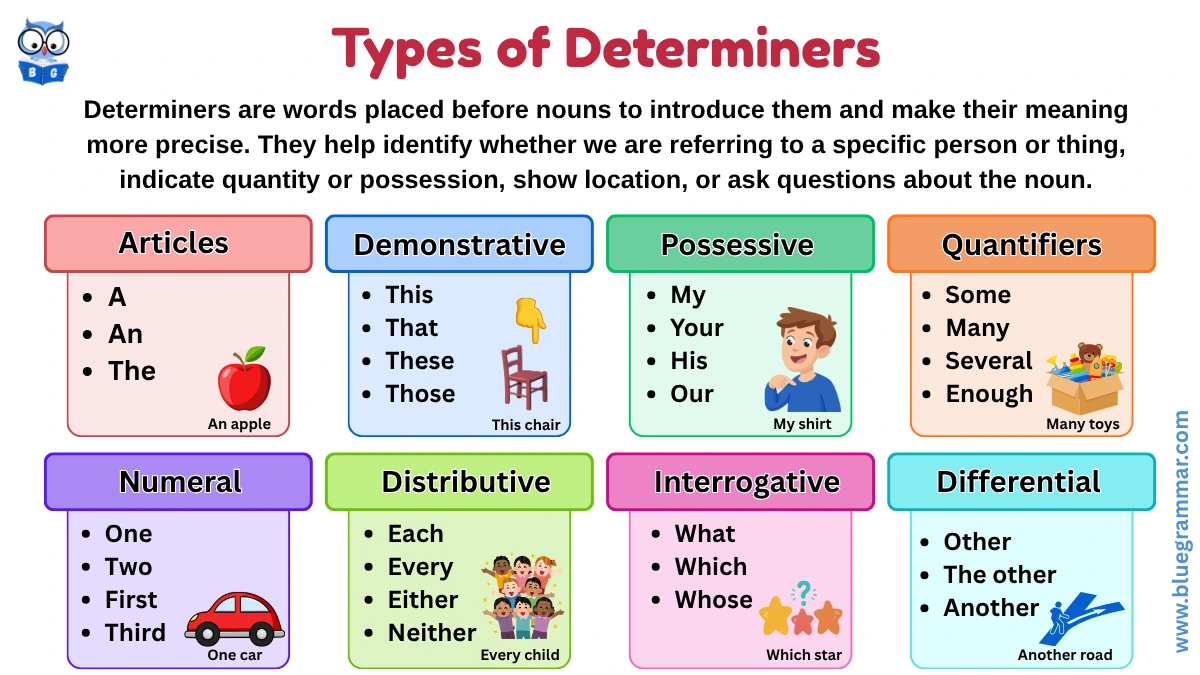
Determiners are words placed before nouns to introduce them and make their meaning more precise. They help identify whether we are referring to a specific person or thing, indicate quantity or possession, show location, or ask questions about the noun.
For example:
- the book
- my friend
- these flowers
- some water
- three students
Although all determiners appear before nouns, they do not all perform the same function. Modern English grammar generally classifies them into eight major types based on what they express.
Types of Determiners
Modern English grammar commonly recognizes the following types of determiners:
- Articles
- Demonstrative determiners
- Possessive determiners
- Quantifiers
- Numeral determiners
- Distributive determiners
- Interrogative determiners
- Determiners of difference
Each type performs a different grammatical function. Some identify a noun, some express quantity or possession, while others point to specific people or things or introduce questions. The following sections explain each type in detail with definitions and examples.
1. Articles
Articles are the most common determiners. They tell us whether a noun is specific or non-specific.
There are two kinds of articles.
Definite Article
The definite article the refers to a particular person or thing that is already known or can be identified.
Examples
- The sun rises in the east.
- Please close the door.
- The teacher explained the lesson.
Indefinite Articles
The articles a and an refer to a non-specific singular countable noun.
Examples
- I bought a notebook.
- She saw an elephant.
- He wants a bicycle.
Remember
- Use a before a consonant sound.
- Use an before a vowel sound.
2. Demonstrative Determiners
Demonstrative determiners identify nouns by indicating their position in relation to the speaker.
| Near | Far |
|---|---|
| this | that |
| these | those |
Examples
- This phone belongs to me.
- That building is very old.
- These cookies taste delicious.
- Those mountains are covered with snow.
3. Possessive Determiners
Possessive determiners show ownership, possession, or relationship.
They answer the question “Whose?”
Examples include:
- my
- your
- his
- her
- its
- our
- their
Examples
- My brother lives in Lahore.
- Their house is near the river.
- Her ideas impressed everyone.
- Our team won the match.
4. Quantifiers
Quantifiers indicate how much or how many of something there is.
Unlike numeral determiners, quantifiers usually express an approximate amount rather than an exact number.
Common quantifiers include:
- some
- any
- many
- much
- few
- little
- several
- enough
- plenty of
- most
Examples
- Many students attended the seminar.
- We still have some milk.
- Few people understood the joke.
- There isn’t much sugar left.
5. Numeral Determiners
Numeral determiners express an exact number or the position of a noun in a sequence.
They are divided into two groups.
Cardinal Numerals
These show quantity.
Examples:
- one
- two
- five
- ten
Examples
- Three children were playing outside.
- She owns two bicycles.
Ordinal Numerals
These indicate order or position.
Examples:
- first
- second
- third
- tenth
Examples
- He won first prize.
- This is my second visit.
6. Distributive Determiners
Distributive determiners refer to members of a group individually rather than as a whole.
Common distributive determiners include:
- each
- every
- either
- neither
Examples
- Each student received a certificate.
- Every child deserves respect.
- Either answer is acceptable.
- Neither proposal was approved.
Difference Between Each and Every
Although both refer to all members of a group, they are not identical. Each focuses on individuals, while every emphasizes the group as a whole. Read the complete article on each vs every.
Compare:
- Each player received a medal.
- Every player followed the rules.
7. Interrogative Determiners
Interrogative determiners introduce questions by modifying a noun.
They include:
- what
- which
- whose
Examples
- Which route is shorter?
- What subject do you enjoy most?
- Whose bag is lying on the table?
These words function as determiners only when they directly modify a noun.
Compare:
- Which book is yours? ✔
- Which do you prefer? (pronoun)
8. Determiners of Difference
Determiners of difference distinguish one noun from another.
The two principal determiners are:
- other
- another
Examples
- I need another pen.
- The other students have already left.
- Let’s try another method.
- She chose the other option.
Can One Word Belong to More Than One Category?
Yes. English grammar is based on function, not simply on the word itself.
For example:
-
Which book is yours?
Here which functions as an interrogative determiner. -
Which is yours?
Here which functions as a pronoun because it replaces the noun instead of introducing it.
The same principle applies to words such as this, that, some, and all.
Summary
Determiners are an essential part of English grammar because they introduce nouns and make their meaning clearer. Depending on their purpose, they may identify something specific, express possession, indicate quantity, show number, distinguish between alternatives, or introduce questions. Mastering the different types of determiners will help you build more accurate noun phrases and write with greater precision.
Quick Revision
Let’s briefly review the eight types of determiners.
- Articles: introduce nouns as specific or non-specific (a, an, the).
- Demonstrative determiners: point to people or things (this, that, these, those).
- Possessive determiners: express ownership (my, your, her, our).
- Quantifiers: indicate quantity without giving an exact number (some, many, much, few).
- Numeral determiners: express exact numbers or order (one, five, first, second).
- Distributive determiners: refer to members of a group individually (each, every, either, neither).
- Interrogative determiners: introduce questions about nouns (which, what, whose).
- Determiners of difference: distinguish one noun from another (other, another).
References
- Carter, Ronald, and Michael McCarthy. Cambridge Grammar of English. Cambridge University Press, 2006.
- Huddleston, Rodney, and Geoffrey K. Pullum. The Cambridge Grammar of the English Language. Cambridge University Press, 2002.
- Greenbaum, Sidney, and Randolph Quirk. A Student’s Grammar of the English Language. Longman, 1990.
- Quirk, Randolph, et al. A Comprehensive Grammar of the English Language. Longman, 1985.
- Eastwood, John. Oxford Guide to English Grammar. Oxford University Press, 1994.
- Swan, Michael. Practical English Usage (4th ed.). Oxford University Press, 2016.