
What Are Punctuation Marks?
Punctuation marks are special symbols used in English writing. They help organize sentences and guide the reader. These small marks show where to pause, where to stop, and how ideas are connected. Punctuation also helps separate different parts of a sentence clearly. Some punctuation marks highlight important words or emotions. When punctuation is used correctly, sentences become easier to read. It helps readers understand the message quickly. Proper punctuation also improves the accuracy and overall quality of writing.
Introduction to Main Punctuation Marks in English Grammar
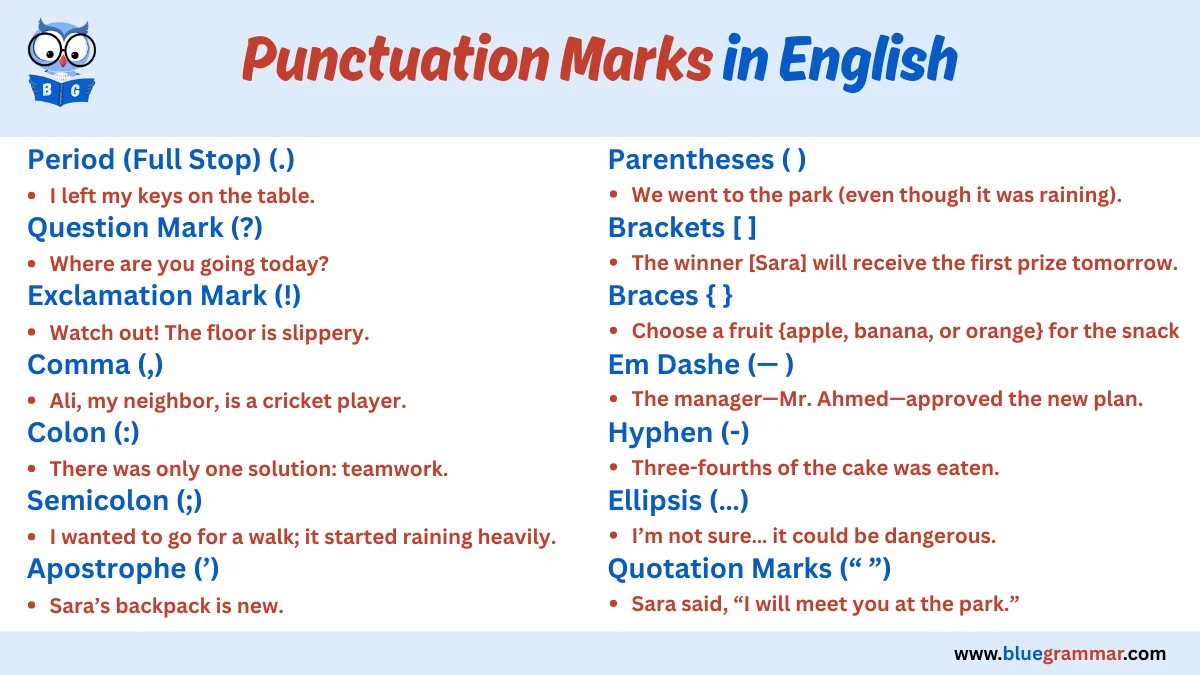
Here is a list of common punctuation marks used in English grammar:
- Period (Full Stop) (.)
- Question Mark (?)
- Exclamation Mark (!)
- Comma (,)
- Colon (:)
- Semicolon (;)
- Parentheses ( ( ) )
- Brackets ( [ ] )
- Braces ( { } )
- Em Dashes (—)
- En Dash (–)
- Hyphen (-)
- Apostrophe (’)
- Quotation Marks (“ ”)
- Ellipsis (…)
Period / Full Stop (.)
The period (.) is one of the most important punctuation marks in English. It is used to show that a sentence is complete. When a period is missing, the meaning of a sentence becomes unclear. Simple statements and commands usually end with a period.
1. Ending Declarative Sentences
Declarative sentences state a fact, opinion, or idea. They always end with a period.
Examples:
- Helen went on a study trip to Russia.
- I left my keys on the table.
- The sky looks beautiful today.
2. Ending Imperative Sentences
Imperative sentences give a command, request, or instruction. These also end with a period.
Examples:
- Please close the door.
- Write your name on the paper.
- Turn off the lights before leaving.
3. After Abbreviations
Periods are used in abbreviations to shorten words.
Examples:
- Mister → Mr.
- Doctor → Dr.
- Professor → Prof.
- General → Gen.
4. In Numbers and Decimals
Periods are used as decimal points in numbers.
Examples:
- The price of the book is $12.50.
- The baby weighed 3.2 kilograms.
- The train traveled 45.6 miles.
5. In Email Addresses and Web URLs
Periods are used in emails and website addresses to separate parts.
Examples:
- Contact: hello@example.com
- Website: www.bluegrammar.com
6. In Acronyms and Initials
Periods can separate letters in initials or acronyms (mostly in American English).
Examples:
- U.S.A.
- G.P.S. navigation system
7. Ellipsis (Three Periods)
Three periods in a row (…) form an ellipsis, which shows a pause, hesitation, or that part of a text is missing.
Examples:
- I… I don’t know what to say.
- She said, “If only I had… never mind.”
Comma (,)
A comma is a punctuation mark used to separate ideas, words, or phrases in a sentence. It helps the reader pause, understand the meaning, and avoid confusion. Using commas correctly can make your writing smooth, clear, and professional.
1. Separating Items in a List
Commas are used to separate three or more items in a sentence.
Examples:
- I bought apples, bananas, oranges, and grapes.
- She packed her bag with books, pencils, notebooks, and a water bottle.
Tip: The comma before the last item is called the Oxford comma. It is optional but improves clarity.
2. Adding Extra Information
Commas can include extra details that are not essential to the main sentence.
Examples:
- Ali, my neighbor, is a cricket player.
- The library, which is near the park, opens at 9 a.m.
Tip: If you remove the extra information, the sentence should still make sense.
3. Before Conjunctions in Compound Sentences
When two independent clauses are joined by and, but, or, so, yet, use a comma before the conjunction.
Examples:
- I wanted to go for a walk, but it started raining.
- She studied hard for the test, so she scored full marks.
4. After Introductory Words or Phrases
Use a comma after words or phrases that introduce a sentence.
Examples:
- After the meeting, we went to a café.
- Yes, I will help you with your homework.
- In the morning, I like to drink tea.
5. In Direct Speech
Commas separate the speaker from the words spoken in dialogue.
Examples:
- Sara said, “I will call you tomorrow.”
- He asked, “Are you coming to the party?”
6. Showing a Pause or Emphasis
Commas can indicate a short pause or emphasize a part of the sentence.
Examples:
- No, I don’t want any dessert.
- Well, I think we should leave now.
- Honestly, I didn’t expect that result.
7. Commas in Numbers, Dates, and Addresses
Commas are also used in numbers, dates, and addresses to separate parts clearly.
Examples:
- 1,000; 25,000; 1,000,000
- March 15, 2024
- 123 Main Street, Lahore, Pakistan
Question Mark (?)
A question mark (?) is used at the end of a sentence that asks a question. It shows that the speaker is seeking information or an answer. Without a question mark, a question looks incomplete and confusing. This punctuation mark helps the reader understand the tone of inquiry.
Examples:
- Where are you going today?
- Did you complete your homework on time?
- Who will attend the meeting tomorrow?
- Can you help me with this lesson?
Colon (:)
A colon (:) is a punctuation mark used to introduce information. It tells the reader that something important is coming next. Colons are often used before lists, explanations, examples, or quotations. The colon cannot be used randomly; it must follow a complete sentence or independent clause.
1. Introducing a List
Use a colon to present a list of items after a complete sentence.
Examples:
- She packed the following items for the trip: a notebook, a water bottle, snacks, and a jacket.
- For the art project, you will need: scissors, glue, colored pencils, and paper.
2. Before an Explanation or Expansion
A colon can connect a sentence with an explanation or detail that follows.
Examples:
- He had one main goal: to finish his homework before dinner.
- There is one thing I cannot tolerate: dishonesty in any form.
3. Before a Quotation
A colon can be used before a long or formal quotation.
Examples:
- The teacher said: “Practice every day to improve your English skills.”
- Shakespeare wrote: “All the world’s a stage, and all the men and women merely players.”
4. Emphasizing a Point
A colon can highlight a word or phrase at the end of a sentence.
Examples:
- She finally understood the truth: honesty matters most.
- There was only one solution: teamwork.
Semicolon (;)
A semicolon (;) is a punctuation mark used to connect closely related sentences or separate items in a complex list. It is stronger than a comma but weaker than a period. Semicolons help make writing smooth, especially when two ideas are connected but could stand alone as separate sentences.
1. Joining Two Related Sentences
Use a semicolon to join two complete sentences that are closely related in meaning.
Examples:
- I wanted to go for a walk; it started raining heavily.
- She enjoys reading books; her brother prefers watching movies.
2. Separating Items in a Complex List
When a list contains items that already have commas, use semicolons to avoid confusion.
Examples:
- I have lived in Paris, France; Rome, Italy; Cairo, Egypt; and Tokyo, Japan.
- The team includes John, the manager; Sara, the designer; Ali, the developer; and Nina, the tester.
Exclamation Mark (!)
An exclamation mark (!) is used at the end of a sentence to show strong feelings. It expresses excitement, surprise, happiness, anger, or urgency. Using an exclamation mark helps the reader understand the emotion behind the sentence.
Examples:
- Wow! That fireworks display was amazing!
- I can’t believe we won the competition!
- Watch out! The floor is slippery.
- Hurray! We finished the project on time!
Parentheses ( )
Parentheses ( ( ) ) are punctuation marks used to include extra information in a sentence. This information is not essential to the main sentence but provides clarification, explanation, or additional detail. Parentheses are helpful because they allow writers to give extra context without breaking the flow of the sentence.
1. Adding Extra Information
Parentheses can enclose extra details that help the reader understand the sentence better.
Examples:
- The Eiffel Tower (one of the most famous landmarks in the world) attracts millions of visitors every year.
- My cousin (who lives in Karachi) is visiting us next week.
- The recipe calls for sugar (two cups), flour (three cups), and butter (one cup).
- She bought a new car (a red sedan) last month.
2. Clarifying Abbreviations or Terms
Parentheses can explain abbreviations or unfamiliar terms.
Examples:
- The World Health Organization (WHO) monitors global health.
- He joined the British Broadcasting Corporation (BBC) as an intern.
- NASA (National Aeronautics and Space Administration) plans new space missions.
- The International Space Station (ISS) orbits the Earth continuously.
3. Including Additional Notes or Comments
Parentheses can also be used to insert a short comment or observation.
Examples:
- I finally finished reading the book (it took me two weeks!).
- She passed the exam (much to everyone’s surprise).
- We went to the park (even though it was raining).
- He completed the marathon (a personal best time).
Brackets [ ]
Brackets ( [ ] ) are punctuation marks used to add clarification, explanation, or corrections within a sentence. Unlike parentheses, brackets usually enclose words rather than full sentences. They are often used in formal writing, academic texts, or translations.
1. Clarifying Names or Subjects
Brackets can explain who or what is being referred to in a sentence.
Examples:
- He [Ahmed] scored the highest marks in the class.
- The winner [Sara] will receive the first prize tomorrow.
- My teacher [Mr. Khan] is very strict about homework.
- The author [J.K. Rowling] wrote the famous Harry Potter series.
2. Adding Translations
Brackets are used to provide the meaning of foreign words or phrases.
Examples:
- The word “bonjour [good morning]” is commonly used in French.
- He said “gracias [thank you]” politely.
- I learned the Spanish phrase “¿Cómo estás? [How are you?]” last week.
- The Italian word “ciao [hello]” is used for both greeting and farewell.
3. Indicating Corrections or Editorial Notes
Brackets can show corrections, missing words, or grammatical adjustments in a quote.
Examples:
- She [has] been to Europe many times.
- The report stated that he [was] absent on Monday.
- “I can’t believe she [didn’t] reply to my email,” he said.
- The article said the event would happen on June [15], not June [14].
Braces { }
Braces ( { } ), also called curly brackets, are punctuation marks used to group related items or show choices. They are not very common in everyday writing but are often used in mathematics, programming, or structured lists.
1. Showing a Group of Choices
Braces can present options or choices in a sentence.
Examples:
- Choose a fruit {apple, banana, or orange} for the snack.
- Pick a subject {Math, Science, English} for the project.
- Select your preferred color {red, blue, green} for the painting.
- Decide your favorite sport {cricket, football, or tennis}.
2. Organizing Information in Structured Lists
Braces can help organize related items in a list, especially in technical writing.
Examples:
- The following ingredients are needed {flour, sugar, eggs, and butter}.
- The team members {John, Sara, Ali, and Nina} are responsible for different tasks.
- In programming, variables can be grouped using braces {x, y, z}.
- The festival schedule {music, dance, games} will start at 10 a.m.
Em Dash (—)
The Em dash (—) is a long dash used to add emphasis, extra information, or show a sudden change in thought. It is stronger than a comma and can replace parentheses or colons in some cases. Em dashes make sentences more dynamic and engaging.
1. Adding Extra Information
Em dashes can enclose extra details that explain or expand on the main idea.
Examples:
- My brother—who just returned from Canada—is visiting us.
- The book—full of colorful illustrations—was a big hit with the children.
- The manager—Mr. Ahmed—approved the new plan.
- The festival—celebrated every spring—attracts thousands of visitors.
2. Showing a Sudden Change in Thought
Use an Em dash to indicate a break or shift in a sentence.
Examples:
- I was going to buy the red dress—wait, they only have blue left.
- She started cooking dinner—but then realized she forgot to buy vegetables.
- I can’t believe he—oh, never mind, it’s not important.
- He was happy with the results—but his friends were disappointed.
3. Adding Emphasis
Em dashes can highlight an important part of the sentence at the end.
Examples:
- There is one thing I cannot ignore—honesty.
- I have a secret to tell you—listen carefully.
- She won the race—against all odds.
- The answer is clear—teamwork makes everything possible.
En Dash (–)
The En dash (–) is slightly shorter than an Em dash. It is mainly used to show a range, connection, or relationship between numbers, dates, or places. Unlike the Em dash, it does not replace commas or parentheses.
1. Showing a Range
The En dash can indicate a range of numbers, dates, or times.
Examples:
- The meeting will be held from 10:00 a.m.–12:00 p.m.
- The conference runs May 15–18 this year.
- Students aged 10–15 can participate in the event.
- The book covers pages 50–75 in the chapter.
2. Showing a Connection or Relationship
En dashes can connect places, people, or organizations to show a link.
Examples:
- The Karachi–Lahore train route is very popular.
- The Nobel Prize–winning scientist gave a speech.
- The CEO–Board meeting is scheduled for next Monday.
- The India–Pakistan cricket match attracted thousands of fans.
Hyphen (-)
A hyphen (-) is a short dash used to connect two words or parts of words. It is different from an En dash or Em dash. Hyphens help make compound words, numbers, and certain prefixes clear and readable.
1. Connecting Words to Form Compound Words
Hyphens join two words to create a single idea.
Examples:
- Ice-cream
- Good-looking
- Well-known
- Mother-in-law
2. Connecting Numbers and Fractions
Hyphens are used in numbers or fractions written in words.
Examples:
- Twenty-nine students attended the class.
- Three-fourths of the cake was eaten.
- The teacher assigned a fifty-page report.
- We need a twenty-two-foot ladder for the roof.
3. With Prefixes and Suffixes
Sometimes hyphens link prefixes or suffixes to words for clarity.
Examples:
- Re-enter
- Co-operation
- Ultra-violet
- Semi-detached
Apostrophe (’)
The apostrophe (’) is a punctuation mark with two main uses: showing possession and forming contractions. It helps make writing clear and concise.
1. Showing Possession
An apostrophe indicates that something belongs to someone or something.
Singular Nouns – Add ’s to show possession.
Examples:
- Rohit’s book is on the table.
- The dog’s collar is red.
- Sara’s backpack is new.
- The teacher’s pen fell on the floor.
Plural Nouns Ending in -s – Add ’ after the s.
Examples:
- The students’ classroom is large.
- The cats’ toys are in the box.
- The players’ uniforms are clean.
- The teachers’ lounge is on the second floor.
Plural Nouns Not Ending in -s – Add ’s.
Examples:
- The children’s books are on the shelf.
- The men’s team won the match.
2. Forming Contractions
Apostrophes are used to combine words by replacing missing letters.
Examples:
- Do not → Don’t
- Will not → Won’t
- I am → I’m
- They are → They’re
- Should not → Shouldn’t
Quotation Marks (“ ”)
Quotation marks (“ ”), also called speech marks, are used to enclose someone’s exact words or a quote. They help the reader know when someone is speaking or when a phrase is taken directly from another source.
1. For Direct Speech
Quotation marks show what someone actually said.
Examples:
- Sara said, “I will meet you at the park.”
- Ali asked, “Can you help me with my homework?”
- The teacher said, “Submit your assignments by Friday.”
- He shouted, “Watch out for the car!”
2. For Quotes from Books, Articles, or Media
Quotation marks can enclose text from a source.
Examples:
- Shakespeare wrote, “All the world’s a stage, and all the men and women merely players.”
- The article stated, “Climate change is a serious global issue.”
- She read aloud, “It was the best of times, it was the worst of times.”
- The news report said, “Thousands attended the festival yesterday.”
3. For Emphasis or Special Words
Quotation marks can also highlight a word or phrase being discussed.
Examples:
- The word “freedom” has different meanings in various cultures.
- He called it “the opportunity of a lifetime.”
- The term “digital literacy” is very popular in education today.
- The teacher asked us to define “sustainability.”
Ellipsis (…)
An ellipsis (…) is a set of three dots used in writing to show that part of a sentence is missing, to shorten a quote, or to indicate hesitation. Ellipses help make writing smoother and convey pauses or unfinished thoughts.
1. Shortening a Quote
Ellipses can remove unnecessary parts of a long quote while keeping the main meaning.
Examples:
- Original: “If all else perished, and he remained, I should still continue to be; and if all else remained, and he were annihilated, the universe would turn to a mighty stranger.”
- With Ellipsis: “If all else perished, and he remained … the universe would turn to a mighty stranger.”
2. Indicating Hesitation or Pause
Ellipses can show a pause or hesitation in speech.
Examples:
- I… I don’t know what to say.
- Well… maybe we can try again tomorrow.
- She was thinking… then she finally spoke.
- I’m not sure… it could be dangerous.
3. Creating Suspense or Unfinished Thoughts
Writers sometimes use ellipses to leave a thought unfinished or create suspense.
Examples:
- He opened the door and saw…
- The answer to the mystery was hidden in the…
- She looked at him and said… nothing.
- I was going to tell you something, but…