
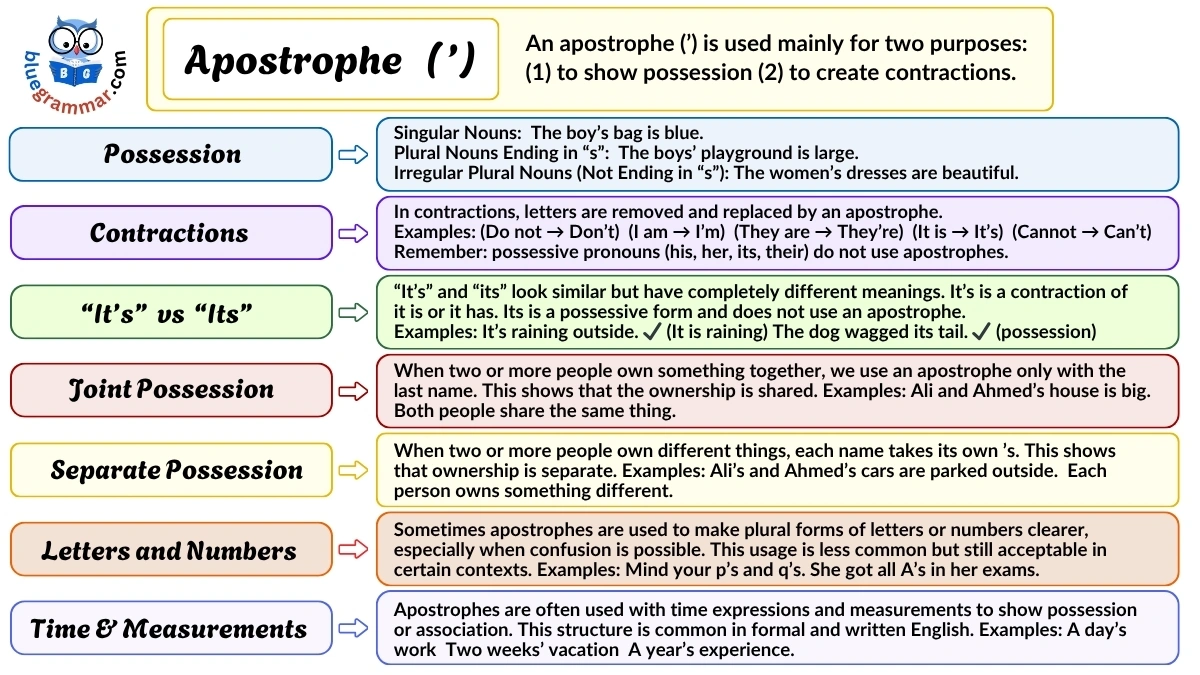
The apostrophe (’) is a small punctuation mark, but it has very important uses in English. It helps show ownership (possession) and is also used to form contractions (shortened words). Many learners confuse its usage, especially when dealing with plurals and possessive forms.
In this guide, you will learn all the apostrophe rules in a simple and clear way, with explanations and examples for each case.
What Is an Apostrophe (’)?
An apostrophe (’) is a punctuation mark used mainly for two purposes: to show possession and to create contractions. It is not used to make words plural, which is a common mistake.
Understanding when to use (and not use) an apostrophe is essential for writing correct English sentences.
1. Apostrophe for Possession
An apostrophe is used to show that something belongs to someone or something. This is called possession. The form of the apostrophe depends on whether the noun is singular or plural.
a. Singular Nouns
For singular nouns, we usually add ’s to show ownership. This rule applies even if the noun ends in “s”.
- Example: The boy’s bag is blue.
- Example: Sara’s book is on the table.
- Example: The class’s schedule has changed.
Explanation: Here, the apostrophe shows that something belongs to one person or thing.
b. Plural Nouns Ending in “s”
When a plural noun already ends in “s”, we add only an apostrophe (’) after the “s”. We do not add another “s”.
- Example: The boys’ playground is large.
- Example: The teachers’ room is upstairs.
- Example: The players’ uniforms are clean.
Explanation: This shows that something belongs to more than one person.
c. Irregular Plural Nouns (Not Ending in “s”)
Some plural nouns do not end in “s” (like children, men, women). In these cases, we add ’s just like singular nouns.
- Example: The children’s toys are everywhere.
- Example: The men’s shoes are outside.
- Example: The women’s dresses are beautiful.
Explanation: Even though these words are plural, they follow the singular possession rule.
2. Apostrophe in Contractions
Apostrophes are used in contractions, which are shortened forms of two words. In contractions, letters are removed and replaced by an apostrophe.
This makes speech and writing more natural and informal.
- Do not → Don’t
- I am → I’m
- They are → They’re
- It is → It’s
- Cannot → Can’t
Explanation: The apostrophe shows where letters have been omitted.
3. Apostrophe with “It’s” vs “Its”
This is one of the most common areas of confusion in English. “It’s” and “its” look similar but have completely different meanings.
- It’s is a contraction of it is or it has.
- Its is a possessive form and does not use an apostrophe.
- Example: It’s raining outside. (It is raining)
- Example: The dog wagged its tail. (possession)
Remember: Possessive pronouns (his, her, its, their) do not use apostrophes.
4. Apostrophe for Joint Possession
When two or more people own something together, we use an apostrophe only with the last name. This shows that the ownership is shared.
- Example: Ali and Ahmed’s house is big.
- Example: Sara and Hina’s project is complete.
Explanation: Both people share the same thing.
5. Apostrophe for Separate Possession
When two or more people own different things, each name takes its own ’s. This shows that ownership is separate.
- Example: Ali’s and Ahmed’s cars are parked outside.
- Example: Sara’s and Hina’s books are on the table.
Explanation: Each person owns something different.
6. Apostrophe with Time and Measurements
Apostrophes are often used with time expressions and measurements to show possession or association. This structure is common in formal and written English.
- Example: A day’s work
- Example: Two weeks’ vacation
- Example: A year’s experience
Explanation: These phrases mean “work of a day” or “vacation of two weeks”.
7. Apostrophe in Letters and Numbers (Optional Use)
Sometimes apostrophes are used to make plural forms of letters or numbers clearer, especially when confusion is possible. This usage is less common but still acceptable in certain contexts.
- Example: Mind your p’s and q’s.
- Example: She got all A’s in her exams.
Explanation: The apostrophe improves readability.
Common Mistakes with Apostrophes
Many learners misuse apostrophes. Understanding these mistakes will help you avoid them.
- Using Apostrophes for Plurals
❌ Apple’s are sweet.
✔ Apples are sweet.
Note: Apostrophes are for possession, not plural forms. - Confusing “Your” and “You’re”
❌ Your welcome.
✔ You’re welcome.
Note: You’re = you are, while your shows possession. - Misusing “Its” and “It’s”
❌ The dog lost it’s bone.
✔ The dog lost its bone.
Note: This is one of the most frequent errors in English writing.
Quick Summary of Apostrophe Rules
| Rule / Category | Correct Usage | Example |
|---|---|---|
| Singular Possession | Add ’s | The girl’s bag |
| Plural Possession (ends in "s") | Add ’ after "s" | The teachers’ room |
| Irregular Plural Possession | Add ’s | Children’s toys |
| Contractions | Use ’ to replace omitted letters | don’t, can’t, it’s |
| Simple Plurals | Do NOT use an apostrophe | Apples (not Apple's) |
Remember: Never use an apostrophe to make a standard noun plural. Use apostrophes strictly for possession, contractions, or specific letter clarity!
Conclusion
The apostrophe (’) is a simple but powerful punctuation mark. When used correctly, it makes your writing clear and precise. By understanding the rules of possession and contractions—and avoiding common mistakes—you can use apostrophes confidently in your writing.