
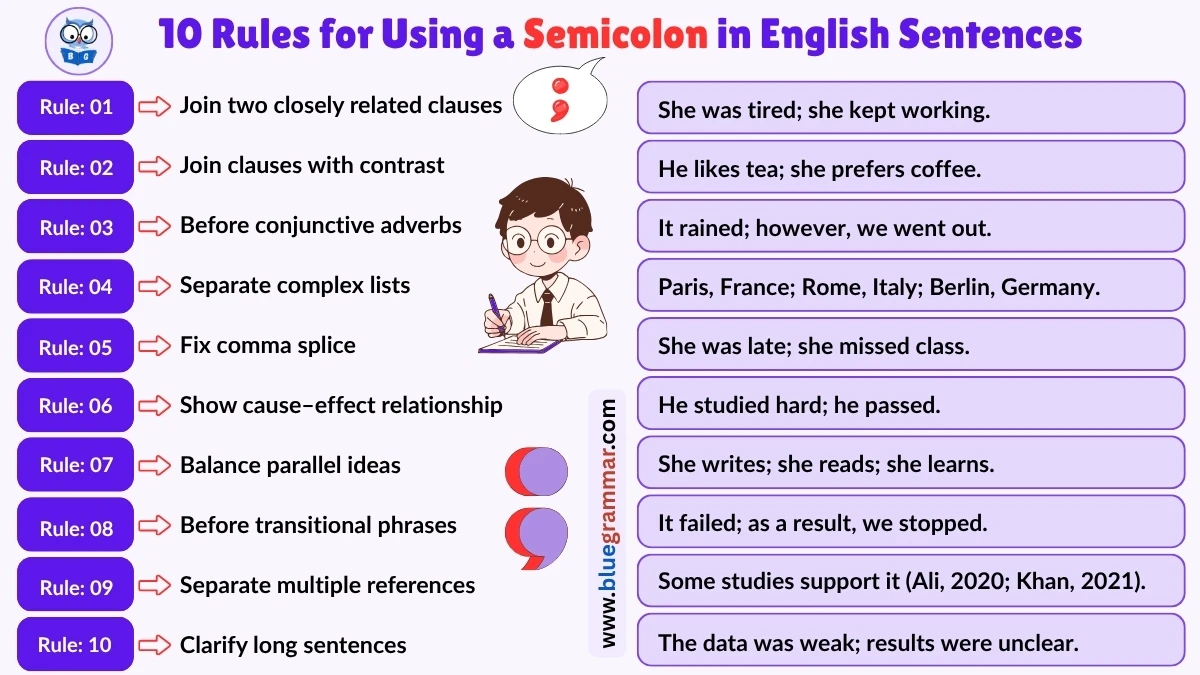
The semicolon (;) is one of the most misunderstood punctuation marks in English writing — yet it is also one of the most useful. Many writers either avoid it completely or use it incorrectly, often confusing it with a comma or a colon. As a result, their writing can feel either too choppy or improperly connected.
At its core, the semicolon is a mark of connection and balance. It signals to the reader: “these two parts belong together, but they are strong enough to stand on their own.” Think of it as a bridge between closely related ideas. Everything before the semicolon is a complete sentence, and everything after it is also a complete sentence — but the two are more closely connected than if they were separated by a period.
This article covers twelve essential rules for using the semicolon correctly in English sentences, with clear explanations and examples for each rule. Whether you are a student, a blogger, or someone who wants to write more clearly and professionally, mastering the semicolon will significantly improve your writing.
What Is a Semicolon?
A semicolon is a punctuation mark represented by a comma with a dot above it ( ; ). It is used to link closely related ideas or to organize complex information. Like the colon, it never appears at the beginning of a sentence. Most importantly, a semicolon usually connects two independent clauses — that is, two complete sentences that could stand alone if separated.
If either side of the semicolon is not a complete sentence, then the semicolon is being used incorrectly. Keep this key rule in mind as you go through all twelve rules below.
Rule 1: Use a Semicolon to Join Two Closely Related Independent Clauses
The most common use of the semicolon is to connect two independent clauses that are closely related in meaning. Instead of using a period (which would separate them completely), the semicolon keeps the ideas linked.
Explanation: Both parts must be complete sentences, and they should be strongly connected in meaning. The semicolon suggests a pause that is stronger than a comma but weaker than a period.
- Example: She loves reading; she visits the library every weekend.
- Example: The weather was extremely cold; we decided to stay indoors.
- Example: He worked hard all year; he deserved the promotion.
- Example: The road was empty; not a single car passed by.
Rule 2: Do Not Use a Semicolon with a Coordinating Conjunction
A semicolon should not be used together with coordinating conjunctions such as “and,” “but,” “or,” “so,” or “yet” when connecting clauses. In such cases, a comma is used instead.
Explanation: The semicolon already functions as a connector, so adding a conjunction creates redundancy and incorrect structure.
- ❌ Incorrect: She was tired; but she continued working.
- ✔ Correct: She was tired, but she continued working.
- ✔ Correct: She was tired; she continued working.
Rule 3: Use a Semicolon with Conjunctive Adverbs
When words like “however,” “therefore,” “moreover,” “nevertheless,” or “consequently” connect two independent clauses, a semicolon is used before the conjunctive adverb and a comma after it.
Explanation: These transition words show relationships such as contrast, cause, or addition. The semicolon helps separate the clauses clearly.
- Example: He wanted to go for a walk; however, it started raining.
- Example: She studied hard; therefore, she passed the exam.
- Example: The plan seemed risky; nevertheless, they decided to try it.
- Example: He was not feeling well; consequently, he stayed home.
Rule 4: Use a Semicolon in Complex Lists
A semicolon is used to separate items in a list when the items themselves contain commas. This prevents confusion and makes the list easier to read.
Explanation: When list items are long or include additional details, commas alone are not enough to separate them clearly. The semicolon acts as a higher-level separator.
- Example: The conference had participants from Lahore, Pakistan; Delhi, India; London, England; and New York, USA.
- Example: She has lived in Paris, France; Rome, Italy; and Berlin, Germany.
- Example: The menu included pasta with tomato sauce, basil, and cheese; grilled chicken with herbs and spices; and chocolate cake with cream.
Rule 5: Use a Semicolon to Balance Contrasting Ideas
A semicolon can connect two sentences that present contrasting or opposing ideas, especially when the contrast is subtle.
Explanation: This use highlights the relationship between two ideas without breaking them into separate sentences.
- Example: He prefers coffee; she prefers tea.
- Example: The task seemed simple; it was actually quite difficult.
- Example: Some people enjoy working at night; others are more productive in the morning.
- Example: She wanted to stay; he insisted on leaving.
Rule 6: Use a Semicolon for Emphasis in Parallel Structure
When two or more clauses follow a similar grammatical structure, a semicolon can enhance rhythm and clarity.
Explanation: This is often used in formal or persuasive writing to create balance and emphasis.
- Example: She believed in honesty; she believed in hard work; she believed in kindness.
- Example: He came, he saw, he conquered; he left, he reflected, he returned stronger.
- Example: They planned carefully; they executed efficiently; they succeeded completely.
Rule 7: Use a Semicolon to Avoid Comma Splices
A comma splice occurs when two independent clauses are incorrectly joined by a comma alone. A semicolon can fix this error.
Explanation: If you have two complete sentences joined by just a comma, replace the comma with a semicolon or add a conjunction.
- ❌ Incorrect: She was late, she missed the meeting.
- ✔ Correct: She was late; she missed the meeting.
- ✔ Correct: She was late, so she missed the meeting.
Rule 8: Use a Semicolon Before Transitional Phrases
When longer transitional phrases such as “as a result,” “in fact,” or “for example” connect clauses, a semicolon is often used before them.
Explanation: These phrases function similarly to conjunctive adverbs and require clear separation.
- Example: The project was delayed; as a result, the deadline was extended.
- Example: He did not prepare well; in fact, he forgot about the test entirely.
- Example: She loves outdoor activities; for example, hiking and cycling are her favorites.
Rule 9: Do Not Use a Semicolon with Dependent Clauses
A semicolon should not connect an independent clause with a dependent clause.
Explanation: A dependent clause cannot stand alone, so it does not meet the requirement for semicolon usage.
- ❌ Incorrect: Although it was raining; we went outside.
- ✔ Correct: Although it was raining, we went outside.
- ✔ Correct: It was raining; we still went outside.
Rule 10: Use a Semicolon in Formal Writing for Clarity
Semicolons are more common in formal, academic, and professional writing than in casual writing.
Explanation: They help create clear, well-structured sentences, especially when ideas are complex or closely related.
- Example: The results were significant; further research is required.
- Example: The policy was updated; all employees must review the changes.
- Example: The data was incomplete; the conclusions remain uncertain.
Rule 11: Use a Semicolon in Academic Citations and References
In academic writing, semicolons are often used to separate multiple references or sources within the same citation.
Explanation: This is a conventional use in research papers and formal documents.
- Example: Several studies support this theory (Smith, 2020; Ahmed, 2021; Lee, 2022).
- Example: The method has been widely adopted (Brown, 2019; Khan, 2020).
Rule 12: Do Not Overuse the Semicolon
While the semicolon is useful, overusing it can make writing seem overly formal or difficult to read.
Explanation: Use semicolons only when they genuinely improve clarity or connection between ideas. In many cases, a period or comma may be more appropriate.
- ❌ Overuse: She woke up early; she brushed her teeth; she had breakfast; she left for work.
- ✔ Better: She woke up early. She brushed her teeth, had breakfast, and left for work.
Quick Summary of Semicolon Rules
| Rule / Usage | When to Use | Key Requirement |
|---|---|---|
| Joining Clauses | Linking closely related sentences | Both sides must be independent clauses |
| Conjunctive Adverbs | Before words like however, therefore | Follow with a comma (e.g., ; however,) |
| Complex Lists | Separating list items that contain commas | Prevents confusion in multi-part lists |
| Avoid Comma Splices | Fixing two sentences joined only by a comma | Replaces the improper comma |
| Academic Citations | Grouping multiple sources | Separates sources within parentheses |
Golden Rule: Only use a semicolon when both parts of the sentence are complete independent clauses that can stand alone, unless you are using it to separate items in a complex list!
Conclusion
The semicolon is a precise and elegant punctuation mark that helps connect ideas without losing clarity. When used correctly — primarily between closely related independent clauses or within complex lists — it enhances both readability and style. It tells the reader: “these ideas are separate, but they belong together.”
The twelve rules in this guide cover the most important uses of the semicolon, from joining clauses and using conjunctive adverbs to organizing complex lists and avoiding common errors. Together, they provide a complete understanding of how and when to use this often-overlooked punctuation mark.
The key takeaway is this: use a semicolon only when both parts of the sentence are complete and closely related. If you follow this simple principle, your semicolon usage will always be accurate and effective.