
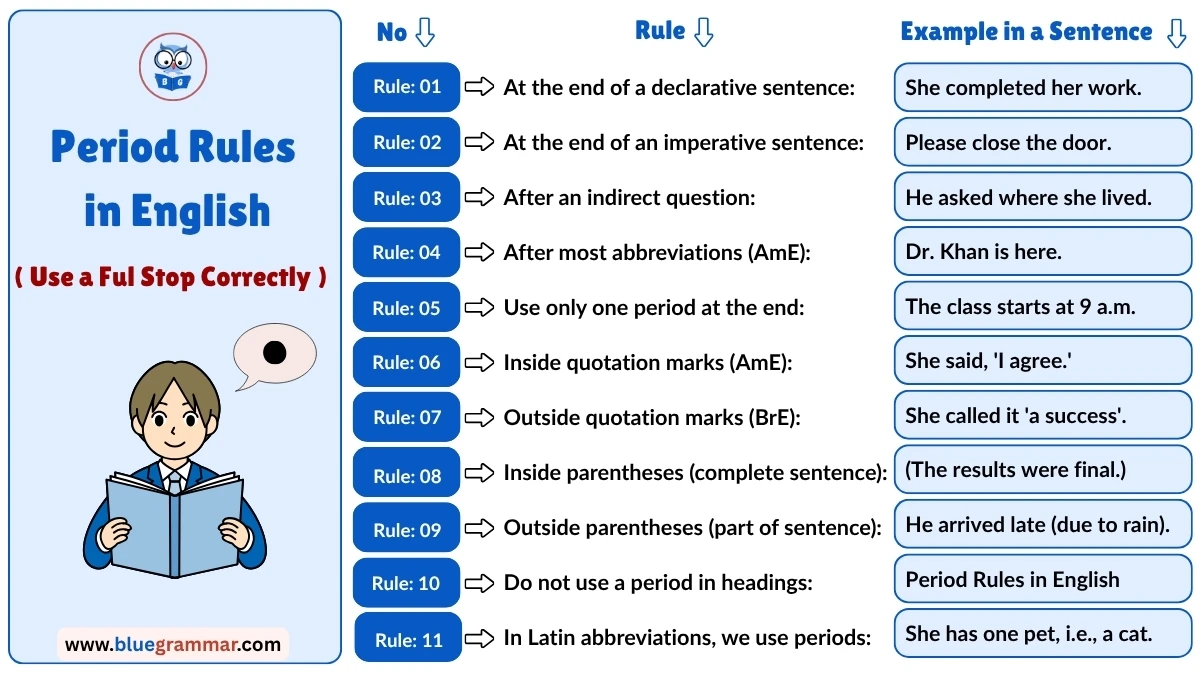
The period—known as the full stop in British English—is one of the most essential punctuation marks in written English. Although it appears to be a simple dot, its correct use is crucial for clarity, structure, and meaning. A missing or incorrectly placed period can confuse the reader or change the intended message. For ESL learners and academic writers, understanding how and when to use the period is an important step toward producing clear and professional writing.
This article explains the rules of using periods in English, including their role in sentences, abbreviations, quotations, and common writing situations. Each rule is supported with clear explanations and examples to help learners apply them correctly.
What Is a Period (Full Stop)?
A period ( . ) is a punctuation mark used mainly to signal the end of a complete sentence or to indicate abbreviations. In American English, it is called a period, while in British English, it is known as a full stop. Despite the difference in terminology, both refer to the same symbol and function.
The term period comes from the Latin word periodus, meaning a complete thought or sentence. Similarly, the term full stop reflects its function of marking a complete pause in writing. Understanding this basic role helps learners recognize why the period is fundamental in structuring written communication.
The Primary Function: Ending a Declarative Sentence
The most important function of a period is to mark the end of a declarative sentence. A declarative sentence expresses a statement, fact, opinion, or idea. It does not ask a question or express strong emotion, and therefore it requires a period rather than a question mark or an exclamation mark.
Rule: Use a period at the end of every declarative sentence
A declarative sentence presents information in a clear and neutral way. The period signals that the thought is complete and that the reader can pause before moving to the next idea. Without a period, sentences may run together and become difficult to understand.
- The conference begins on Monday.
- She submitted the report before the deadline.
Rule: Use a period at the end of a mild imperative sentence
Imperative sentences give instructions, advice, or requests. When the tone is polite or neutral, a period is used to end the sentence. This helps maintain a calm and professional tone in writing. However, if the command is strong or urgent, an exclamation mark is more appropriate.
- Please submit your application by Friday.
- Close the door on your way out.
- Forceful command: Stop! Do not proceed any further.
Rule: Use a period after an indirect question
An indirect question reports a question rather than asking it directly. Even though the meaning involves a question, the structure of the sentence is declarative, so it ends with a period. This is an important distinction for ESL learners, who may be tempted to use a question mark.
- She asked when the results would be published.
- He wondered whether the proposal had been approved.
Periods in Abbreviations
In addition to ending sentences, periods are also used in abbreviations. However, the use of periods in abbreviations varies between American and British English, and it is important to follow one style consistently in formal writing.
Titles and Honorifics
In American English, abbreviated titles such as Mr., Mrs., Ms., Dr., and Prof. always include a period. In British English, the period is often omitted if the abbreviation ends with the same letter as the full word. This difference reflects stylistic preferences rather than grammatical rules.
- American English: Dr. Smith confirmed the appointment.
- British English: Dr Smith confirmed the appointment.
Latin Abbreviations
Latin abbreviations are widely used in both American and British English, and they typically include periods. These abbreviations are common in academic and formal writing, so learners should become familiar with them.
- Participants were asked to bring identification, e.g., a passport.
- The report was written by Ali et al.
Initialisms and Acronyms
Modern English usually omits periods in initialisms and acronyms, especially when they are written in capital letters. This trend reflects a move toward simpler and cleaner writing styles. However, older forms with periods may still appear in formal or traditional contexts.
- Modern style: USA, UK, BBC, FBI
- Older style: U.S.A., U.K.
Consistency is more important than choosing one style over another.
The Single-Period Rule
When a sentence ends with an abbreviation that already includes a period, only one period is used. This single period functions both as the abbreviation marker and as the sentence-ending punctuation. Using two periods is considered incorrect.
- ✔ Correct: The meeting starts at 9 a.m.
- ❌ Incorrect: The meeting starts at 9 a.m..
Periods with Quotation Marks
The placement of periods with quotation marks differs between American and British English. This difference is important for learners who write for international audiences or academic purposes.
American English Convention
In American English, the period is always placed inside the closing quotation mark, regardless of whether it belongs to the quoted material. This rule is based on typographical tradition and is consistently followed in most American style guides.
- She described the result as “very successful.”
- The document was marked “confidential.”
British English Convention
British English follows a logical system, placing the period inside the quotation mark only if it is part of the original quoted material. If the period belongs to the main sentence, it is placed outside the quotation marks.
- He said, “The results are final.”
- She referred to it as “a major success”.
Periods with Parentheses
The placement of periods with parentheses depends on whether the information inside the parentheses forms a complete sentence or is part of a larger sentence.
Rule: Period inside parentheses for complete sentences
When the text inside parentheses is a complete sentence, it should begin with a capital letter and end with a period inside the parentheses. This shows that it is independent of the main sentence.
- The schedule has been updated. (New details will be shared tomorrow.)
Rule: Period outside parentheses for partial information
When the parenthetical information is only part of a sentence, the period is placed outside the closing parenthesis. The main sentence carries the final punctuation.
- The proposal (discussed in the meeting) was approved.
- The event attracted many participants (over 200 people).
Periods in Lists and Headings
The use of periods in lists and headings depends on the structure and style of the writing. Maintaining consistency is essential in both cases.
Lists
If each item in a list is a complete sentence, it should end with a period. However, if the list contains short phrases or single words, periods are usually not necessary. Mixing styles within the same list should be avoided, as it creates inconsistency and reduces clarity.
Bring the following items:
- A pen
- A notebook
- A calculator
Headings and Titles
Headings and titles do not usually end with a period, even if they are complete sentences. This is a standard practice in academic and professional writing, as headings are meant to label sections rather than function as full sentences.
- ✔ Correct: Period Rules in English
- ❌ Incorrect: Period Rules in English.
Common Errors to Avoid
Understanding common mistakes can help learners avoid errors and improve their writing accuracy.
Run-on Sentences
A run-on sentence occurs when two independent sentences are joined without proper punctuation. This often happens when a period is replaced with a comma. Using a period correctly separates ideas and improves readability.
- ❌ Incorrect: He completed the work, he submitted it later.
- ✔ Correct: He completed the work. He submitted it later.
Sentence Fragments
A sentence fragment is an incomplete sentence that lacks a subject, a verb, or a complete idea. In formal writing, every sentence should express a complete thought and end with a period.
- ❌ Incorrect: Because the results were unclear.
- ✔ Correct: The experiment was repeated because the results were unclear.
Double Period
Using two periods at the end of a sentence is a common mistake, especially when abbreviations are involved. Only one period should be used.
- ❌ Incorrect: The class starts at 8 a.m..
- ✔ Correct: The class starts at 8 a.m.
Omitting Periods in Formal Writing
In informal communication such as text messages, people sometimes omit periods. However, in academic, professional, and formal writing, periods must always be used to mark the end of sentences. Omitting them can make writing appear incomplete or careless.
Golden Rule: Ensure every complete sentence ends with appropriate punctuation, and always place periods consistently relative to quotation marks and parentheses based on your chosen style (American vs. British).
Conclusion
The period is a small but powerful punctuation mark that plays a central role in written English. It helps organize ideas, separate sentences, and ensure clarity in communication. For ESL learners and academic writers, mastering the rules of period usage is essential for producing accurate and effective writing.
By understanding its functions—whether ending sentences, forming abbreviations, or interacting with other punctuation marks—students can write with greater confidence and precision. Consistent and correct use of the period is a key step toward clear, professional, and well-structured writing.