
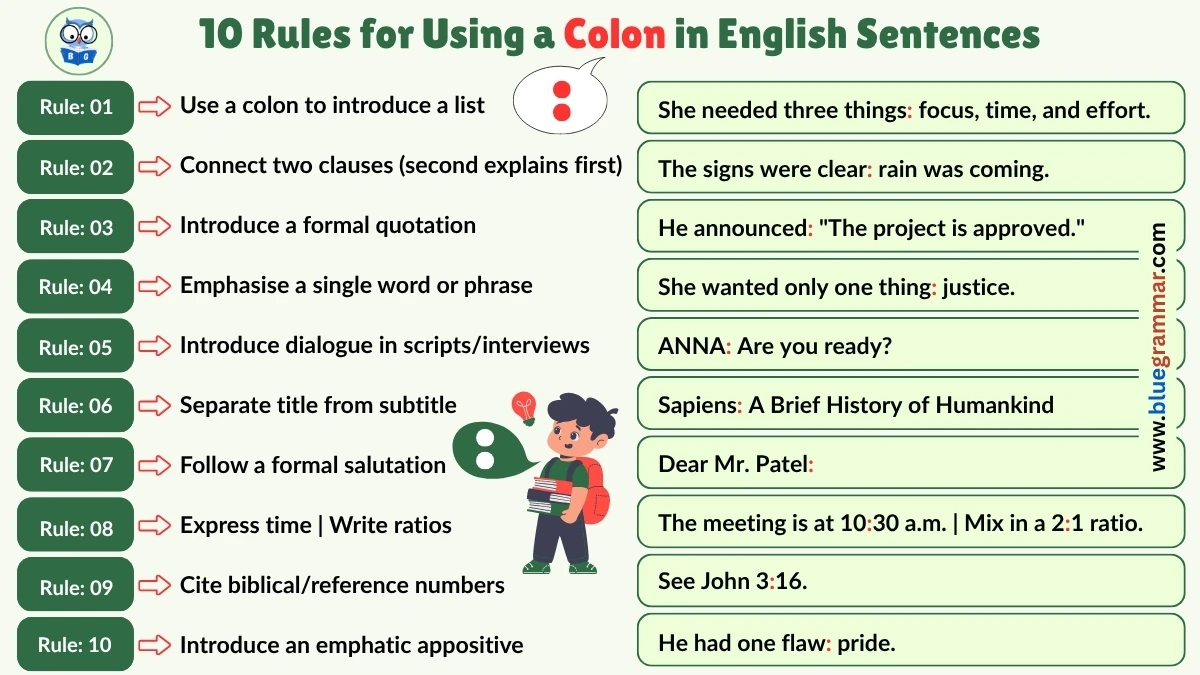
The colon (:) is one of the most powerful punctuation marks in the English language — and one of the least understood. Many writers either avoid it altogether out of uncertainty or misuse it by placing it where it does not belong. Both of these habits weaken writing unnecessarily.
At its core, the colon is a mark of introduction and emphasis. It signals to the reader: “what comes next is directly connected to — and flows from — what you just read.” Think of it as an arrow pointing forward. Everything before the colon sets up an expectation, and everything after it delivers the answer, the list, the explanation, or the detail.
This article covers twelve essential rules for using the colon correctly in English sentences, with clear explanations and examples for each rule. Whether you are a student, a blogger, or someone who simply wants to write with more precision and confidence, mastering the colon will immediately improve the quality of your writing.
What Is a Colon?
A colon is a punctuation mark represented by two vertically stacked dots ( : ). It appears within or at the end of a sentence — never at the very beginning — and it always follows a complete independent clause. That last point is the single most important rule about colons: the words that come before the colon must be able to stand alone as a complete sentence.
If what comes before the colon is not a complete sentence, the colon is being used incorrectly. Keep this principle in mind as you read through all twelve rules below.
Rule 1: Use a Colon to Introduce a List
The most common use of the colon is to introduce a list of items that follows a complete sentence. The sentence before the colon announces that a list is coming, and the colon is the bridge between the announcement and the list itself.
Explanation: The words before the colon must form a complete, independent clause. You are essentially saying: “Here is what I mean” and then listing the items. Do not use a colon if the list is embedded naturally into the flow of the sentence without a complete clause before it.
- She needed three things to succeed: dedication, discipline, and patience.
- The survival kit contained the following items: a flashlight, matches, water, and a first aid kit.
- The professor outlined the essay structure: introduction, body paragraphs, and conclusion.
- ❌ Incorrect: She needed: dedication, discipline, and patience. (Incorrect — “She needed” is not a complete sentence.)
Tip for ESL learners: A helpful test is to ask yourself, “Does the part before the colon make sense on its own as a complete sentence?” If the answer is yes, the colon is almost certainly correct.
Rule 2: Use a Colon to Introduce an Explanation or Clarification
When the second part of a sentence explains, defines, or clarifies what was stated in the first part, a colon can connect the two. The colon here works like an equals sign: the second part restates or unpacks the first part in greater detail.
Explanation: This use of the colon is more formal than using phrases like “that is” or “in other words.” It creates a tight, elegant connection between a general statement and its specific meaning. Both sides of the colon must relate directly to each other.
- He had only one weakness: his inability to say no.
- The reason for the delay was simple: the shipment had been lost in transit.
- She faced a difficult truth: hard work alone is not always enough.
- The new policy had one clear goal: to reduce waste across all departments.
Notice how in each example, the second part answers the implied question raised by the first. “One weakness — what is it?” The colon delivers the answer immediately and efficiently.
Rule 3: Use a Colon to Introduce a Quotation
When you introduce a direct quotation with a complete sentence, a colon is the appropriate punctuation mark to use. This is especially common in formal, academic, and journalistic writing.
Explanation: The colon here signals that you are about to present someone else’s exact words. It is a more formal alternative to using a comma to introduce a quote. The first word of the quoted sentence is capitalized.
- The manager addressed the team directly: “We need to improve our response times significantly.”
- Albert Einstein once observed: “Imagination is more important than knowledge.”
- The report concluded with a stark warning: “Without immediate action, the situation will deteriorate further.”
- Her grandmother always reminded her: “A kind word costs nothing, but it is worth everything.”
Note: Use a comma — not a colon — when the quotation is introduced by a simple verb of saying, such as “said,” “asked,” or “replied,” and when the introductory phrase is not a complete sentence.
- ✔ Correct with comma: She said, “I will be there by noon.”
- ✔ Correct with colon: She sent a clear message to everyone on the team: “I will be there by noon, and I expect everyone else to be on time.”
Rule 4: Use a Colon Between Two Independent Clauses When the Second Explains the First
A colon can join two independent clauses — two complete sentences — when the second sentence directly explains, expands upon, or gives the reason for the first. This is a more sophisticated use of the colon that many writers overlook.
Explanation: Think of this use as a cause-and-effect or a statement-and-explanation relationship. The first clause makes a claim or observation; the second clause tells you why or how. A colon is more emphatic than a semicolon in this context because it says “here is the proof” or “here is the detail.”
- The student was well prepared for the exam: she had reviewed her notes every evening for two weeks.
- The meeting was cancelled: the chairman had been called away on urgent business.
- I have very little time to learn the language: my new job starts in five weeks.
- The results were remarkable: the new treatment reduced recovery time by forty percent.
Capitalization note: When a complete sentence follows a colon, American English style generally recommends capitalizing the first word of the second clause. British English style typically uses lowercase. Whichever convention you follow, be consistent throughout your writing.
Rule 5: Use a Colon to Emphasize a Single Word or Phrase
The colon can be used to draw sharp attention to a single word or short phrase that concludes a sentence. This technique creates a dramatic pause and gives the final word or phrase significantly more weight than it would otherwise carry.
Explanation: This is a stylistic use of the colon that is particularly effective in opinion writing, journalism, and persuasive essays. The sentence builds toward the colon, and what follows lands with impact. The key is that what follows the colon must feel like a revelation, a punchline, or the essential point of the sentence.
- After weeks of searching, they finally found the missing piece: trust.
- The jury reached its decision after three days of deliberation: guilty.
- Five continents, thirty countries, one hundred cities: this was the journey of a lifetime.
- She asked herself every morning the same question: why?
Used sparingly and with intention, this technique makes writing memorable and powerful.
Rule 6: Use a Colon to Introduce a Bulleted or Numbered List
In formal documents, reports, essays, and business writing, a colon is used to introduce a bulleted or numbered list that follows a complete sentence or a formal introductory phrase such as “the following” or “as follows.”
Explanation: The colon signals that detailed, itemized information is coming. This is extremely common in professional and academic writing. Each item in the list can be a word, a phrase, or a complete sentence, depending on the level of formality required.
The workshop will cover the following topics:
- Comma usage and the Oxford comma debate
- The difference between the colon and semicolon
- How to use quotation marks correctly
Applicants must submit the following documents:
- A completed application form
- A copy of their most recent academic transcript
- A personal statement of no more than 500 words
Capitalization in lists: When each item in a bulleted list is a complete sentence, capitalize the first word and end with a period. When items are words or short phrases, capitalization and end punctuation are optional — but you must be consistent within the same list.
Rule 7: Use a Colon in Titles and Subtitles
Colons are widely used in the titles of books, films, academic papers, articles, and other published works to separate the main title from the subtitle. The subtitle usually explains, expands on, or adds detail to the main title.
Explanation: In titles, the colon introduces the subtitle, which reframes or clarifies the main idea. This is a well-established convention in publishing, academia, and journalism. Both parts of the title are typically capitalized following standard title case rules.
- Thinking, Fast and Slow: A Study of Human Decision-Making
- Sapiens: A Brief History of Humankind
- The Blue Economy: Rethinking Growth, Progress, and Prosperity
This convention also applies to academic papers and research articles:
- Digital Literacy in the Classroom: Challenges and Opportunities for ESL Educators
- Climate Policy and Economic Growth: A Cross-National Analysis
Rule 8: Use a Colon in Business Letter Salutations
In formal business correspondence, a colon follows the salutation — the opening greeting of the letter. This is standard practice in American English. A comma is used instead in personal or informal letters.
Explanation: The colon after the salutation signals a level of formality appropriate to professional communication. It draws a clear line between the greeting and the body of the letter. In British English, it is common to omit any punctuation after the salutation entirely, so be aware of this distinction when writing internationally.
Examples:
- Dear Dr. Patel:
- To Whom It May Concern:
- Dear Hiring Manager:
Contrast with personal letters (comma is used):
- Dear Sarah,
- Hi James,
Rule 9: Use a Colon to Express Time, Ratios, and Reference Numbers
Beyond grammar and composition, the colon has several conventional mechanical uses in English that are important to know.
Explanation: These are fixed conventions rather than stylistic choices. Using them correctly marks you as a careful and educated writer. These uses are so standard that most readers would not even notice the colon — it simply looks right.
Expressing time (American English):
- The presentation begins at 9:30 a.m.
- The film runs from 7:15 p.m. to 9:45 p.m.
- Doors open at 8:00 and the ceremony starts at 8:30.
Note: British English typically uses a period instead of a colon for time (e.g., 9.30), so be consistent with your chosen style.
Expressing ratios:
- The recipe calls for a 2:1 ratio of rice to water.
- The odds of winning were estimated at 50:1.
- Mix the solution in a 3:1 ratio of water to concentrate.
In biblical or legal references:
- The passage is found in Genesis 1:1.
- See Section 4:12 of the guidelines.
In citations:
- Journal of Applied Linguistics 14: 23–45.
Rule 10: Use a Colon to Introduce Dialogue in Scripts and Plays
In scripts, plays, screenplays, and formal dialogue formats, a colon follows the speaker’s name to introduce what they say. This convention is also used in interviews and formal transcripts.
Explanation: This use of the colon is entirely conventional and makes it immediately clear who is speaking before the words are read. No quotation marks are needed in this format because the colon and the name already signal that spoken words follow.
Examples in a play or script:
- ANNA: I don’t think we have enough time to finish this before the deadline.
- MARK: If we start now, we can finish by midnight.
In interviews and transcripts:
- Interviewer: What inspired you to start this company?
In formal dialogues used in educational materials:
- Teacher: Can you tell me what a subordinate clause is?
- Student: Yes. It is a clause that cannot stand alone as a complete sentence.
Rule 11: Use a Colon After “The Following” and Similar Phrases
Certain introductory phrases — such as “the following,” “as follows,” “these,” and “the next steps are” — are almost always followed by a colon. These phrases explicitly announce that a list, explanation, or enumeration is coming.
Explanation: The colon here works hand in hand with the introductory phrase to prepare the reader for what follows. When you write “the following,” you are making a promise to your reader: “I am about to show you something.” The colon delivers on that promise.
- Please review the following grammar rules: the use of commas, colons, and semicolons.
- The hiring process proceeds as follows: application, shortlisting, interview, and offer.
- The symptoms were as follows: fatigue, mild fever, and loss of appetite.
Common mistake to avoid:
Do not use a colon after “such as,” “including,” or “for example.” These phrases do not form complete clauses and therefore cannot precede a colon correctly.
- ❌ Incorrect: There are many options, including: walking, cycling, and taking the bus.
- ✔ Correct: There are many options, including walking, cycling, and taking the bus.
- ✔ Correct: There are several transport options available: walking, cycling, and taking the bus.
Rule 12: Do Not Use a Colon After an Incomplete Sentence
This final rule addresses one of the most common colon errors in English writing. A colon must always follow a complete independent clause. If what comes before the colon is not a complete sentence, the colon is grammatically incorrect and should be removed.
Explanation: This mistake most often occurs when writers place a colon directly after a verb or preposition, when those words are still part of the main clause. The sentence feels unfinished before the colon, and the result is grammatically awkward.
Incorrect Examples:
- ❌ The main ingredients are: flour, butter, and sugar. (Incorrect — “The main ingredients are” is not a complete sentence without what follows.)
- ❌ The exhibition features: paintings, sculptures, and photographs. (Incorrect — same issue.)
- ❌ She is interested in: grammar, vocabulary, and pronunciation. (Incorrect.)
Correct Versions:
- ✔ The main ingredients are flour, butter, and sugar. (No colon needed.)
- ✔ The main ingredients include the following: flour, butter, and sugar. (Colon correct — complete clause before it.)
- ✔ She is interested in grammar, vocabulary, and pronunciation. (No colon needed.)
- ✔ The exhibition features three types of art: paintings, sculptures, and photographs. (Colon correct.)
A simple test: Cover the colon and everything after it. Read only what is before the colon. Does it sound like a complete, finished sentence? If yes, the colon is correct. If no, remove the colon.
Conclusion
The colon is an elegant and versatile punctuation mark that rewards careful use. When placed correctly — after a complete independent clause, and before something that directly expands upon it — the colon brings clarity, precision, and rhythm to your writing. It tells the reader: “pay attention, because what comes next is exactly what you need to know.”
The twelve rules covered in this article address every major context in which the colon appears: from introducing lists and quotations, to joining clauses and expressing ratios, to formatting titles and business letters. Together, they give you a complete working knowledge of one of English grammar’s most useful tools.
The key takeaway is this: always make sure the words before your colon form a complete sentence, and always make sure what follows the colon is directly related to what came before it. Follow those two principles, and your colon usage will always be correct.