
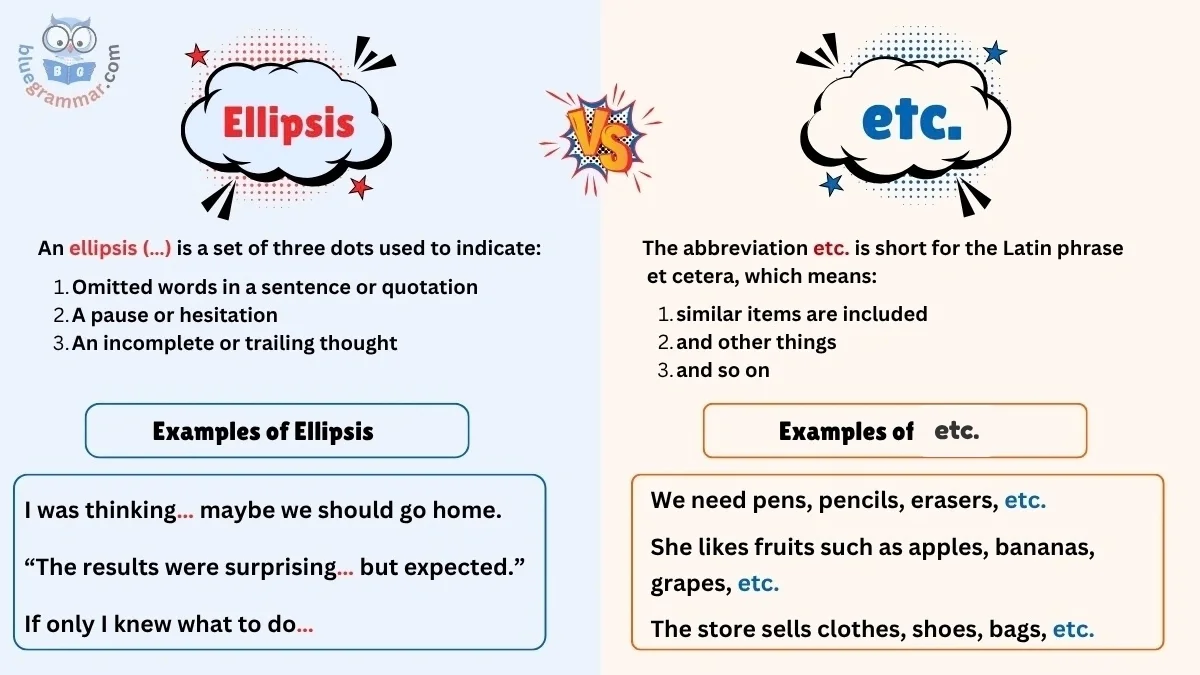
Ellipsis (…) and etc. are both used in English to indicate something is incomplete or not fully listed. However, they are not interchangeable, and many learners confuse their usage in writing.
In this guide, you will clearly understand the difference between an ellipsis and etc., their correct uses, examples, and common mistakes to avoid.
What Is an Ellipsis (…) ?
An ellipsis (…) is a punctuation mark made of three dots. It is used to show that words are missing, a sentence is unfinished, or a speaker is pausing.
It is mainly used in writing style, speech, and quotations, not for listing items.
- Examples:
Pause: “I was thinking… maybe we should go home.”
Omission: “The results were surprising… but expected.”
Unfinished thought: “If only I knew what to do…”
The ellipsis shows pause, omission, or unfinished thought.
What Does “etc.” Mean?
Etc. is short for the Latin phrase “et cetera,” meaning “and other things” or “and so on.”
It is used at the end of a list to show that more similar items exist but are not written.
- Examples:
“We need pens, pencils, erasers, etc.”
“She likes fruits such as apples, bananas, grapes, etc.”
“The store sells clothes, shoes, bags, etc.”
Etc. is used for lists of similar items.
Key Differences Between Ellipsis and Etc.
Ellipsis = thinking or missing words | Etc. = more items in a list
1. Ellipsis for Missing Words
An ellipsis is used when some words are removed from a sentence or quotation without changing its meaning.
- Original: “She was very tired, but she continued working.”
- Shortened: “She was very tired… but she continued working.”
It shows omitted content.
2. etc. for Continuing a List
Etc. is used when you don’t want to list everything in a group of similar items.
- Example: “We need fruits like apples, oranges, bananas, etc.”
It means more fruits are included but not written.
3. Ellipsis for Speech and Emotion
An ellipsis is often used in dialogue to show hesitation or emotion.
- Example: “I don’t know… maybe I was wrong.”
- Example: “Well… I guess it’s fine.”
It creates a natural speaking rhythm.
4. Etc. in Formal Writing
Etc. is more common in:
- Reports
- Academic writing (limited use)
- Informative lists
Example: “The experiment used water, salt, sugar, etc.”
However, in formal academic writing, it is often better to write full lists instead of using “etc.”
5. Can Ellipsis Replace “etc.”?
No, they are not interchangeable.
- ❌ Incorrect: We bought apples, bananas… (wrong if meant as “etc.”)
- ✔ Correct: We bought apples, bananas, etc.
Ellipsis cannot replace etc. in lists.
Common Mistakes to Avoid
- Using Ellipsis for Lists
❌ I like tea, coffee…
✔ I like tea, coffee, etc.
Note: Ellipsis is not for listing items. - Using “etc.” in Sentences
❌ I was tired, etc.
✔ I was tired…
Note: Etc. cannot replace sentence continuation or emotion. - Overusing Both
❌ We bought apples, bananas, etc…
Note: Combining both is unnecessary and grammatically incorrect. - Double Punctuation with “etc.”
❌ etc.. or etc…
✔ etc.
Note: Only one period is used (the period in etc. already includes the abbreviation ending in modern style).
Quick Summary
| Mark | Primary Function | Context |
|---|---|---|
| Ellipsis (…) | Shows pause, omission, or unfinished thought | Sentence / Speech tool |
| Etc. | Means “and so on” in a list | List continuation tool |
Remember: Ellipsis (…) and etc. are not interchangeable!
Conclusion
Ellipsis (…) and etc. may look simple, but they serve completely different purposes in English writing. The ellipsis helps express emotion, pause, or missing words, while etc. is used to shorten lists of similar items.
Understanding this difference will improve both your writing clarity and grammar accuracy. Avoid mixing them, and always choose the correct form based on context.