
Introduction
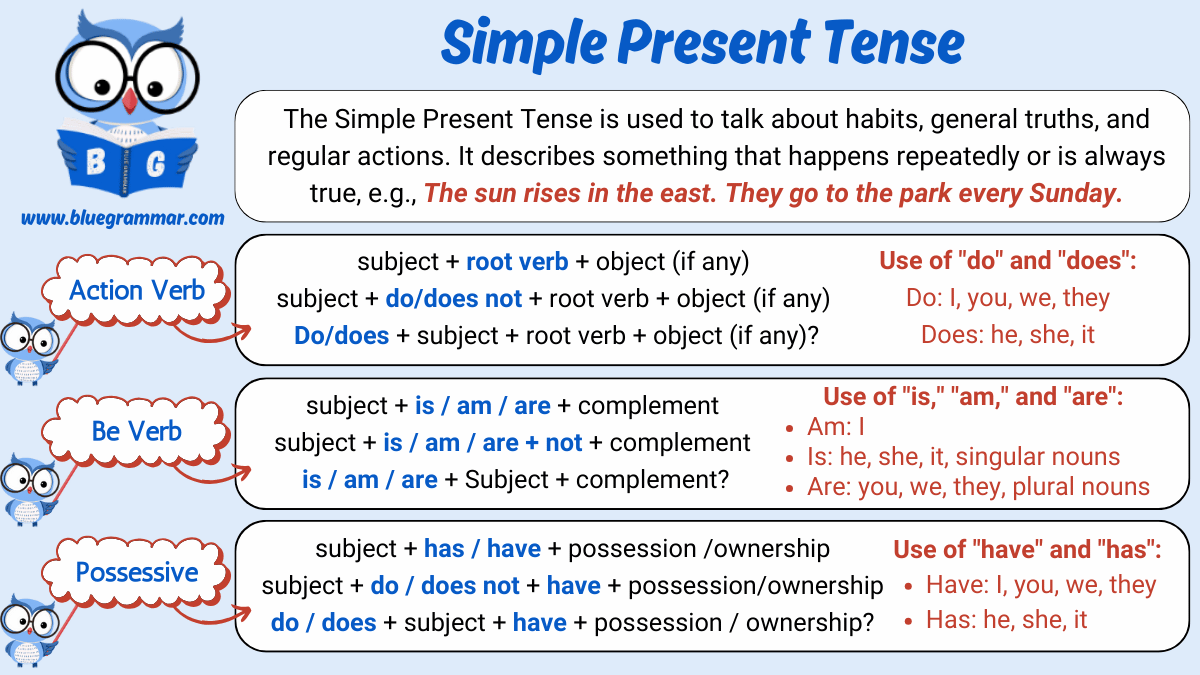
The Present Simple Tense, also known as the Present Indefinite Tense, is one of the most important tenses in English grammar. It is used to describe daily routines, regular habits, general facts, universal truths, permanent situations, and scheduled events. The present simple can be formed in three common ways: with action verbs (e.g., She reads every day.), the verb "to be" (e.g., He is a doctor.), and the verbs "have" and "has" to express possession or relationships (e.g., They have two children.).
Learning all three forms will help you communicate accurately in both spoken and written English. In this comprehensive guide, you will learn the rules, sentence structures, uses, examples, common mistakes, and practice exercises for each form of the Present Simple Tense, along with free printable charts and worksheets to strengthen your understanding.
When Do We Use the Present Simple Tense?
The Present Simple Tense is used to talk about actions, situations, and facts that are regular, permanent, or generally true. It describes things that happen repeatedly or are always true, rather than actions taking place at the moment of speaking. Below are the most common uses of the Present Simple Tense.
1. To Describe Daily Routines
We use the Present Simple Tense to talk about activities that are part of a person's everyday routine.
Examples:
- I wake up at 6:00 a.m. every day.
- She walks to school every morning.
- They eat dinner at 8:00 p.m.
2. To Talk About Habits
The Present Simple is used to describe habits or actions that happen regularly.
Examples:
- He drinks coffee every morning.
- We usually play cricket on weekends.
- My brother always reads before bedtime.
3. To State General Facts
We use the Present Simple to express facts that are generally accepted as true.
Examples:
- Water boils at 100°C.
- Birds build nests.
- Most plants need sunlight to grow.
4. To Express Universal Truths
The Present Simple is used for scientific facts and universal truths that never change.
Examples:
- The Earth revolves around the Sun.
- The Sun rises in the east.
- Ice melts when heated.
5. To Describe Permanent Situations
We use the Present Simple to talk about situations or characteristics that are generally permanent or long-lasting.
Examples:
- She lives in London.
- My father works in a bank.
- They own a small business.
6. To Talk About Fixed Schedules and Timetables
The Present Simple is often used for official schedules, timetables, and planned events.
Examples:
- The train leaves at 7:30 a.m.
- School starts at 8:00 a.m.
- The meeting begins after lunch.
7. To Give Instructions or Directions
The Present Simple is commonly used when giving instructions, recipes, or directions.
Examples:
- Turn left at the traffic lights.
- Mix the flour with water.
- Add two teaspoons of sugar.
8. To Write Headlines or Commentaries
Newspaper headlines, sports commentaries, and live reports often use the Present Simple to make events sound immediate and engaging.
Examples:
- Local Team Wins Championship.
- The referee blows the final whistle.
- The President visits Japan.
Understanding these uses will help you choose the Present Simple Tense correctly in everyday speaking and writing. In the following sections, you will learn how to form positive, negative, and interrogative sentences using action verbs, the verb "to be", and the verbs "have" and "has".
Signal Words of the Present Simple Tense
Signal words are words and phrases that often indicate the use of the Present Simple Tense. They help us recognize that an action happens regularly, repeatedly, or is generally true.
Common Signal Words
The most common signal words used with the Present Simple Tense are:
- Always – She always arrives on time.
- Usually – We usually have breakfast at 7:00 a.m.
- Often – They often visit their grandparents.
- Frequently – He frequently travels for work.
- Sometimes – I sometimes watch documentaries.
- Occasionally – We occasionally eat out on weekends.
- Rarely – She rarely misses a class.
- Seldom – My uncle seldom drives at night.
- Never – He never tells lies.
- Generally – People generally enjoy holidays.
- Normally – The shop normally opens at 9:00 a.m.
Common Time Expressions
The following time expressions are also commonly used with the Present Simple Tense:
- Every day – I exercise every day.
- Every morning – She reads the newspaper every morning.
- Every afternoon – We study every afternoon.
- Every evening – They go for a walk every evening.
- Every night – He checks his emails every night.
- Every week – We visit our grandparents every week.
- Every month – The company publishes a report every month.
- Every year – They travel to the mountains every year.
- On Mondays – Our English class starts on Mondays.
- On weekends – We play football on weekends.
- Once a day – She waters the plants once a day.
- Twice a week – I attend yoga classes twice a week.
- Three times a month – They meet three times a month.
- From time to time – We go hiking from time to time.
Note: Signal words are useful clues that help identify the Present Simple Tense, but they are not required in every sentence. Many Present Simple sentences do not contain signal words because the context already makes the meaning clear.
Forms of the Present Simple Tense
The Present Simple Tense is used in three common forms, depending on the type of verb in the sentence. Each form follows its own sentence structure and is used to express a different meaning.
1. Present Simple with Action Verbs
Action verbs describe what a person, animal, or thing does. They are used to talk about daily routines, habits, repeated actions, general facts, and universal truths.
Examples:
- She reads books every evening.
- They play football on weekends.
- I drink coffee every morning.
2. Present Simple with the Verb "To Be"
The verb "to be" (am, is, are) is used to describe a person's identity, condition, location, profession, or characteristics. Unlike action verbs, it does not describe an action.
Examples:
- I am a teacher.
- He is very helpful.
- They are at home.
3. Present Simple with Have and Has
The verbs have and has are used to express possession, relationships, physical features, and certain conditions or experiences.
Examples:
- She has a new bicycle.
- We have two children.
- I have a headache.
In the following sections, you will learn how to form positive, negative, and interrogative sentences for each of these three forms, along with their rules, structures, and examples.
Present Simple with Action Verbs

The Present Simple Tense is most commonly used with action verbs to describe actions that happen regularly, habits, daily routines, general facts, and universal truths. Action verbs express what a person, animal, or thing does, such as play, read, write, eat, run, and study.
Sentence Structure
Positive Sentences
Structure:
Subject + Base Verb (+ s/es for third-person singular) + Object
Examples:
- I read newspapers every morning.
- We play football on Sundays.
- They watch movies together.
- He reads books every evening.
- She studies English every day.
- It barks loudly at strangers.
Negative Sentences
Structure:
Subject + do/does + not + Base Verb + Object
- Use "do not (don't)" with I, you, we, and they.
- Use "does not (doesn't)" with he, she, and it.
Examples:
- I do not drink coffee.
- They do not watch television at night.
- We do not eat fast food every day.
- He does not play cricket.
- She does not study on Sundays.
- It does not make any noise.
Interrogative Sentences
Structure:
Do/Does + Subject + Base Verb + Object?
Examples:
- Do you play football?
- Do they live in Karachi?
- Do we have enough time?
- Does he speak English?
- Does she work in a hospital?
- Does it rain often here?
Rules for Adding s/es
In positive sentences, the base verb remains unchanged with I, you, we, and they. However, when the subject is he, she, it, or a singular noun, the verb usually takes -s or -es.
Rule 1: Add -s to Most Verbs
Simply add -s to the base verb.
Examples:
- play → plays
- read → reads
- work → works
- drink → drinks
- open → opens
Rule 2: Add -es to Verbs Ending in -ch, -sh, -ss, -x, -z, or -o
Examples:
- watch → watches
- wash → washes
- pass → passes
- fix → fixes
- buzz → buzzes
- go → goes
- do → does
Rule 3: Change -y to -ies
If a verb ends in a consonant + y, change y to i and add -es.
Examples:
- study → studies
- carry → carries
- cry → cries
- try → tries
- fly → flies
Rule 4: Keep -y Before Adding -s
If a verb ends in a vowel + y, simply add -s.
Examples:
- play → plays
- enjoy → enjoys
- stay → stays
- buy → buys
- obey → obeys
Remember: The -s or -es ending is added only in positive sentences with he, she, it, or a singular noun. In negative and interrogative sentences, the main verb always returns to its base form because does already carries the third-person singular marker.
Examples:
- He plays football.
- He does not play football.
- Does he play football?
Present Simple with the Verb " To Be"

The verb "to be" is one of the most commonly used verbs in English. In the Present Simple Tense, it is used to describe a person's identity, profession, condition, feelings, location, age, or characteristics. Unlike action verbs, the verb "to be" does not describe an action. Instead, it tells us what someone or something is.
The Present Simple forms of "to be" are:
- am – used with I
- is – used with he, she, it, and singular nouns
- are – used with you, we, they, and plural nouns
Positive Sentences
Structure:
Subject + am/is/are + Complement
The complement may be a noun, pronoun, adjective, or prepositional phrase.
Examples:
- I am a teacher.
- She is very intelligent.
- He is my brother.
- They are students.
- We are ready.
- The books are on the table.
Negative Sentences
Structure:
Subject + am/is/are + not + Complement
Examples:
- I am not tired.
- He is not at home.
- She is not a doctor.
- We are not busy today.
- They are not interested.
- The children are not in the classroom.
Interrogative Sentences
Structure:
Am/Is/Are + Subject + Complement?
Unlike action verbs, do and does are not used with the verb "to be".
Examples:
- Am I late?
- Is she your teacher?
- Is he at work?
- Are you ready?
- Are they your friends?
- Are the children in the garden?
Common Uses of the Verb "To Be"
The Present Simple form of "to be" is commonly used to:
Describe identity:
- She is a doctor.
Describe a profession or occupation:
- My father is an engineer.
Describe feelings or conditions:
- I am happy.
- They are tired.
Describe characteristics:
- The weather is pleasant.
- He is honest.
Describe location:
- The books are on the shelf.
- She is at school.
State age:
- My sister is twelve years old.
Remember: The verb "to be" has its own forms (am, is, are) and does not use do or does to make negative or interrogative sentences.
Present Simple with Has and Have

The verbs have and has are used in the Present Simple Tense to express possession, relationships, physical characteristics, illnesses, experiences, and other states. They indicate what someone owns, possesses, or experiences in the present.
Use have with: I, you, we, and they.
Use has with: he, she, it, and singular nouns.
Positive Sentences
Structure:
Subject + have/has + Object or Complement
Examples:
- I have a new laptop.
- We have enough time.
- They have three children.
- She has a beautiful garden.
- He has a driving licence.
- The company has many employees.
Negative Sentences
Structure:
Subject + do/does + not + have + Object or Complement
- Use do not (don't) with I, you, we, and they.
- Use does not (doesn't) with he, she, it, and singular nouns.
Examples:
- I do not have any questions.
- We do not have enough money.
- They do not have a car.
- She does not have a passport.
- He does not have a mobile phone.
- The school does not have a library.
Interrogative Sentences
Structure:
Do/Does + Subject + have + Object or Complement?
Examples:
- Do you have a pen?
- Do they have any homework?
- Do we have enough time?
- Does she have a bicycle?
- Does he have a younger brother?
- Does the hotel have a swimming pool?
Common Uses of Have and Has
The Present Simple forms have and has are commonly used to:
Express possession:
- She has a new car.
- We have a large house.
Describe family relationships:
- I have two sisters.
- He has a caring father.
Describe physical features:
- She has long black hair.
- The dog has a short tail.
Talk about illnesses or health conditions:
- I have a headache.
- She has a fever.
Describe qualities or characteristics:
- He has a great sense of humor.
- They have excellent communication skills.
Remember: In the Present Simple Tense, have changes to has only in positive sentences with he, she, it, and singular nouns. In negative and interrogative sentences, always use the base form have after do or does.
Examples:
- She has a bicycle.
- She does not have a bicycle.
- Does she have a bicycle?
Examples of Present Simple Tense
The following examples demonstrate how the Present Simple Tense is used in different situations. They include sentences with action verbs, the verb "to be", and the verbs "have" and "has".
Daily Routines
- I wake up at 6:00 a.m. every day.
- She brushes her teeth after breakfast.
- We leave for school at 8:00 a.m.
- He drinks coffee every morning.
- They go to bed early.
Habits
- She reads a book before bedtime.
- We usually play football on Saturdays.
- He always arrives on time.
- I sometimes watch documentaries.
- They never miss their English class.
General Facts
- Water boils at 100°C.
- Birds build nests.
- Most plants need sunlight to grow.
- Fish live in water.
- The moon reflects the Sun's light.
Universal Truths
- The Earth revolves around the Sun.
- The Sun rises in the east.
- Gravity pulls objects toward the Earth.
- Ice melts when heated.
- Air contains oxygen.
Permanent Situations
- My parents live in Lahore.
- She works for a software company.
- They own a grocery store.
- I study at a local college.
- He speaks three languages.
Fixed Schedules and Timetables
- The train leaves at 7:30 a.m.
- School starts at 8:00 a.m.
- The meeting begins at 10:00 a.m.
- The library opens at 9:00 a.m.
- The bus arrives every thirty minutes.
Examples with the Verb "To Be"
- I am a student.
- She is very kind.
- He is at work.
- We are ready for the exam.
- They are good friends.
Examples with Have and Has
- I have a new laptop.
- She has two brothers.
- We have enough time.
- He has a beautiful garden.
- They have a meeting this afternoon.
Common Mistakes in the Present Simple Tense
Learners often make mistakes when using the Present Simple Tense, especially with third-person singular verbs, do/does, and the verb "to be." Understanding these common errors will help you write and speak English more accurately.
1. Forgetting to Add -s or -es
When the subject is he, she, it, or a singular noun, the main verb takes -s or -es in positive sentences.
He play football every Sunday.- He plays football every Sunday.
She watch television every evening.- She watches television every evening.
2. Using Does with a Verb Ending in -s
After does, always use the base form of the verb.
She does likes coffee.- She does like coffee.
Does he plays cricket?- Does he play cricket?
3. Using Do Instead of Does
Use does with he, she, it, and singular nouns.
Do she speak English?- Does she speak English?
Do your brother work here?- Does your brother work here?
4. Using the Wrong Form of the Verb "To Be"
Choose the correct form: am, is, or are.
She are happy.- She is happy.
They is ready.- They are ready.
I is tired.- I am tired.
5. Using Do/Does with the Verb "To Be"
The verb "to be" forms questions and negatives without do or does.
Does he is a doctor?- Is he a doctor?
She doesn't is at home.- She isn't at home. (or) She is not at home.
6. Using Have Instead of Has
Use has with he, she, it, and singular nouns.
She have a new bicycle.- She has a new bicycle.
My father have a car.- My father has a car.
7. Using Has After Does
After does, always use the base form have.
Does she has a laptop?- Does she have a laptop?
He doesn't has enough money.- He doesn't have enough money.
8. Omitting the Subject
Every Present Simple sentence requires a subject.
Goes to school every day.- He goes to school every day.
Is very friendly.- She is very friendly.
Tip: Before writing or speaking in the Present Simple Tense, always check:
Is the subject he, she, it, or a singular noun?
If yes, add -s/-es to the main verb in positive sentences.
Are you using do or does correctly?
If the sentence uses am, is, or are, do not use do or does.
After do or does, always use the base form of the verb.
Practice Exercise
Test your understanding of the Present Simple Tense by completing the following exercises. Check your answers after completing all the questions.
Exercise 1: Fill in the Blanks
Complete each sentence with the correct form of the verb in brackets.
- She ________ to school every day. (walk)
- They ________ football on Sundays. (play)
- He ________ a new bicycle. (have)
- I ________ very happy today. (be)
- The train ________ at 8:00 a.m. (leave)
- We ________ coffee every morning. (drink)
- My father ________ in a bank. (work)
- The children ________ in the garden. (be)
- She ________ her homework after dinner. (do)
- Birds ________ nests in trees. (build)
Exercise 2: Make the Sentences Negative
Rewrite the following sentences in the negative form.
- She likes ice cream.
- They have a pet dog.
- He is a teacher.
- We play cricket every weekend.
- The shop opens at 9:00 a.m.
Exercise 3: Change the Sentences into Questions
Rewrite the following sentences as interrogative sentences.
- She speaks English fluently.
- He has a new laptop.
- They are ready for the meeting.
- You like chocolate.
- The bus arrives on time.
Exercise 4: Correct the Mistakes
Find and correct the mistake in each sentence.
- She don't like coffee.
- He go to school every day.
- Does she has a passport?
- They is my classmates.
- I am have two sisters.
Tip: Try to complete the exercises without looking at the rules. Once you finish, compare your answers with the explanations or continue practicing with our free printable Present Simple worksheets for extra practice.
Summary
The Present Simple Tense, also known as the Present Indefinite Tense, is used to describe daily routines, habits, general facts, universal truths, permanent situations, and fixed schedules. It has three common forms: action verbs, the verb "to be" (am, is, are), and the verbs "have" and "has". By learning the correct sentence structures, understanding when to use each form, and practicing with examples and worksheets, you can use the Present Simple Tense accurately and confidently in both spoken and written English.
Download Free Present Simple Worksheets
Strengthen your understanding of the Present Simple Tense with our free printable worksheets. These worksheets are designed for students, teachers, and parents and include a variety of exercises to help you practice sentence formation and verb usage.
You can download and print the worksheets for classroom activities, homework, self-study, or revision.
Visit our page Present Tense Worksheets to download A4 size printable worksheets.