
Introduction
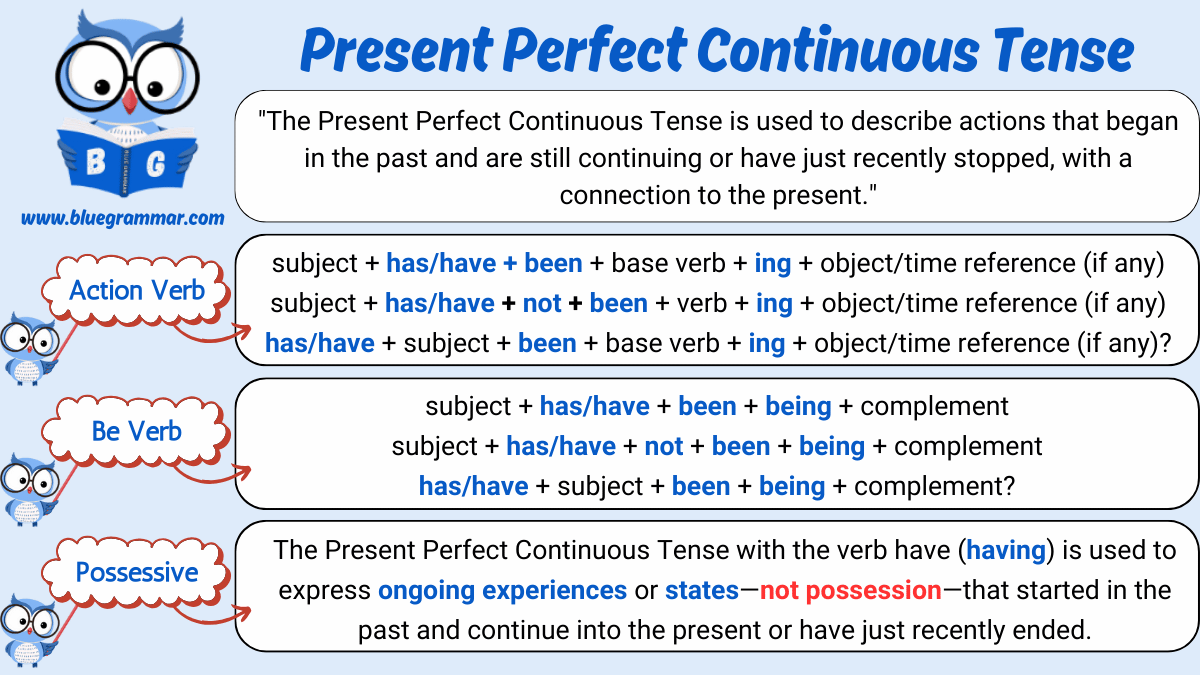
The Present Perfect Continuous Tense, also known as the Present Perfect Progressive Tense, is used to describe actions that began in the past and are still continuing in the present or have recently stopped but still have visible results. It emphasizes the duration or continuity of an action rather than simply its completion.
The Present Perfect Continuous Tense is formed using the helping verbs has been or have been followed by the present participle (verb + -ing) of the main verb. For example, I have been studying English for two hours, She has been working all day, and They have been playing football since morning.
In this complete guide, you will learn when to use the Present Perfect Continuous Tense, its sentence structures, signal words, rules for forming -ing verbs, common mistakes, examples, practice exercises, and free printable worksheets to help you master this important English tense.
What Is the Present Perfect Continuous Tense?
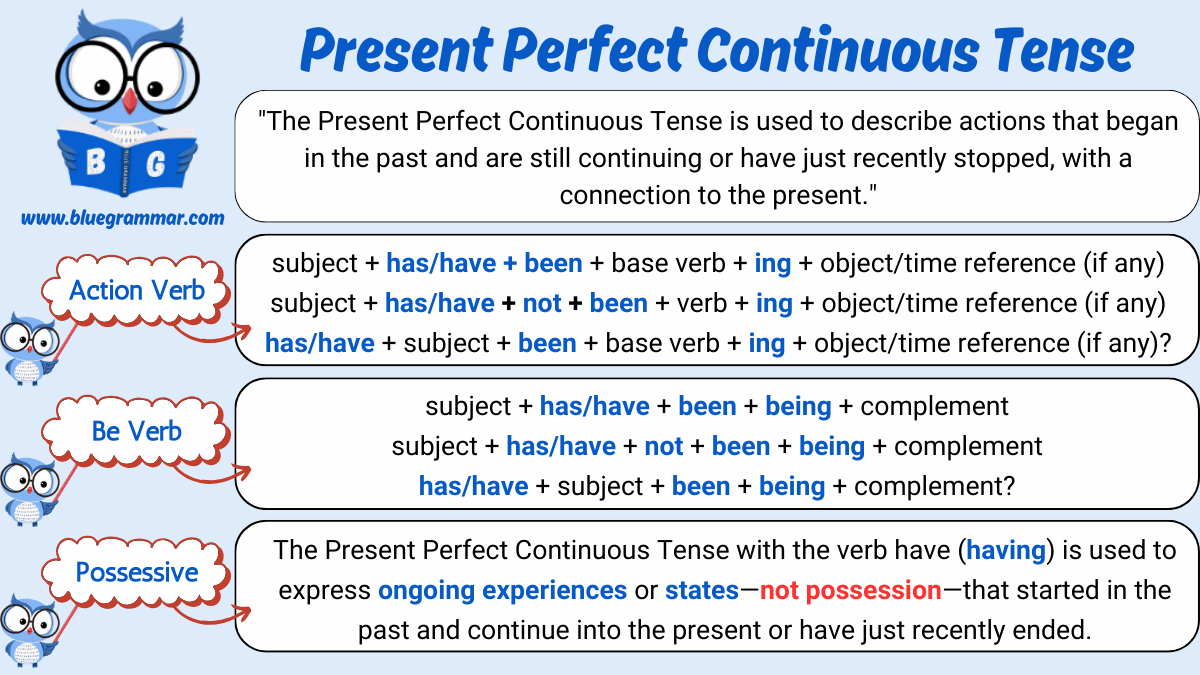
The Present Perfect Continuous Tense, also called the Present Perfect Progressive Tense, is used to describe actions that started in the past and are still continuing in the present or have recently stopped but still have a connection to the present. It emphasizes the duration or ongoing nature of an action rather than its completion.
This tense is formed by using the helping verbs has been or have been followed by the present participle (verb + -ing) of the main verb.
Structure:
Subject + has/have + been + verb (-ing) + object (if any)
Examples:
- I have been studying English for two hours.
- She has been working since morning.
- They have been playing football all afternoon.
- We have been waiting for the bus.
- He has been reading a novel.
The Present Perfect Continuous Tense is commonly used with time expressions such as for, since, all day, all morning, recently, and lately because these words emphasize how long an action has been happening.
This tense is widely used in both spoken and written English to describe ongoing activities, repeated actions over a period of time, and situations whose effects are still visible in the present.
When Do We Use the Present Perfect Continuous Tense?
The Present Perfect Continuous Tense is used to describe actions that began in the past and are still continuing, actions that have recently stopped but have present results, repeated actions over a period of time, and ongoing situations. It emphasizes the duration or continuity of an action rather than its completion.
1. Actions That Started in the Past and Continue to the Present
Use the Present Perfect Continuous Tense to describe actions that began in the past and are still happening now.
Examples:
- I have been studying English for three years.
- She has been working here since 2022.
- They have been living in Karachi for five years.
- We have been waiting for the bus since 8:00 a.m.
- He has been teaching at this school for ten years.
2. Actions That Have Recently Stopped but Have Present Results
Use the Present Perfect Continuous Tense to describe actions that have just finished but whose results can still be seen or felt.
Examples:
- She has been crying. Her eyes are red.
- I have been running, so I am tired.
- They have been painting the house. It still smells of paint.
- He has been cooking, and the kitchen is messy.
- We have been cleaning the classroom. It looks much better now.
3. Repeated Actions Over a Period of Time
Use the Present Perfect Continuous Tense for actions that have happened repeatedly from the past until now.
Examples:
- I have been calling you all morning.
- She has been practicing the piano every day.
- They have been visiting their grandparents regularly.
- We have been meeting every Friday.
- He has been asking the same question repeatedly.
4. Ongoing Temporary Situations
Use the Present Perfect Continuous Tense to describe temporary situations that started in the past and are still continuing.
Examples:
- I have been staying with my uncle this month.
- She has been working from home recently.
- They have been using a temporary office.
- We have been living in a rented apartment.
- He has been driving his brother's car for a few weeks.
5. Emphasizing the Duration of an Action
Use the Present Perfect Continuous Tense when you want to focus on how long an action has been happening rather than whether it has finished.
Examples:
- I have been reading this book for two hours.
- She has been studying since early morning.
- They have been playing football all afternoon.
- We have been discussing the project for several days.
- He has been exercising every evening this month.
Remember: The Present Perfect Continuous Tense emphasizes the duration or continuity of an action. If you want to emphasize the completion or result of an action instead, the Present Perfect Tense is usually the better choice.
Signal Words of the Present Perfect Continuous Tense
Signal words help identify when the Present Perfect Continuous Tense should be used. These words and phrases usually indicate that an action started in the past and is still continuing, has recently stopped with a present result, or emphasizes the duration of an action.
Common Signal Words Include:
- For – I have been studying for three hours.
- Since – She has been working here since 2022.
- All day – They have been playing football all day.
- All morning – He has been cleaning the house all morning.
- All afternoon – We have been discussing the project all afternoon.
- All evening – She has been practicing the piano all evening.
- Lately – I have been feeling tired lately.
- Recently – They have been traveling a lot recently.
- So far – We have been making good progress so far.
- These days – He has been working from home these days.
- This week – She has been preparing for her exams this week.
- This month – I have been reading several grammar books this month.
- Until now – They have been waiting until now.
- How long – How long have you been learning English?
Remember: Signal words are helpful clues, but they do not determine the tense by themselves. Always consider whether the action began in the past and continues to the present or has recently ended with a present result.
Forms of the Present Perfect Continuous Tense
The Present Perfect Continuous Tense is commonly used in three forms, depending on the type of verb and the meaning of the sentence. Each form follows a different sentence structure and is used in specific situations.
1. Present Perfect Continuous Tense with Action Verbs
Action verbs describe activities that begin in the past and continue to the present or have recently stopped with visible results. This is the most common form of the Present Perfect Continuous Tense.
Examples:
- She has been reading a book for two hours.
- They have been playing football since morning.
- I have been studying English all week.
2. Present Perfect Continuous with the Verb "To Be"
The verb "to be" can be used in the Present Perfect Continuous Tense as been being. Although this structure is grammatically correct, it is rarely used in everyday English. It is mainly used to describe temporary behavior or situations that have continued over a period of time.
Examples:
- She has been being very patient lately.
- He has been being unusually polite.
- They have been being cooperative throughout the project.
3. Present Perfect Continuous with the Verbs "Have" and "Has"
The verbs have and has can also appear in the Present Perfect Continuous Tense as have been having or has been having. This structure is generally used only when have describes activities, experiences, meals, meetings, or temporary situations. It is not normally used to express possession or ownership.
Examples:
- She has been having piano lessons for six months.
- We have been having meetings every Monday.
- They have been having a wonderful time on vacation.
Note: In the following sections, you will learn how to form positive, negative, and interrogative sentences for each of these three forms, along with their rules, sentence structures, and examples.
Forming the Present Participle (-ing Form)
The Present Perfect Continuous Tense uses the present participle (verb + -ing) after has been or have been. To form the -ing form correctly, follow these spelling rules.
1. Most Verbs: Add -ing
Simply add -ing to the base verb.
Examples:
- read → reading
- play → playing
- work → working
- learn → learning
- speak → speaking
2. Verbs Ending in -e: Drop the e and Add -ing
If a verb ends with a silent e, remove the e before adding -ing.
Examples:
- write → writing
- make → making
- drive → driving
- come → coming
- dance → dancing
Exception: Keep the e if the verb ends in -ee, -ye, or -oe.
Examples:
- see → seeing
- agree → agreeing
- dye → dyeing
3. Verbs Ending in -ie: Change -ie to -y and Add -ing
Examples:
- lie → lying
- die → dying
- tie → tying
4. One-Syllable Verbs Ending in Consonant–Vowel–Consonant (CVC)
Double the final consonant before adding -ing.
Examples:
- run → running
- sit → sitting
- stop → stopping
- swim → swimming
- get → getting
5. Two-Syllable Verbs with Stress on the Last Syllable
Double the final consonant before adding -ing.
Examples:
- begin → beginning
- prefer → preferring
- admit → admitting
Do not double the final consonant if the stress is not on the last syllable.
Examples:
- open → opening
- visit → visiting
- happen → happening
Present Perfect Continuous Tense with Action Verbs
The Present Perfect Continuous Tense is most commonly used with action verbs to describe actions that started in the past and are still continuing, have recently stopped with present results, or emphasize the duration of an activity.
Action verbs describe physical or mental activities, such as read, write, play, eat, study, work, and exercise. In the Present Perfect Continuous Tense, these verbs are used with the helping verbs has been or have been followed by the present participle (verb + -ing).

For example:
- She has been reading a book for two hours.
- They have been playing football since morning.
- I have been studying English all week.
Making Positive Sentences
Structure:
Subject + has/have + been + verb (-ing) + object (if any)
Examples with Object:
- She has been reading a book.
- They have been playing football.
- We have been watching a movie.
Examples without Object:
- He has been sleeping.
- I have been running.
- The birds have been flying.
Making Negative Sentences
Structure:
Subject + has/have + not + been + verb (-ing) + object (if any)
Examples with Object:
- She has not been reading a book.
- We have not been watching television.
- He has not been writing an email.
Examples without Object:
- I have not been sleeping.
- They have not been running.
- The baby has not been crying.
Making Interrogative Sentences
Structure:
Has/Have + subject + been + verb (-ing) + object (if any)?
Examples with Object:
- Has she been reading a book?
- Have they been playing football?
- Have you been watching the news?
Examples without Object:
- Have I been speaking too fast?
- Has he been sleeping?
- Have the children been laughing?
Remember: The Present Perfect Continuous Tense is generally used with action verbs. Many stative verbs, such as know, believe, like, love, understand, own, and belong, are not normally used in the continuous form because they describe states rather than actions.
Present Perfect Continuous with the Verb "To Be"
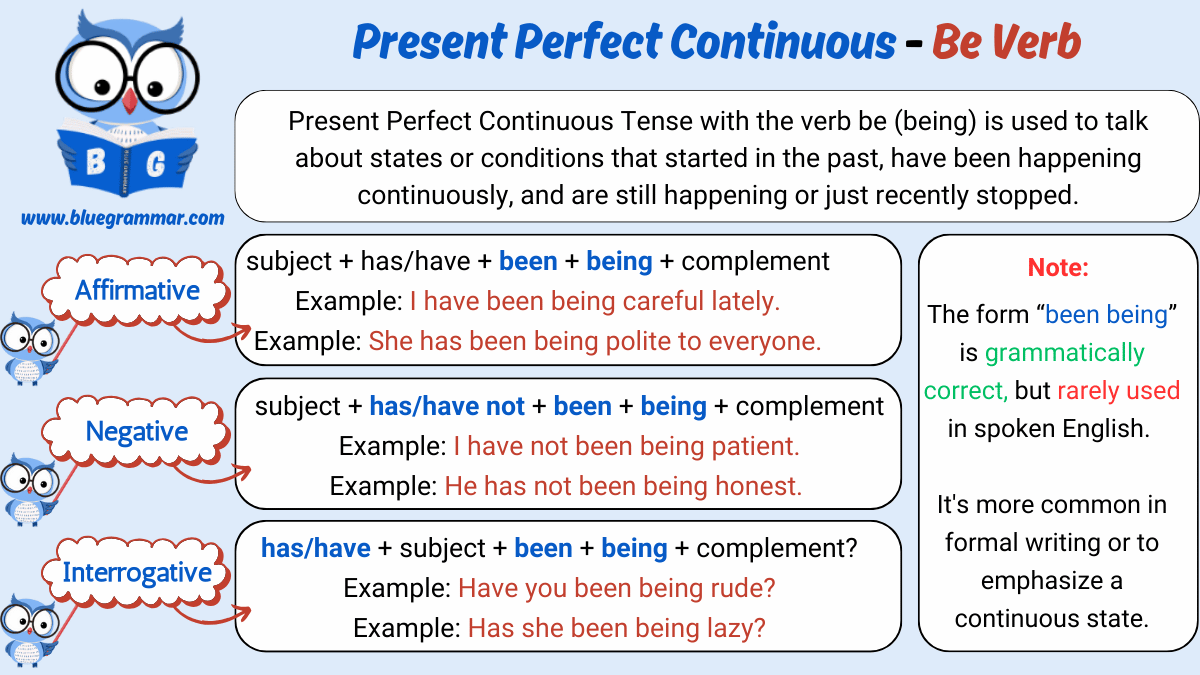
The verb "to be" can be used as the main verb in the Present Perfect Continuous Tense. In this case, it appears as been being after the helping verbs has or have.
Although this structure is grammatically correct, it is rarely used in everyday English. Native speakers usually choose simpler sentence structures unless they want to emphasize that someone's temporary behavior or attitude has continued over a period of time.
For example:
- She has been being very patient during the training.
- He has been being unusually polite lately.
- They have been being cooperative throughout the project.
- I have been being more careful with my work.
- We have been being supportive of each other.
When Do We Use Been Being?
Use been being only in limited situations to describe:
- Temporary behavior that has continued over a period of time
- A person's attitude or manner that has lasted until now
- Behavior that is unusual or different from normal
- Temporary conduct that is still continuing or has recently ended
Making Positive Sentences
Structure:
Subject + has/have + been + being + complement
Examples:
- She has been being very patient.
- He has been being unusually kind.
- They have been being respectful to everyone.
- I have been being more confident lately.
- We have been being careful with our expenses.
Making Negative Sentences
Structure:
Subject + has/have + not + been + being + complement
Examples:
- She has not been being honest.
- He has not been being cooperative.
- They have not been being respectful.
- I have not been being patient recently.
- We have not been being careful enough.
Making Interrogative Sentences
Structure:
Has/Have + subject + been + being + complement?
Examples:
- Has she been being patient?
- Have they been being helpful?
- Have you been being honest?
- Has he been being respectful?
- Have we been being fair to everyone?
Remember: The structure has/have been being is grammatically correct but uncommon. In everyday English, native speakers often use the Present Perfect Tense or the Present Perfect Continuous Tense with action verbs instead. Use been being only when you specifically want to emphasize that a person's temporary behavior or attitude has continued over a period of time.
Present Perfect Continuous with the Verbs "Have" and "Has"
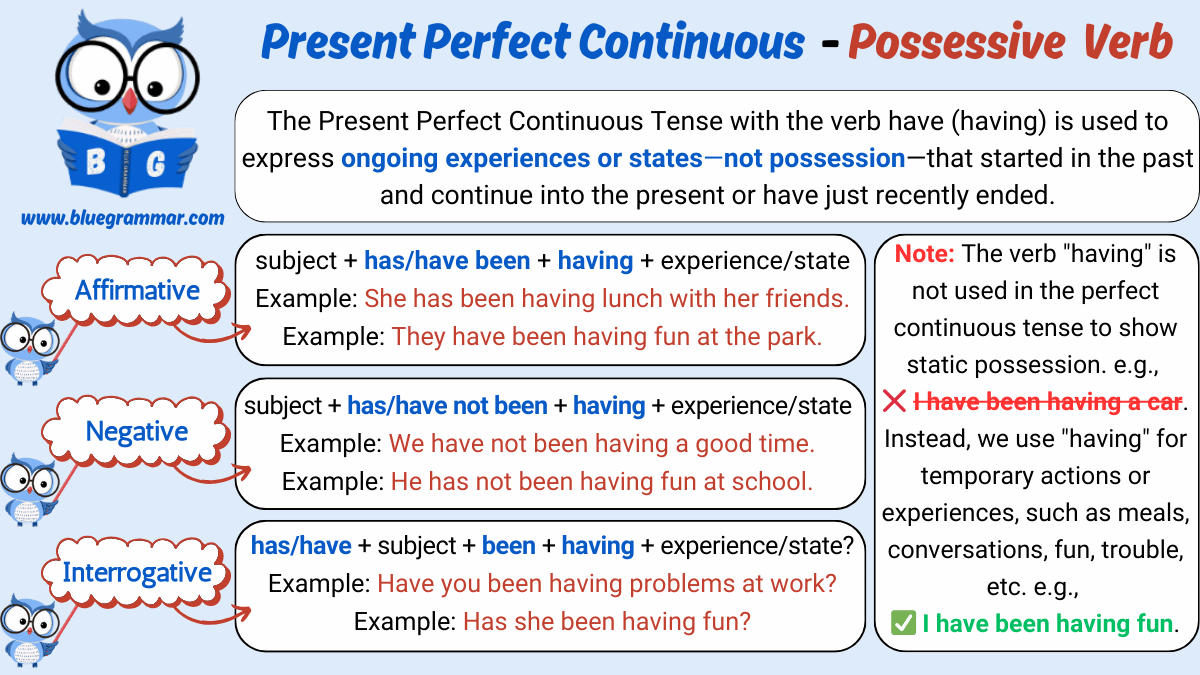
The verbs have and has can also be used as the main verb in the Present Perfect Continuous Tense. In this case, they appear as have been having or has been having.
Although this structure is grammatically correct, it is generally used only when have describes activities, experiences, meals, meetings, lessons, or temporary situations. It is not normally used to express possession, ownership, family relationships, or permanent characteristics.
When Do We Use Have Been Having or Has Been Having?
Use these structures to describe:
- Meals or drinks over a period of time
- Meetings, lessons, or discussions that continue over time
- Experiences or temporary situations
- Repeated activities involving have
Examples:
- I have been having breakfast later than usual this week.
- She has been having piano lessons for six months.
- They have been having meetings every Monday.
- We have been having a wonderful time on vacation.
- He has been having trouble sleeping lately.
Making Positive Sentences
Structure:
Subject + has/have + been + having + object
Examples:
- She has been having English lessons.
- They have been having regular meetings.
- We have been having dinner together every weekend.
- I have been having a great time.
- He has been having difficulty concentrating.
Making Negative Sentences
Structure:
Subject + has/have + not + been + having + object
Examples:
- She has not been having breakfast regularly.
- We have not been having meetings this month.
- They have not been having any problems recently.
- I have not been having enough sleep.
- He has not been having much success lately.
Making Interrogative Sentences
Structure:
Has/Have + subject + been + having + object?
Examples:
- Have you been having English lessons?
- Has she been having lunch at the office?
- Have they been having regular meetings?
- Have we been having enough practice?
- Has he been having any difficulties?
Remember: Do not use have been having or has been having to express possession or ownership.
She has been having a new car for two years.- She has had a new car for two years.
They have been having three children.- They have three children.
Use have been having only when have describes an activity, experience, or temporary situation that has continued over a period of time.
Present Perfect Continuous vs. Present Perfect
The Present Perfect Continuous Tense and the Present Perfect Tense are closely related because both connect the past with the present. However, they are used for different purposes. The Present Perfect Continuous emphasizes the duration or continuity of an action, while the Present Perfect emphasizes the completion or result of an action.
When to Use the Present Perfect Continuous Tense
Use the Present Perfect Continuous Tense when you want to focus on how long an action has been happening or to show that it is still continuing or has recently stopped with visible results.
Examples:
- I have been studying for three hours.
- She has been working since morning.
- They have been playing football all afternoon.
- We have been waiting for the bus for thirty minutes.
- He has been painting the wall, so his clothes are dirty.
When to Use the Present Perfect Tense
Use the Present Perfect Tense when you want to emphasize that an action has been completed or when the result of the action is more important than its duration.
Examples:
- I have finished my homework.
- She has written three emails.
- They have completed the project.
- We have cleaned the classroom.
- He has repaired the bicycle.
Compare the Sentences
- I have been reading for two hours. (Focus on the duration of the activity.)
- I have read three chapters. (Focus on the completed result.)
- She has been cooking since 6:00 p.m. (She is still cooking or has just finished.)
- She has cooked dinner. (The dinner is ready.)
- They have been painting the house all week. (The activity is emphasized.)
- They have painted the house. (The job is complete.)
- We have been waiting for an hour. (The waiting continues or has just ended.)
- We have waited long enough. (The result or conclusion is emphasized.)
Remember: Many verbs can be used in both tenses, but the meaning changes depending on what you want to emphasize. Use the Present Perfect Continuous Tense to highlight the duration or ongoing nature of an action, and use the Present Perfect Tense to highlight its completion, achievement, or result.
Examples of the Present Perfect Continuous Tense
The following examples demonstrate how the Present Perfect Continuous Tense is used in different situations. They include sentences with action verbs, actions that continue to the present, recently completed actions with present results, and the verbs "to be", "have", and "has".
Actions That Continue to the Present
- I have been studying English for three years.
- She has been working here since 2022.
- We have been living in Lahore for five years.
- He has been teaching at this school since January.
- They have been waiting for the bus for thirty minutes.
Recently Completed Actions with Present Results
- I have been running, so I am tired.
- She has been crying, and her eyes are red.
- We have been painting the house, so our clothes are dirty.
- He has been cooking, and the kitchen is messy.
- They have been playing football, so they are exhausted.
Repeated Actions Over a Period of Time
- I have been calling you all morning.
- She has been practicing the piano every evening.
- We have been meeting every Friday.
- He has been asking the same question repeatedly.
- They have been visiting their grandparents regularly.
Temporary Situations
- I have been staying with my cousin this month.
- She has been working from home recently.
- We have been using a temporary office.
- He has been driving his brother's car for a few weeks.
- They have been living in a rented apartment since April.
Emphasizing the Duration of an Action
- I have been reading this novel for two hours.
- She has been studying since early morning.
- We have been discussing the project all afternoon.
- He has been exercising every evening this month.
- They have been learning English for several years.
Examples with the Verb "To Be"
- I have been being more careful lately.
- She has been being very patient with the children.
- He has been being unusually polite.
- We have been being supportive of one another.
- They have been being cooperative throughout the project.
Examples with Have and Has
- I have been having breakfast later than usual this week.
- She has been having piano lessons for six months.
- We have been having meetings every Monday.
- He has been having trouble sleeping lately.
- They have been having a wonderful time on vacation.
Note: The Present Perfect Continuous Tense is mainly used with action verbs. Although structures such as has/have been being and has/have been having are grammatically correct, they are uncommon in everyday English and are used only in specific situations to emphasize ongoing temporary behavior, activities, or experiences.
Common Mistakes in the Present Perfect Continuous Tense
Learners often make mistakes when using the Present Perfect Continuous Tense, especially with the helping verbs has and have, the word been, the -ing form of verbs, and the difference between the Present Perfect Continuous and the Present Perfect Tense. Understanding these common errors will help you use the tense correctly in both spoken and written English.
1. Forgetting the Word "Been"
Every Present Perfect Continuous sentence requires been after has or have.
She has studying English for two hours.- She has been studying English for two hours.
They have working all day.- They have been working all day.
2. Using the Base Form Instead of the -ing Form
The main verb must always be in the -ing form.
He has been write a letter.- He has been writing a letter.
We have been play football.- We have been playing football.
3. Using the Wrong Helping Verb
Use has with singular third-person subjects and have with I, you, we, and they.
She have been studying.- She has been studying.
They has been waiting.- They have been waiting.
I has been reading.- I have been reading.
4. Using Stative Verbs in the Continuous Form
Many stative verbs describe states, feelings, opinions, possession, or knowledge and are not normally used in the Present Perfect Continuous Tense.
I have been knowing him for years.- I have known him for years.
She has been liking chocolate.- She has liked chocolate since childhood.
They have been owning this house for ten years.- They have owned this house for ten years.
5. Using For and Since Incorrectly
Use for with a period of time and since with a starting point.
I have been studying since three hours.- I have been studying for three hours.
She has been working for 2022.- She has been working since 2022.
6. Confusing the Present Perfect Continuous with the Present Perfect
Use the Present Perfect Continuous to emphasize the duration of an action and the Present Perfect to emphasize its completion or result.
I have been finishing my homework.- I have finished my homework.
- I have been doing my homework for two hours.
7. Forgetting to Change the Word Order in Questions
In interrogative sentences, place has or have before the subject.
She has been studying English?- Has she been studying English?
They have been waiting for long?- Have they been waiting for long?
8. Incorrect Spelling of -ing Verbs
Follow the spelling rules when adding -ing to verbs.
He has been makeing dinner.- He has been making dinner.
She has been runing every morning.- She has been running every morning.
Tip: Before writing or speaking in the Present Perfect Continuous Tense, check that:
- You have used the correct helping verb (has or have).
- You have included the word been.
- The main verb is in the -ing form.
- You have used for and since correctly.
- You are not using stative verbs in the continuous form unless they have a special meaning.
- Questions begin with Has or Have.
Practice Exercise
Test your understanding of the Present Perfect Continuous Tense by completing the following exercises. Try to answer each question without looking at the rules. Once you finish, check your answers and identify any mistakes.
Exercise 1: Fill in the Blanks
Complete each sentence with the correct form of the verb in brackets.
- She __________ English for three years. (study)
- They __________ football since morning. (play)
- I __________ for the bus for twenty minutes. (wait)
- He __________ very hard recently. (work)
- We __________ our project all week. (prepare)
- The children __________ outside since lunch. (play)
- My father __________ the garden this afternoon. (clean)
- The students __________ for the final exam since Monday. (practice)
- She __________ piano lessons for six months. (have)
- The weather __________ colder lately. (become)
Exercise 2: Make the Sentences Negative
Rewrite the following sentences in the negative form.
- She has been reading a novel.
- They have been having meetings every Monday.
- He has been working since morning.
- We have been waiting for the train.
- I have been learning English for two years.
Exercise 3: Change the Sentences into Questions
Rewrite the following sentences as interrogative sentences.
- She has been writing an email.
- They have been playing cricket.
- He has been having piano lessons.
- We have been living in this city for five years.
- The children have been making too much noise.
Exercise 4: Correct the Mistakes
Find and correct the mistake in each sentence.
- She has studying English since January.
- They has been working all day.
- He has been writeing a letter.
- I have been knowing him for many years.
- Have you been study for the exam?
Tip: The Present Perfect Continuous Tense is formed with has or have, followed by been and the -ing form of the main verb. Pay special attention to the correct helping verb, the word been, spelling rules for -ing verbs, and the proper use of for and since while completing these exercises.
Short Summary
The Present Perfect Continuous Tense is used to describe actions that started in the past and continue to the present, actions that have recently stopped with visible results, repeated actions over a period of time, and ongoing temporary situations. It is formed using has/have + been + verb (-ing). By learning its rules, sentence structures, signal words, spelling rules, common mistakes, and practicing with examples and worksheets, you can use the Present Perfect Continuous Tense accurately and confidently in everyday English.
Download Free Present Perfect Continuous Worksheets
Improve your understanding of the Present Perfect Continuous Tense with our free printable worksheets. These worksheets are designed for students, teachers, parents, and ESL/EFL learners and provide a variety of exercises to strengthen your grammar skills.
You can download and print the worksheets for classroom activities, homework, self-study, revision, test preparation, or ESL/EFL practice.
Our Present Perfect Continuous worksheets include:
- Fill in the blanks
- Sentence rewriting exercises
- Positive, negative, and interrogative sentence practice
- Error correction activities
- Uses of for and since
- Present Perfect Continuous vs. Present Perfect exercises
- Action verb practice
- Grammar revision worksheets
- Printable classroom activities
- Answer keys for self-checking
These free Present Perfect Continuous worksheets are suitable for beginners, intermediate learners, school students, teachers, homeschoolers, and anyone who wants to improve their English grammar through regular practice.
Visit our page Present Tense Worksheets to download A4 size printable worksheets.