
Introduction
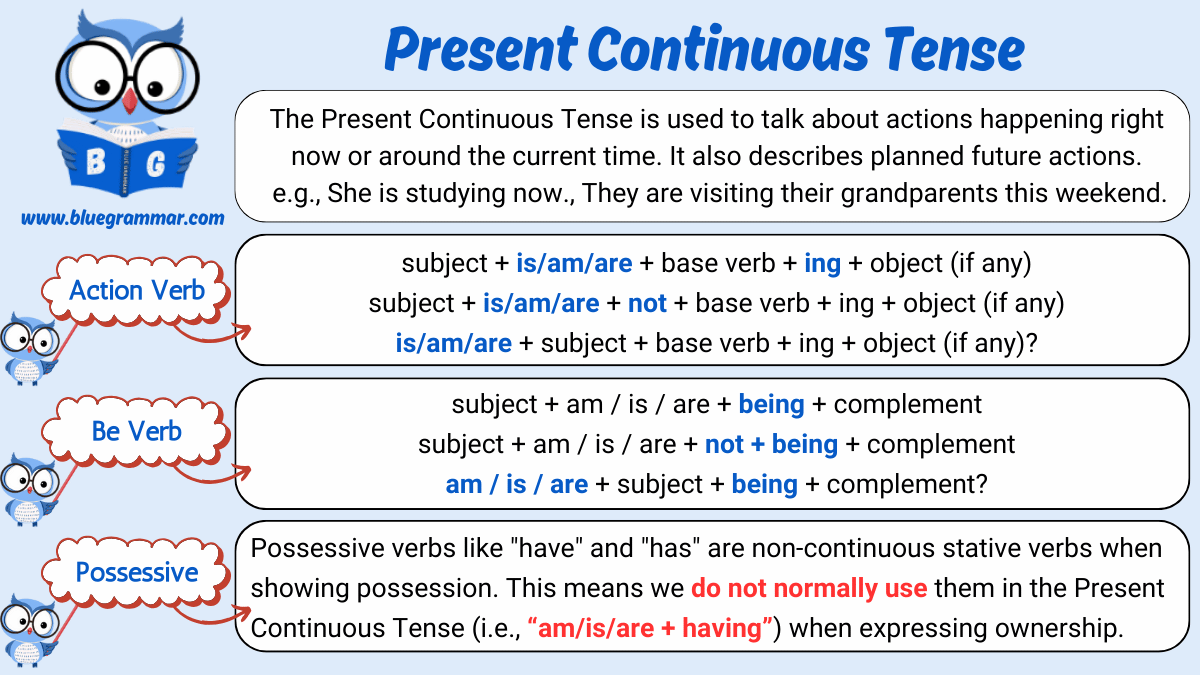
The Present Continuous Tense, also known as the Present Progressive Tense, is used to describe actions that are happening right now, around the present time, or for a temporary period. It is also used to talk about planned future arrangements, changing situations, and repeated actions that may be annoying when used with words like always or constantly. The Present Continuous Tense is formed using the present tense of the verb "to be" (am, is, are) followed by the present participle (verb + -ing). For example, I am reading a book, She is cooking dinner, and They are playing football.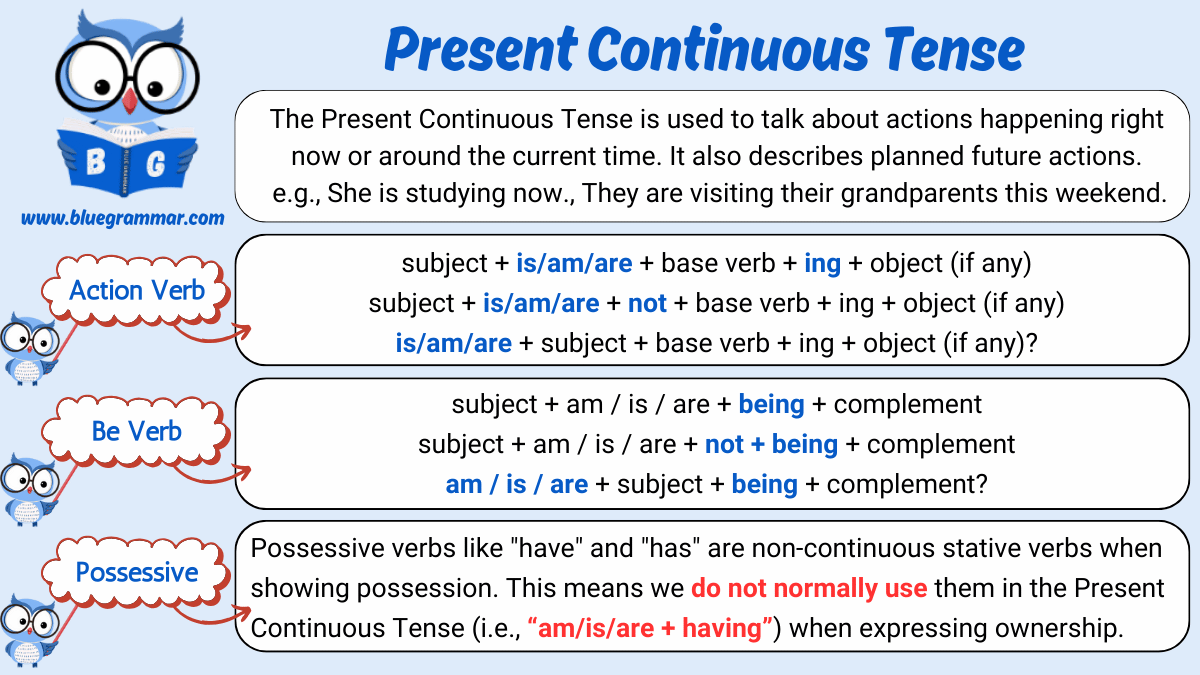
When Do We Use the Present Continuous Tense?
The Present Continuous Tense is used to describe actions that are happening now, temporary situations, future arrangements, and changing conditions. It emphasizes that an action is in progress or continuing at the present time.1. Actions Happening Right Now
Use the Present Continuous Tense to describe actions that are taking place at the moment of speaking. Examples:- She is reading a novel.
- I am writing an email.
- They are playing football.
- The baby is sleeping.
- We are watching a movie.
2. Temporary Actions or Situations
Use the Present Continuous Tense for actions or situations that are temporary and not permanent. Examples:- He is staying with his grandparents this week.
- I am working on a new project.
- They are living in Dubai for a few months.
- She is attending a short training course.
- We are using a temporary office.
3. Planned Future Arrangements
Use the Present Continuous Tense to talk about personal plans or arrangements that have already been decided. Examples:- I am meeting my teacher tomorrow.
- She is flying to London next week.
- We are visiting our grandparents this weekend.
- They are having a party on Friday.
- He is starting a new job next month.
4. Changing or Developing Situations
Use the Present Continuous Tense to describe situations that are changing, growing, or developing over time. Examples:- The weather is getting colder.
- Technology is advancing rapidly.
- My English is improving every day.
- The population is increasing.
- Prices are rising quickly.
5. Repeated Actions That Show Annoyance
The Present Continuous Tense can be used with words such as always, constantly, or forever to express irritation, surprise, or criticism about repeated actions. Examples:- He is always losing his keys.
- She is constantly talking during class.
- They are always arriving late.
- My brother is forever borrowing my books.
- You are always interrupting me.
Signal Words of the Present Continuous Tense
Signal words help identify when the Present Continuous Tense should be used. These words and phrases usually indicate that an action is happening now, around the present time, or has been planned for the near future.Common signal words include:
- Now – She is studying now.
- Right now – They are playing football right now.
- At the moment – I am talking to my friend at the moment.
- Currently – He is currently working on a new project.
- At present – We are living in Karachi at present.
- Today – She is working from home today.
- This week – They are staying with their grandparents this week.
- This month – I am taking an online English course this month.
- These days – People are using smartphones more these days.
- Nowadays – Many students are learning online nowadays.
- Look! – Look! The children are playing in the park.
- Listen! – Listen! Someone is knocking at the door.
- Still – He is still sleeping.
- For the time being – We are staying in a hotel for the time being.
- Tomorrow (for planned arrangements) – I am meeting my manager tomorrow.
- Next week/month/year (for planned future events) – She is traveling to Dubai next week.
Forms of the Present Continuous Tense
The Present Continuous Tense is commonly used in three forms, depending on the type of verb and the meaning of the sentence. Each form follows a different sentence structure and is used in specific situations.1. Present Continuous with Action Verbs
Action verbs describe what a person, animal, or thing is doing at the moment of speaking or around the present time. This is the most common form of the Present Continuous Tense. Examples:- She is reading a book.
- They are playing football.
- I am writing an email.
2. Present Continuous with the Verb "To Be"
The verb "to be" (am, is, are) is used as the helping (auxiliary) verb to form the Present Continuous Tense. It is always followed by the present participle (verb + -ing). Examples:- I am studying English.
- He is sleeping.
- We are watching a movie.
3. Present Continuous with the Verbs Have and Has
The verbs have and has can also be used in the Present Continuous Tense, but only when they describe activities, experiences, or temporary situations. They are not normally used in the continuous form to express possession, relationships, or permanent characteristics. Examples:- She is having breakfast.
- We are having a meeting.
- They are having a great time.
- She has a new car.
- They have two children.
She is having a new car.They are having two children.
Forming the -ing Form of Verbs
When using action verbs in the Present Continuous Tense, follow these spelling rules:1. Most Verbs: Add -ing
Simply add -ing to the base verb. Examples:- read → reading
- play → playing
- work → working
- learn → learning
- speak → speaking
2. Verbs Ending in -e: Drop the e and Add -ing
If a verb ends with a silent e, remove the e before adding -ing. Examples:- write → writing
- make → making
- drive → driving
- come → coming
- dance → dancing
- see → seeing
- agree → agreeing
- dye → dyeing
3. Verbs Ending in -ie: Change -ie to -y and Add -ing
Examples:- lie → lying
- die → dying
- tie → tying
4. One-Syllable Verbs Ending in Consonant–Vowel–Consonant (CVC)
Double the final consonant before adding -ing. Examples:- run → running
- sit → sitting
- stop → stopping
- swim → swimming
- get → getting
5. Two-Syllable Verbs with Stress on the Last Syllable
Double the final consonant before adding -ing. Examples:- begin → beginning
- prefer → preferring
- admit → admitting
- open → opening
- visit → visiting
- happen → happening
Present Continuous Tense with Action Verbs
The Present Continuous Tense is most commonly used with action verbs to describe actions that are happening now, in progress around the present time, or temporary activities. It is also used to talk about planned future arrangements and changing situations.
- She is reading a novel.
- They are playing football.
- I am studying English.
Making Positive Sentences
Structure: Subject + am/is/are + verb (-ing) + object (if any) Examples with Object:- She is reading a book.
- They are playing football.
- We are watching a movie.
- He is sleeping.
- I am running.
- The birds are flying.
Making Negative Sentences
Structure: Subject + am/is/are + not + verb (-ing) + object (if any) Examples with Object:- She is not reading a book.
- We are not watching television.
- He is not writing an email.
- I am not sleeping.
- They are not running.
- The baby is not crying.
Making Interrogative Sentences
Structure: Am/Is/Are + subject + verb (-ing) + object (if any)? Examples with Object:- Is she reading a book?
- Are they playing football?
- Are you watching the news?
- Am I speaking too fast?
- Is he sleeping?
- Are the children laughing?
Present Continuous with the Verb "To Be"
The verb "to be" can also be used as the main verb in the Present Continuous Tense. In this case, it appears as being after the helping verbs am, is, or are.
- She is being very kind today.
- He is being careless.
- The children are being noisy.
- I am being honest.
- They are being helpful.
When Do We Use Being?
Use being to describe:- Temporary behavior
- Someone's attitude or manner
- Actions that are unusual or different from normal
- Behavior that is changing for a short time
Making Positive Sentences
Structure: Subject + am/is/are + being + complement Examples:- She is being polite.
- He is being impatient.
- They are being quiet.
- I am being careful.
- We are being supportive.
Making Negative Sentences
Structure: Subject + am/is/are + not + being + complement Examples:- She is not being honest.
- He is not being serious.
- They are not being helpful.
- I am not being rude.
- We are not being careless.
Making Interrogative Sentences
Structure: Am/Is/Are + subject + being + complement? Examples:- Is she being friendly?
- Are they being noisy?
- Am I being too loud?
- Is he being honest?
- Are we being unfair?
- She is kind. (Permanent personality – Present Simple)
- She is being kind today. (Temporary behavior – Present Continuous)
- He is rude. (General characteristic)
- He is being rude. (His behavior at this moment is rude.)
Present Continuous with the Verbs "Have" and "Has"
The verbs have and has can also be used in the Present Continuous Tense, but only when they describe an activity, experience, or temporary situation. In these cases, have changes to having and is used with the helping verbs am, is, or are.
When Do We Use Having?
Use having to describe:- Meals and drinks
- Meetings and discussions
- Experiences
- Lessons or classes
- Temporary activities
- I am having breakfast.
- She is having lunch with her friends.
- They are having a meeting.
- We are having an English lesson.
- He is having a great time.
Making Positive Sentences
Structure: Subject + am/is/are + having + object Examples:- She is having breakfast.
- They are having a meeting.
- We are having dinner together.
- I am having a cup of coffee.
- He is having a wonderful vacation.
Making Negative Sentences
Structure: Subject + am/is/are + not + having + object Examples:- She is not having breakfast.
- We are not having a meeting today.
- They are not having lunch together.
- I am not having any problems.
- He is not having a good day.
Making Interrogative Sentences
Structure: Am/Is/Are + subject + having + object? Examples:- Are you having breakfast?
- Is she having lunch?
- Are they having a meeting?
- Am I having the right lesson?
- Is he having a good time?
Present Simple vs. Present Continuous
Use the Present Simple Tense when have expresses possession or ownership. Examples:- She has a new car.
- They have two children.
- I have a laptop.
- She is having breakfast.
- They are having a party.
- I am having a great time.
She is having a new car.- She has a new car.
They are having two children.- They have two children.
Examples of the Present Continuous Tense
The following examples demonstrate how the Present Continuous Tense is used in different situations. They include sentences with action verbs, temporary actions, actions happening now, and the verb "to be".Actions Happening Now
- I am writing an email.
- She is cooking dinner.
- We are watching a movie.
- He is playing football.
- They are studying English.
Temporary Actions
- I am staying with my friend this week.
- She is working from home these days.
- We are living in Dubai for a few months.
- He is learning Spanish this year.
- They are building a new house.
Actions Happening Around the Present Time
- I am reading a very interesting book.
- She is preparing for her exams.
- We are working on a new project.
- He is looking for a new job.
- They are improving their English skills.
Changing or Developing Situations
- The weather is getting colder.
- Technology is changing rapidly.
- The population is increasing.
- Your English is improving.
- The world is becoming more connected.
Future Arrangements
- I am meeting my teacher tomorrow.
- She is visiting her parents next week.
- We are traveling to Dubai this weekend.
- He is starting a new job next month.
- They are coming to our house tonight.
Temporary Situations
- My brother is living with us for a few months.
- She is working at a different office this week.
- I am using my friend's laptop today.
- They are staying at a hotel during their trip.
- We are studying in the library this evening.
Examples with the Verb "To Be"
- I am being careful with my work.
- She is being very polite today.
- He is being quiet in the class.
- We are being patient with the new students.
- They are being helpful to everyone.
Examples with Have and Has
- I am having lunch with my friends.
- She is having a great time at the party.
- We are having a meeting right now.
- He is having trouble understanding the lesson.
- They are having dinner at a restaurant.
Common Mistakes in the Present Continuous Tense
Learners often make mistakes when using the Present Continuous Tense, especially with the helping verbs am, is, and are, the -ing form of verbs, and the use of stative verbs. Understanding these common errors will help you use the tense correctly in both spoken and written English.1. Forgetting the Helping Verb
Every Present Continuous sentence requires the helping verb am, is, or are before the -ing form of the main verb.She reading a book.- She is reading a book.
They playing football.- They are playing football.
2. Using the Base Form Instead of the -ing Form
The main verb must always end in -ing.He is write a letter.- He is writing a letter.
We are play cricket.- We are playing cricket.
3. Using the Wrong Helping Verb
Choose the correct helping verb according to the subject.I is studying.- I am studying.
They is working.- They are working.
She are cooking.- She is cooking.
4. Using Stative Verbs in the Continuous Form
Many stative verbs describe states, feelings, opinions, possession, or knowledge and are not normally used in the Present Continuous Tense.I am knowing the answer.- I know the answer.
She is liking chocolate.- She likes chocolate.
They are owning a house.- They own a house.
5. Using Having to Express Possession
Use having only for activities or experiences, not for possession.She is having a new car.- She has a new car.
I am having two brothers.- I have two brothers.
6. Using Being for Permanent Characteristics
Use being to describe temporary behavior, not permanent qualities.She is being intelligent.- She is intelligent.
7. Forgetting to Change the Word Order in Questions
In interrogative sentences, place the helping verb before the subject.She is reading a book?- Is she reading a book?
They are playing outside?- Are they playing outside?
8. Incorrect Spelling of -ing Verbs
Follow the spelling rules when adding -ing.He is makeing dinner.- He is making dinner.
She is runing fast.- She is running fast.
- You have used the correct helping verb (am, is, or are).
- The main verb is in the -ing form.
- You are not using a stative verb in the continuous form unless it has a special meaning.
- You have used being and having correctly.
- Questions begin with Am, Is, or Are.
Practice Exercise
Test your understanding of the Present Continuous Tense by completing the following exercises. Try to answer each question without looking at the rules. Once you finish, check your answers and identify any mistakes.Exercise 1: Fill in the Blanks
Complete each sentence with the correct form of the verb in brackets.- She __________ a letter to her friend. (write)
- They __________ football in the park. (play)
- I __________ breakfast at the moment. (have)
- He __________ very polite today. (be)
- We __________ for the English exam. (study)
- The children __________ outside. (run)
- My father __________ dinner now. (cook)
- The students __________ carefully to the teacher. (listen)
- She __________ to Dubai next week. (travel)
- The weather __________ colder. (get)
Exercise 2: Make the Sentences Negative
Rewrite the following sentences in the negative form.- She is reading a novel.
- They are having lunch.
- He is being rude.
- We are watching television.
- I am studying English.
Exercise 3: Change the Sentences into Questions
Rewrite the following sentences as interrogative sentences.- She is writing an email.
- They are playing cricket.
- He is having breakfast.
- We are leaving now.
- The children are making noise.
Exercise 4: Correct the Mistakes
Find and correct the mistake in each sentence.- She reading a newspaper.
- They is playing football.
- He is writeing an email.
- I am having a new bicycle.
- Are you study for the exam?
Summary
The Present Continuous Tense, also known as the Present Progressive Tense, is used to describe actions happening now, temporary situations, planned future arrangements, and changing conditions. It is formed using am, is, or are followed by the -ing form of the main verb. By learning its rules, sentence structures, signal words, and common mistakes, and by practicing with examples and worksheets, you can use the Present Continuous Tense accurately and confidently in everyday English.
Download Free Present Simple Worksheets
Improve your understanding of the Present Continuous Tense with our free printable worksheets. These worksheets are designed for students, teachers, parents, and ESL/EFL learners and provide a variety of exercises to strengthen your grammar skills.
You can download and print the worksheets for classroom activities, homework, self-study, or revision.
Visit our page Present Tense Worksheets to download A4 size printable worksheets.