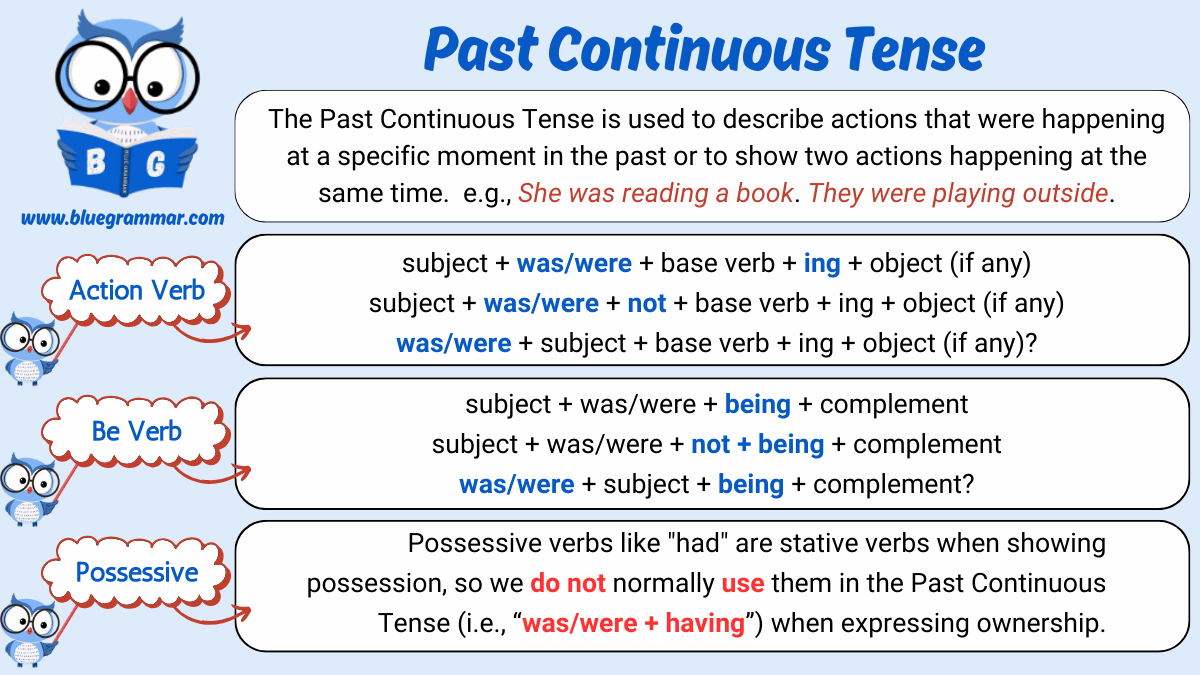
The Past Continuous Tense, also known as the Past Progressive Tense, is used to describe actions that were in progress at a specific time in the past. It is commonly used to talk about ongoing actions, temporary situations, interrupted activities, and two actions happening at the same time in the past. The Past Continuous Tense is formed using was or were followed by the present participle (verb + -ing). In this comprehensive guide, you will learn the rules, sentence structures, uses, signal words, examples, common mistakes, and practice exercises for the Past Continuous Tense. You will also find free printable charts and worksheets to help you understand and use this tense with confidence.
When Do We Use the Past Continuous Tense?
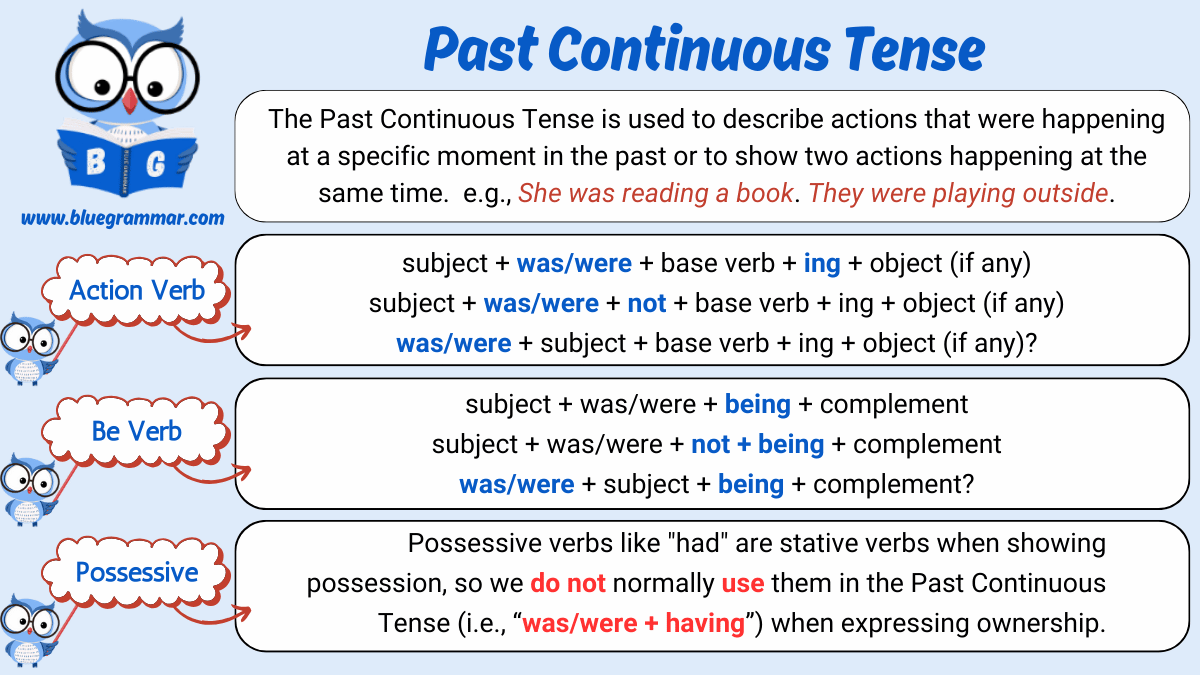
We use the Past Continuous Tense to describe actions that were in progress at a particular time in the past. It is often used to show that an action was continuing when another action happened, to describe two actions happening at the same time, or to set the background in a story.
1. To Describe an Action in Progress at a Specific Time in the Past
We use the Past Continuous Tense to show that an action was happening at a particular moment in the past.
Example: She was studying at 8:00 p.m. yesterday.
2. To Describe an Interrupted Action in the Past
We use the Past Continuous Tense for an action that was already in progress when another action interrupted it. The ongoing action is in the Past Continuous, while the interrupting action is usually in the Simple Past.
Example: I was watching television when the phone rang.
3. To Describe Two Actions Happening at the Same Time
We use the Past Continuous Tense when two actions were happening simultaneously in the past.
Example: While she was cooking, her brother was setting the table.
4. To Describe the Background of a Story
We use the Past Continuous Tense to set the scene or describe the background before introducing the main events in a story.
Example: The birds were singing, and the sun was shining as we started our journey.
5. To Describe Temporary Situations in the Past
We use the Past Continuous Tense to describe temporary situations or activities that were happening for a limited period in the past.
Example: They were staying with their grandparents during the holidays.
Signal Words of the Past Continuous Tense
Signal words are words and phrases that often indicate the use of the Past Continuous Tense. They help us recognize that an action was in progress at a particular time in the past or was happening when another action occurred.
Common Signal Words
The following signal words are frequently used with the Past Continuous Tense:
- While – She was reading while her brother was watching television.
- When – I was sleeping when the alarm rang.
- As – As they were walking home, it started to rain.
- All day – He was working all day.
- All night – The baby was crying all night.
- The whole day – We were cleaning the house the whole day.
- The entire evening – She was studying the entire evening.
Common Time Expressions
The following time expressions are also commonly used with the Past Continuous Tense:
- At 8:00 p.m. yesterday – I was doing my homework at 8:00 p.m. yesterday.
- At that moment – They were waiting for the bus at that moment.
- At this time yesterday – She was flying to Dubai at this time yesterday.
- Last night – We were watching a movie last night.
- Yesterday afternoon – He was playing cricket yesterday afternoon.
- During the meeting – The manager was explaining the new policy during the meeting.
- From 6:00 to 8:00 p.m. – I was studying from 6:00 to 8:00 p.m.
Note: Signal words are useful clues that help identify the Past Continuous Tense, but they are not required in every sentence. The context often makes it clear that an action was in progress in the past.
Forms of the Past Continuous Tense
The Past Continuous Tense is commonly used in three forms, depending on the type of verb in the sentence. Each form follows its own sentence structure and is used to express different meanings in the past.
1. Past Continuous with Action Verbs
Action verbs describe what a person, animal, or thing was doing at a particular time in the past. This form is used to talk about ongoing actions, interrupted actions, simultaneous actions, and temporary situations.
Examples:
- She was reading a book when I arrived.
- They were playing football after school.
- I was studying at 8:00 p.m. yesterday.
2. Past Continuous with the Verb "To Be"
The verb "to be" can be used in the Past Continuous Tense as was being or were being to describe someone's temporary behavior, attitude, or condition in the past. It emphasizes how a person was acting during a particular moment or period of time rather than describing a permanent characteristic.
Examples:
- She was being very helpful during the meeting.
- He was being unusually quiet that morning.
- The children were being noisy in the classroom.
3. Past Continuous with the Verb "Have"
The verb have can be used in the Past Continuous Tense when it means experiencing or doing something, such as having dinner, having fun, or having a meeting. However, it is not normally used in the continuous form to express possession or ownership.
Examples:
- We were having dinner when the lights went out.
- She was having a meeting with her manager.
- They were having a great time at the party.
In the following sections, you will learn how to form positive, negative, and interrogative sentences for each of these three forms, along with their rules, sentence structures, and examples.
Past Continuous Tense with Action Verbs
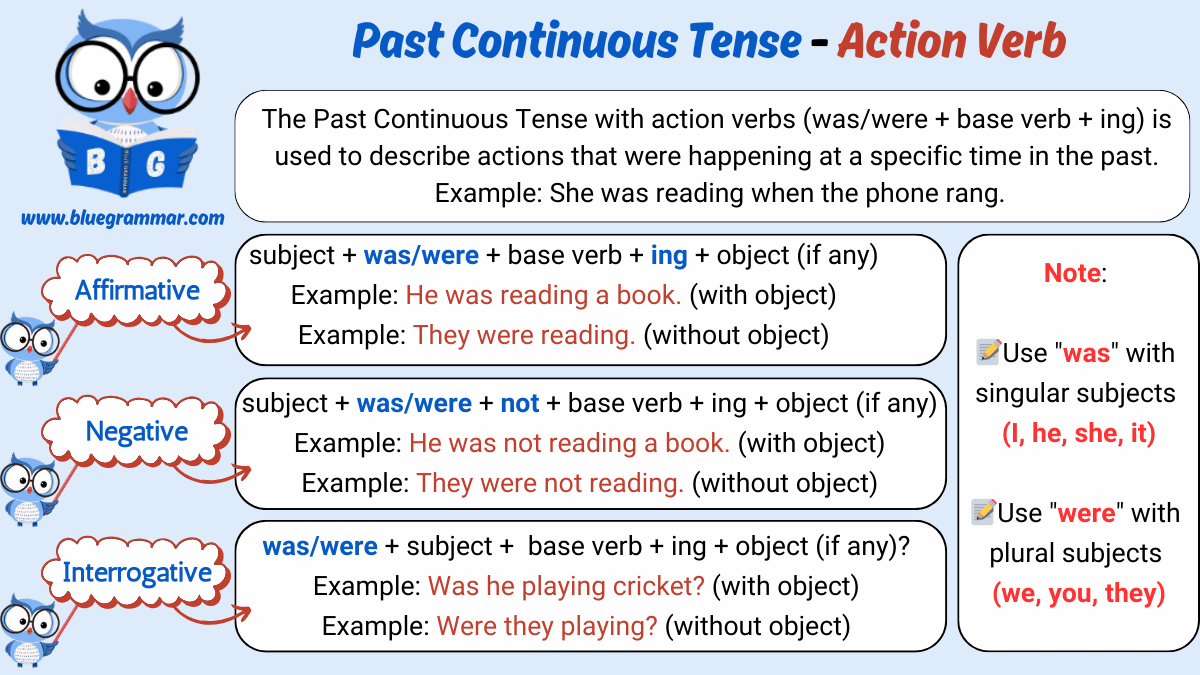
The Past Continuous Tense with action verbs is used to describe actions that were in progress at a particular time in the past. These actions may have continued for some time, been interrupted by another action, or happened simultaneously with another ongoing action. Action verbs express what a person, animal, or thing was doing, such as reading, playing, studying, writing, and traveling.
Positive Sentences
In positive sentences, use was or were followed by the present participle (verb + -ing).
Structure:
Subject + was/were + Verb (-ing) + Object
Examples:
- I was reading a novel last night.
- She was cooking dinner when I arrived.
- They were playing football after school.
- He was studying for his exam.
- We were watching a movie at 8:00 p.m.
Negative Sentences
In negative sentences, place not after was or were.
Structure:
Subject + was/were + not + Verb (-ing) + Object
Examples:
- I was not reading a novel.
- She was not cooking dinner.
- They were not playing football.
- He was not studying for the exam.
- We were not watching television.
Interrogative Sentences
In interrogative sentences, place was or were before the subject.
Structure:
Was/Were + Subject + Verb (-ing) + Object?
Examples:
- Was I reading a novel?
- Was she cooking dinner?
- Were they playing football?
- Was he studying for the exam?
- Were we watching a movie?
Rules for Adding "-ing"
To form the Past Continuous Tense, add -ing to the base form of the main verb. Follow these common spelling rules.
Rule 1: Add -ing to Most Verbs
Simply add -ing to the base verb.
Examples:
- play → playing
- read → reading
- work → working
- jump → jumping
- cook → cooking
Rule 2: Drop the Final e Before Adding -ing
If a verb ends with a silent e, remove the e before adding -ing.
Examples:
- write → writing
- make → making
- drive → driving
- come → coming
- take → taking
Rule 3: Double the Final Consonant
If a one-syllable verb ends in a consonant-vowel-consonant (CVC) pattern, double the final consonant before adding -ing.
Examples:
- run → running
- sit → sitting
- stop → stopping
- swim → swimming
- begin → beginning
Rule 4: Change ie to y
If a verb ends in ie, change ie to y before adding -ing.
Examples:
- lie → lying
- die → dying
- tie → tying
Remember: Every Past Continuous sentence requires was or were together with the -ing form of the main verb. The auxiliary verb changes according to the subject, but the main verb always remains in the -ing form.
Examples:
- She was reading a book.
- She was not reading a book.
- Was she reading a book?
Past Continuous Tense with the Verb "To Be"
The verb "to be" can be used in the Past Continuous Tense as was being or were being. This structure is used to describe someone's temporary behavior, attitude, or condition in the past. It emphasizes how a person was acting during a particular moment or period of time rather than describing a permanent characteristic or identity.

The past continuous forms of the verb "to be" are:
- Was being – used with I, he, she, it, and singular nouns.
- Were being – used with you, we, they, and plural nouns.
Positive Sentences
Structure:
Subject + was/were + being + Complement
The complement may be an adjective or a phrase describing temporary behavior or condition.
Examples:
- She was being very helpful during the meeting.
- He was being unusually quiet that morning.
- I was being careful while carrying the glass.
- We were being patient with the new students.
- The children were being noisy in the classroom.
Negative Sentences
Structure:
Subject + was/were + not + being + Complement
Examples:
- She was not being rude.
- He was not being honest.
- I was not being careless.
- We were not being selfish.
- They were not being cooperative.
Interrogative Sentences
Structure:
Was/Were + Subject + being + Complement?
Examples:
- Was she being helpful?
- Was he being serious?
- Were you being honest?
- Were they being noisy?
- Were we being too impatient?
When Do We Use "Was Being" and "Were Being"?
We use was being and were being to describe temporary behavior, attitude, or conduct at a particular time in the past.
Temporary Behavior
Examples:
- She was being very polite to the guests.
- The children were being unusually quiet.
Temporary Attitude
Examples:
- He was being impatient during the discussion.
- They were being very supportive.
Temporary Condition
Examples:
- I was being extra careful because the road was slippery.
- We were being cautious while crossing the bridge.
Common Mistakes
Do not use was being or were being to describe permanent identities, professions, or long-lasting characteristics.
Incorrect: She was being a doctor.
Correct: She was a doctor.
Incorrect: He was being tall.
Correct: He was tall.
Incorrect: They were being brothers.
Correct: They were brothers.
Remember: Use was being and were being only when describing temporary behavior or attitude. For permanent facts, identities, professions, age, or characteristics, use the simple past forms was and were instead.
Past Continuous Tense with the Verb "Have"
The verb "have" can be used in the Past Continuous Tense when it means experiencing, doing, or taking part in an activity, such as having dinner, having fun, having a meeting, or having a conversation. However, when have means owning or possessing something, it is generally not used in the continuous form.
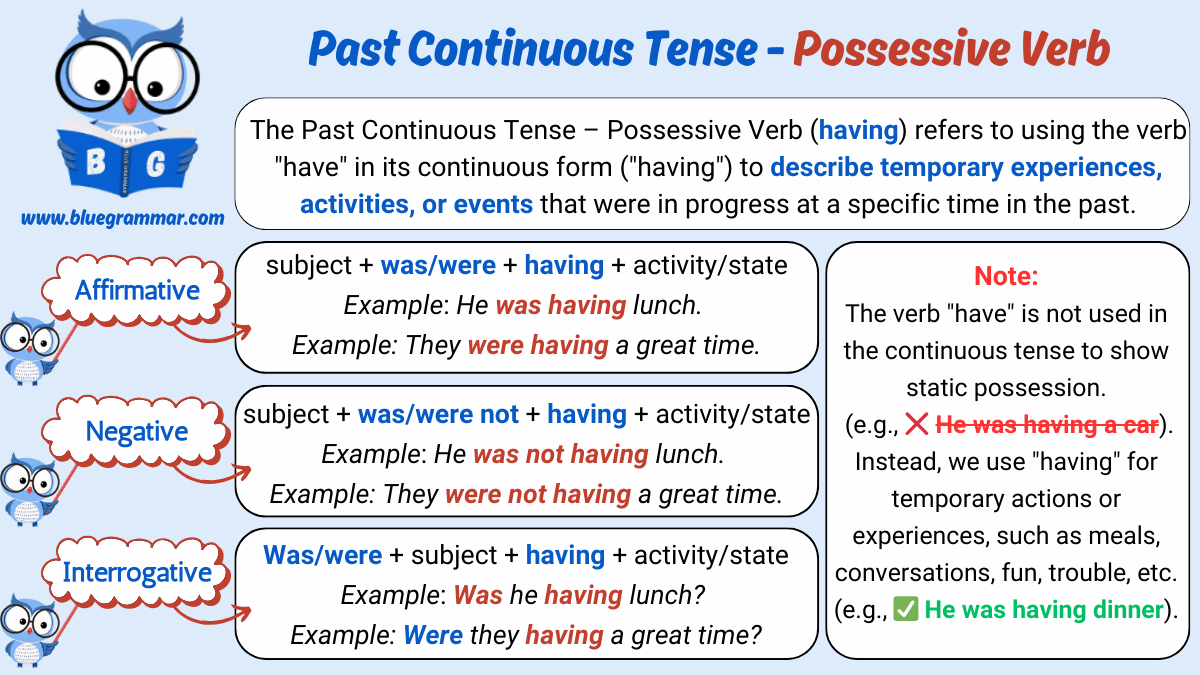
Positive Sentences
Structure:
Subject + was/were + having + Object
Examples:
- I was having breakfast when my friend called.
- She was having a meeting with her manager.
- He was having a bath when the lights went out.
- We were having dinner at a restaurant.
- They were having a great time at the party.
Negative Sentences
Structure:
Subject + was/were + not + having + Object
Examples:
- I was not having breakfast at that time.
- She was not having any problems.
- He was not having a meeting.
- We were not having lunch together.
- They were not having much fun.
Interrogative Sentences
Structure:
Was/Were + Subject + having + Object?
Examples:
- Was she having dinner when you arrived?
- Was he having a bath?
- Were you having a meeting?
- Were they having fun at the party?
- Were we having lunch at noon?
When Can We Use "Having"?
Use having when have means experiencing, doing, receiving, or taking part in an activity rather than expressing possession.
Meals
Examples:
- We were having dinner when the guests arrived.
- She was having lunch with her colleagues.
Meetings and Conversations
Examples:
- He was having a meeting with the principal.
- They were having a serious conversation.
Experiences
Examples:
- The children were having fun at the park.
- I was having a wonderful vacation.
Health or Physical Conditions
Examples:
- She was having a headache.
- He was having difficulty sleeping.
When Should We Not Use "Having"?
Do not normally use having when have means owning or possessing something. In these cases, use the Simple Past Tense instead.
Incorrect: She was having a new car.
Correct: She had a new car.
Incorrect: They were having a large house.
Correct: They had a large house.
Incorrect: He was having two brothers.
Correct: He had two brothers.
Remember: Use was having and were having only when have means experiencing, doing, or participating in an activity. When have expresses possession or ownership, use the Simple Past Tense (had) instead.
Examples of the Past Continuous Tense
The following examples demonstrate how the Past Continuous Tense is used in different situations. They include ongoing actions, interrupted actions, simultaneous actions, temporary situations, and examples with the verbs "to be" and "have".
Actions in Progress at a Specific Time
- I was studying at 8:00 p.m. yesterday.
- She was reading a novel last night.
- They were playing football after school.
- He was working in his office at noon.
- We were watching television in the evening.
Interrupted Actions
- I was sleeping when the alarm rang.
- She was cooking dinner when her friend arrived.
- They were walking home when it started to rain.
- He was driving to work when he saw the accident.
- We were having lunch when the phone rang.
Two Actions Happening at the Same Time
- While I was studying, my sister was listening to music.
- She was cooking while her husband was setting the table.
- The children were playing while their parents were talking.
- We were watching television while it was raining outside.
- The birds were singing while the sun was rising.
Temporary Situations in the Past
- They were staying with their grandparents during the holidays.
- She was working in London for a few months.
- I was living with my cousin while my house was being repaired.
- He was learning French that summer.
- We were preparing for our final exams.
Examples with the Verb "To Be"
- She was being very polite to the guests.
- He was being unusually quiet during the meeting.
- The children were being noisy in the classroom.
- We were being patient with the new employees.
- You were being very helpful that day.
Examples with the Verb "Have"
- We were having dinner when the lights went out.
- She was having a meeting with her manager.
- They were having a wonderful time at the beach.
- He was having a conversation with his teacher.
- I was having breakfast when you called.
Common Mistakes in the Past Continuous Tense
Students often make mistakes when using the Past Continuous Tense, especially with the auxiliary verbs was and were, the -ing form of verbs, and stative verbs such as have and be. Learning these common mistakes will help you use the tense correctly.
1. Using the Base Form Instead of the "-ing" Form
Always use the -ing form of the main verb after was or were.
Incorrect: She was cook dinner.
Correct: She was cooking dinner.
Incorrect: They were play football.
Correct: They were playing football.
2. Using "Was" and "Were" Incorrectly
Use was with I, he, she, it, and singular nouns. Use were with you, we, they, and plural nouns.
Incorrect: They was watching television.
Correct: They were watching television.
Incorrect: We was studying.
Correct: We were studying.
3. Forgetting the Auxiliary Verb
Every Past Continuous sentence requires was or were before the main verb.
Incorrect: She reading a book.
Correct: She was reading a book.
Incorrect: They playing cricket.
Correct: They were playing cricket.
4. Using the Past Continuous for Completed Actions
Use the Simple Past Tense for completed actions and the Past Continuous Tense for actions that were in progress.
Incorrect: I was finished my homework.
Correct: I finished my homework.
Correct: I was doing my homework when my friend called.
5. Using "Having" to Express Possession
Do not normally use was having or were having when have means possession or ownership.
Incorrect: She was having a new bicycle.
Correct: She had a new bicycle.
Correct: She was having breakfast.
6. Using "Was Being" for Permanent Characteristics
Use was being and were being only for temporary behavior or attitude, not for permanent identity or characteristics.
Incorrect: He was being a doctor.
Correct: He was a doctor.
Incorrect: She was being tall.
Correct: She was tall.
Tip: Before writing or speaking in the Past Continuous Tense, check the following:
- Did you use was or were correctly?
- Is the main verb in the -ing form?
- Are you using the Past Continuous for an action that was in progress?
- Did you avoid using having to express possession?
- Are was being and were being describing temporary behavior rather than permanent characteristics?
Practice Exercise
Test your understanding of the Past Continuous Tense by completing the following exercises. Try to answer each question before checking the correct answers.
Exercise 1: Fill in the Blanks
Complete each sentence with the correct form of the verb in brackets.
- She __________ a book when I called. (read)
- They __________ football at 6:00 p.m. yesterday. (play)
- I __________ dinner when the lights went out. (have)
- We __________ for the exam all evening. (study)
- The children __________ in the garden. (run)
- He __________ very polite to the guests. (be)
- You __________ television when I arrived. (watch)
- It __________ heavily all night. (rain)
- She __________ with her manager at that time. (talk)
- They __________ a great time at the party. (have)
Exercise 2: Make the Sentences Negative
Rewrite the following sentences in the negative form.
- She was reading a newspaper.
- They were having lunch together.
- He was being helpful.
- We were waiting for the bus.
- I was writing an email.
Exercise 3: Change the Sentences into Questions
Rewrite the following sentences as interrogative sentences.
- She was cooking dinner.
- They were playing cricket.
- He was having a meeting.
- We were studying English.
- The children were being noisy.
Exercise 4: Choose the Correct Answer
Choose the correct option.
- She ________ dinner when I arrived.
a) cooked
b) was cooking
c) cooks - They ________ football at that time yesterday.
a) were playing
b) played
c) play - He ________ very polite during the meeting.
a) was being
b) were being
c) being - We ________ dinner when the phone rang.
a) were having
b) had
c) have - I ________ for the exam all evening.
a) studied
b) was studying
c) study
Exercise 5: Correct the Mistakes
Find and correct the mistake in each sentence.
- She was read a novel.
- They was playing football.
- He were having dinner.
- We was being patient.
- I was having two bicycles.
Tip: Practice regularly with different sentence patterns to become confident in using the Past Continuous Tense. You can also download our free printable worksheets for additional exercises and revision.
Short Summary
The Past Continuous Tense is used to describe actions that were in progress at a specific time in the past. It is commonly used for ongoing actions, interrupted actions, simultaneous actions, temporary situations, and setting the background of a story. The tense is formed with was or were followed by the -ing form of the main verb. In some cases, was being and were being describe temporary behavior, while was having and were having are used when have means experiencing or doing an activity rather than expressing possession. By understanding the rules, sentence structures, and common mistakes, you can use the Past Continuous Tense accurately in both speaking and writing.
Download Free Past Continuous Tense Worksheets
Improve your understanding of the Past Continuous Tense with our free printable worksheets. These worksheets are designed for students, teachers, parents, and English language learners to practice sentence formation, verb forms, and correct tense usage through a variety of engaging activities.
You can download and print the worksheets for classroom lessons, homework, self-study, revision, or exam preparation.
Visit our page Past Tense Worksheets to download A4 size printable worksheets.