
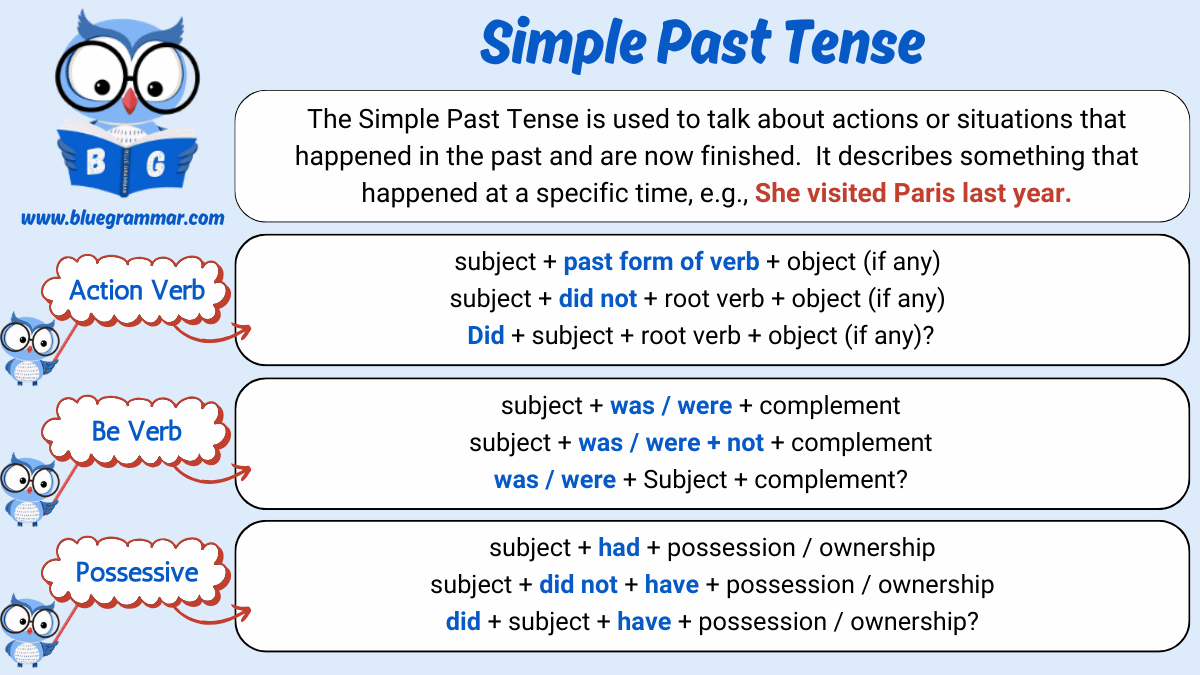
The Simple Past Tense is one of the most commonly used tenses in English grammar. We use it to talk about actions, events, or situations that started and finished in the past. Whether you are describing yesterday's activities, telling a story, or sharing a past experience, the simple past tense helps you express completed actions clearly. In this guide, you will learn the rules, sentence structure, signal words, and plenty of examples of the simple past tense. You will also find common mistakes, practice exercises, and free printable worksheets to help you master this important tense.
When Do We Use the Simple Past Tense?
We use the Simple Past Tense to describe actions, events, or situations that began and ended in the past. It is commonly used to talk about completed activities, past habits, and a series of events that happened at a specific time. The exact time may be mentioned or understood from the context.
1. To Describe a Completed Action in the Past
We use the Simple Past Tense to talk about an action that started and finished in the past.
Example: She visited her grandparents last weekend.
2. To Talk About a Series of Completed Actions
We use the Simple Past Tense to describe two or more actions that happened one after another in the past.
Example: He woke up, brushed his teeth, and left for work.
3. To Describe Past Habits or Routines
We use the Simple Past Tense to talk about habits or routines that someone had in the past but no longer does.
Example: We played football every evening when we were children.
4. To Narrate Stories or Historical Events
We use the Simple Past Tense to tell stories and describe events that happened in history.
Example: The king declared peace after the battle.
5. To Describe a Past State or Condition
We use the Simple Past Tense to describe a person's feelings, condition, or situation in the past.
Example: They were happy with the results.
Signal Words of the Simple Past Tense
Signal words are words and phrases that often indicate the use of the Simple Past Tense. They help us recognize that an action or event happened and was completed in the past.
Common Signal Words
The following signal words are frequently used with the Simple Past Tense:
- Yesterday – We visited the museum yesterday.
- Last night – She finished her homework last night.
- Last week – They traveled to Islamabad last week.
- Last month – I started a new job last month.
- Last year – He graduated from college last year.
- Ago – She called me two hours ago.
- In 2020 – We moved to this city in 2020.
- Then – He opened the door, then walked inside.
- Once – I once met a famous actor.
- The other day – We saw our teacher the other day.
Common Time Expressions
The following time expressions are also commonly used with the Simple Past Tense:
- This morning (if the morning has finished) – I met my friend this morning.
- Yesterday morning – She left early yesterday morning.
- Yesterday afternoon – We played cricket yesterday afternoon.
- Yesterday evening – They watched a movie yesterday evening.
- Last Monday – He visited his uncle last Monday.
- Last weekend – We went hiking last weekend.
- A few days ago – I received your message a few days ago.
- A long time ago – People lived differently a long time ago.
- When I was a child – I loved cartoons when I was a child.
- During my vacation – We explored many beautiful places during our vacation.
Note: Signal words are useful clues that help identify the Simple Past Tense, but they are not required in every sentence. Many Simple Past sentences do not contain signal words because the context already makes the meaning clear.
Forms of the Simple Past Tense
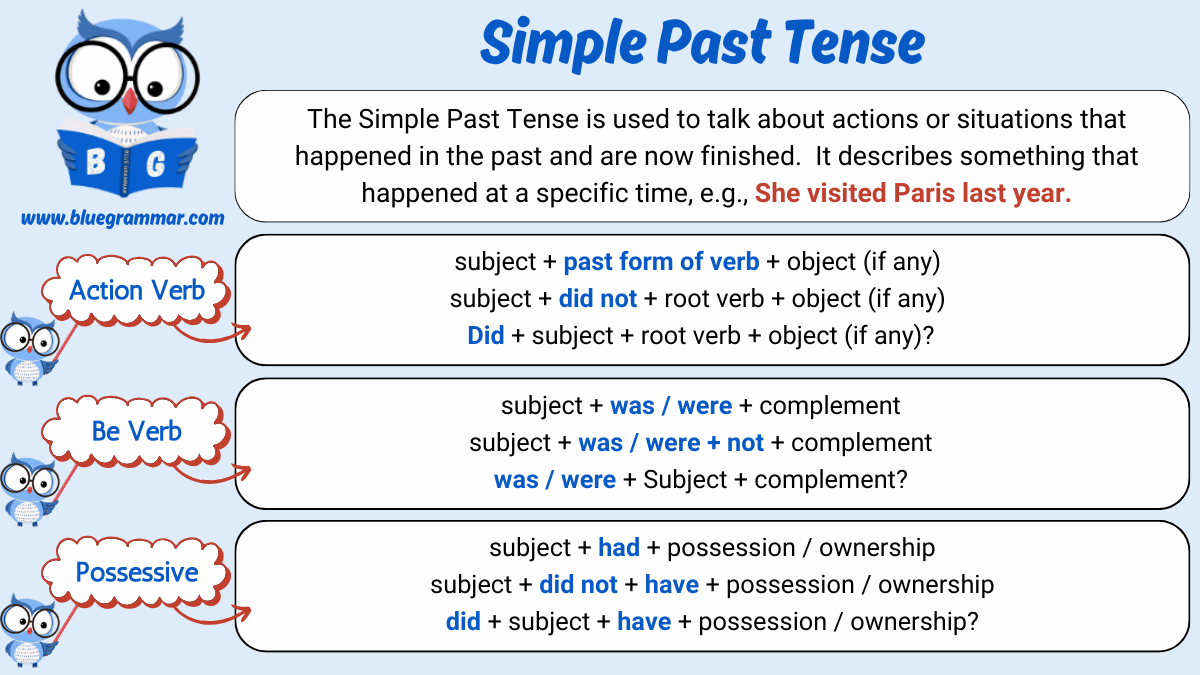
The Simple Past Tense is used in three common forms, depending on the type of verb in the sentence. Each form follows its own sentence structure and is used to express different meanings.
1. Simple Past with Action Verbs
Action verbs describe what a person, animal, or thing did in the past. This form is used to talk about completed actions, past habits, and events that happened at a specific time.
Examples:
- She visited her grandmother yesterday.
- They played football after school.
- I finished my homework before dinner.
2. Simple Past with the Verb "To Be"
The past forms of the verb "to be" (was and were) are used to describe a person's identity, condition, location, age, or characteristics in the past. Unlike action verbs, they do not describe an action.
Examples:
- I was tired after the trip.
- She was at the library yesterday.
- They were excited about the competition.
3. Simple Past with Had
The verb had is the past form of have and has. It is used to express possession, relationships, physical characteristics, illnesses, and experiences in the past.
Examples:
- He had a new bicycle when he was ten.
- We had a wonderful holiday last summer.
- They had two pet cats.
In the following sections, you will learn how to form positive, negative, and interrogative sentences for each of these three forms, along with their rules, structures, and examples.
Simple Past Tense with Action Verbs
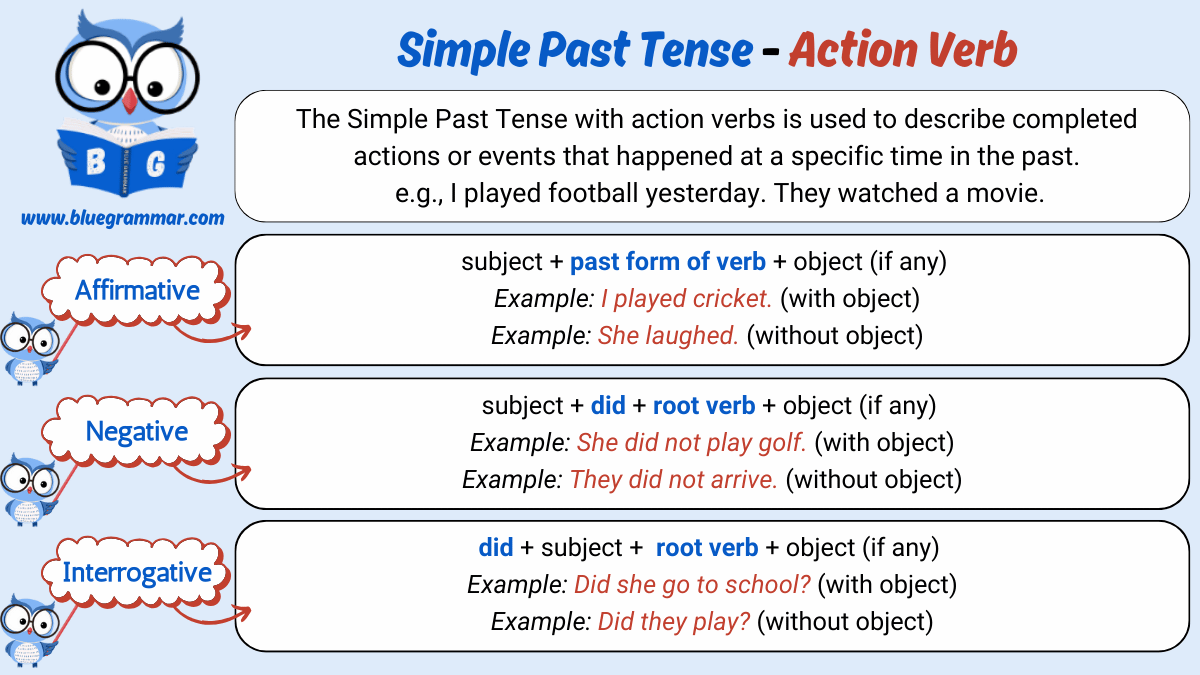
The Simple Past Tense with action verbs is used to describe actions that started and finished in the past. These actions may have happened a few seconds ago, yesterday, last week, or many years ago. Action verbs express what a person, animal, or thing did, such as play, visit, study, write, and travel.
Positive Sentences
In positive sentences, use the past form (second form) of the main verb.
Structure:
Subject + Past Form of the Verb (V2) + Object
Examples:
- I visited my grandparents yesterday.
- She finished her homework before dinner.
- They watched a movie last night.
- He played football after school.
- We traveled to Murree during the holidays.
Negative Sentences
In negative sentences, use did not (didn't) followed by the base form (V1) of the main verb.
Structure:
Subject + did not + Base Verb (V1) + Object
Examples:
- I did not visit my grandparents yesterday.
- She did not finish her homework.
- They did not watch the movie.
- He did not play football after school.
- We did not travel during the holidays.
Interrogative Sentences
In interrogative sentences, place did before the subject and use the base form (V1) of the main verb.
Structure:
Did + Subject + Base Verb (V1) + Object?
Examples:
- Did you visit your grandparents yesterday?
- Did she finish her homework?
- Did they watch the movie?
- Did he play football after school?
- Did we travel during the holidays?
Regular and Irregular Verbs
Action verbs in the Simple Past Tense are divided into two groups: regular verbs and irregular verbs.
Regular Verbs
Regular verbs form the past tense by adding -ed to the base verb.
Examples:
- play → played
- work → worked
- visit → visited
- clean → cleaned
- wash → washed
Irregular Verbs
Irregular verbs do not follow a fixed pattern. Their past forms must be learned individually.
Examples:
- go → went
- eat → ate
- write → wrote
- see → saw
- buy → bought
Remember: Use the past form (V2) only in positive sentences. After did or did not, always use the base form (V1) of the verb.
Examples:
- She visited her aunt.
- She did not visit her aunt.
- Did she visit her aunt?
Simple Past Tense with the Verb "To Be"
The verb "to be" is used to describe a person's identity, condition, feelings, location, age, or characteristics in the past. In the Simple Past Tense, the verb "to be" has two forms: was and were. Unlike action verbs, the verb "to be" does not describe an action. Instead, it tells us what someone or something was.

The past forms of the verb "to be" are:
- Was – used with I, he, she, it, and singular nouns.
- Were – used with you, we, they, and plural nouns.
Positive Sentences
Structure:
Subject + was/were + Complement
The complement may be a noun, pronoun, adjective, or prepositional phrase.
Examples:
- I was tired after the journey.
- She was a doctor.
- He was at home yesterday.
- We were excited about the trip.
- They were in the classroom.
Negative Sentences
Structure:
Subject + was/were + not + Complement
Examples:
- I was not tired.
- She was not at school yesterday.
- He was not angry.
- We were not ready for the meeting.
- They were not at the party.
Interrogative Sentences
Structure:
Was/Were + Subject + Complement?
Unlike action verbs, did is not used with the verb "to be".
Examples:
- Was I late?
- Was she your teacher?
- Was he at work yesterday?
- Were you busy last night?
- Were they your classmates?
Common Uses of the Verb "To Be"
The Simple Past forms was and were are commonly used to:
Describe Identity
Example: She was my English teacher.
Describe a Profession or Occupation
Example: My father was a police officer.
Describe Feelings or Conditions
Examples:
- I was happy with the results.
- They were tired after the match.
Describe Characteristics
Examples:
- He was very honest.
- The weather was pleasant.
Describe Location
Examples:
- The books were on the table.
- She was at the library yesterday.
State Age
Examples:
- I was ten years old.
- My sister was fifteen last year.
Remember: The verb "to be" has its own past forms (was and were) and does not use did to form negative or interrogative sentences.
Simple Past Tense with the Verb "Had"
The verb had is the past form of both have and has. In the Simple Past Tense, had is used with all subjects to express possession, relationships, physical characteristics, illnesses, experiences, and other states in the past.

Unlike the Present Simple Tense, which uses have and has, the Simple Past Tense uses only had with every subject.
Positive Sentences
Structure:
Subject + had + Object or Complement
Examples:
- I had a bicycle when I was a child.
- She had a beautiful garden.
- He had a driving licence.
- We had enough time to finish the project.
- They had three pet cats.
Negative Sentences
Structure:
Subject + did not + have + Object or Complement
Examples:
- I did not have any money.
- She did not have a passport.
- He did not have a mobile phone.
- We did not have enough food.
- They did not have any homework.
Interrogative Sentences
Structure:
Did + Subject + have + Object or Complement?
Examples:
- Did you have a good weekend?
- Did she have a bicycle?
- Did he have a driving licence?
- Did we have enough time?
- Did they have any questions?
Common Uses of the Verb "Had"
The verb had is commonly used to describe possession, relationships, physical characteristics, health conditions, and experiences in the past.
Express Possession
Examples:
- She had a new car.
- We had a large house.
Describe Family Relationships
Examples:
- I had two brothers.
- He had a supportive family.
Describe Physical Features
Examples:
- She had long black hair.
- The dog had a short tail.
Talk About Illnesses or Health Conditions
Examples:
- I had a headache yesterday.
- She had a fever last week.
Describe Qualities or Characteristics
Examples:
- He had a great sense of humor.
- They had excellent communication skills.
Remember: In the Simple Past Tense, had is used with all subjects in positive sentences. In negative and interrogative sentences, use did with the base form have.
Examples:
- She had a bicycle.
- She did not have a bicycle.
- Did she have a bicycle?
Examples of the Simple Past Tense
The following examples demonstrate how the Simple Past Tense is used in different situations. They include sentences with action verbs, the verb "to be" (was and were), and the verb had.
Completed Actions
- I visited my grandparents yesterday.
- She finished her homework before dinner.
- They watched a movie last night.
- He repaired his bicycle on Sunday.
- We cleaned the house together.
Past Habits
- I walked to school every day when I was young.
- She played the piano every evening.
- We visited our grandparents every summer.
- He always carried a notebook.
- They often played cricket after school.
Series of Completed Actions
- She woke up, got dressed, and left for work.
- He opened the window, looked outside, and smiled.
- We packed our bags, locked the house, and left.
- I finished my homework and went to bed.
- They entered the hall, greeted everyone, and took their seats.
Historical Events and Stories
- The Wright brothers invented the first successful airplane.
- The king declared peace after the battle.
- Columbus discovered America in 1492.
- The team won the championship last year.
- The author wrote many famous novels.
Examples with the Verb "To Be"
- I was very tired after the journey.
- She was at the library yesterday.
- He was my best friend in school.
- We were excited about the trip.
- They were ready for the competition.
Examples with the Verb "Had"
- I had a new bicycle when I was a child.
- She had a beautiful garden.
- He had a driving licence.
- We had enough time to complete the project.
- They had a wonderful holiday in the mountains.
Common Mistakes in the Simple Past Tense
Learners often make mistakes when using the Simple Past Tense, especially with irregular verbs, the auxiliary verb did, and the verb "to be". Understanding these common errors will help you write and speak English more accurately.
1. Using the Past Form of the Verb After "Did"
After did or did not, always use the base form (V1) of the main verb.
Incorrect: She did went to school.
Correct: She did go to school.
Incorrect: Did he played football?
Correct: Did he play football?
2. Using the Base Form Instead of the Past Form in Positive Sentences
In positive sentences, use the past form (V2) of the main verb.
Incorrect: They visit us yesterday.
Correct: They visited us yesterday.
Incorrect: I eat breakfast at 8:00 a.m.
Correct: I ate breakfast at 8:00 a.m.
3. Using "Did" with the Verb "To Be"
The verb "to be" forms negative and interrogative sentences without did.
Incorrect: Did she was at home?
Correct: Was she at home?
Incorrect: He didn't was tired.
Correct: He wasn't tired. or He was not tired.
4. Using "Was" and "Were" Incorrectly
Use was with I, he, she, it, and singular nouns. Use were with you, we, they, and plural nouns.
Incorrect: They was happy.
Correct: They were happy.
Incorrect: We was late.
Correct: We were late.
5. Using "Have" or "Has" Instead of "Had"
In the Simple Past Tense, use had for all subjects in positive sentences.
Incorrect: She has a bicycle when she was young.
Correct: She had a bicycle when she was young.
Incorrect: They have a large house ten years ago.
Correct: They had a large house ten years ago.
6. Using "Had" After "Did"
After did, always use the base form have, not had.
Incorrect: Did she had a car?
Correct: Did she have a car?
Incorrect: He didn't had enough money.
Correct: He didn't have enough money.
Tip: Before writing or speaking in the Simple Past Tense, always check:
- Did you use the correct past form (V2) in positive sentences?
- After did, are you using the base form (V1) of the verb?
- Did you use was and were correctly?
- If you are using the verb "to be", do not use did.
- Are you using had correctly to express possession in the past?
Practice Exercise
Test your understanding of the Simple Past Tense by completing the following exercises. Check your answers after completing all the questions.
Exercise 1: Fill in the Blanks
Complete each sentence with the correct form of the verb in brackets.
- She ________ her homework before dinner. (finish)
- They ________ to Lahore last weekend. (travel)
- He ________ a new bicycle when he was twelve. (have)
- We ________ very happy after the match. (be)
- I ________ my best friend yesterday. (meet)
- The children ________ in the park all afternoon. (play)
- My father ________ a letter to his manager. (write)
- They ________ at home last night. (be)
- She ________ the window before leaving. (close)
- We ________ dinner at a nice restaurant. (eat)
Exercise 2: Make the Sentences Negative
Rewrite the following sentences in the negative form.
- She visited her grandparents.
- They had enough time.
- He was at school.
- We watched the movie.
- I bought a new laptop.
Exercise 3: Change the Sentences into Questions
Rewrite the following sentences as interrogative sentences.
- She finished her homework.
- He had a driving licence.
- They were ready for the meeting.
- You visited the museum.
- The train arrived on time.
Exercise 4: Choose the Correct Answer
Choose the correct option.
- She ________ her homework yesterday.
a) finish
b) finished
c) finishing - ________ they visit the museum last week?
a) Do
b) Did
c) Does - We ________ very tired after the journey.
a) was
b) were
c) are - He ________ a new bicycle when he was ten.
a) had
b) has
c) have - I ________ breakfast before leaving home.
a) eat
b) ate
c) eating
Exercise 5: Correct the Mistakes
Find and correct the mistake in each sentence.
- She did went to school yesterday.
- They was very happy.
- Did he played football?
- He has a bicycle when he was young.
- We didn't watched the movie.
Tip: Try to complete the exercises without looking at the rules. Once you finish, compare your answers with the explanations or continue practicing with our free printable Simple Past Tense worksheets for extra practice.
Short Summary
The Simple Past Tense is used to describe actions, events, and situations that started and finished in the past. It is commonly used for completed actions, past habits, historical events, and past states or conditions. The Simple Past Tense has three common forms: action verbs, the verb "to be" (was and were), and the verb had. By learning the correct sentence structures, understanding when to use each form, and practicing with examples and exercises, you can use the Simple Past Tense accurately and confidently in both spoken and written English.
Download Free Simple Past Tense Worksheets
Strengthen your understanding of the Simple Past Tense with our free printable worksheets. These worksheets are designed for students, teachers, parents, and English language learners and include a variety of exercises to help you practice sentence formation, verb forms, and correct tense usage.
You can download and print the worksheets for classroom activities, homework, self-study, revision, or test preparation.
Visit our page Past Tense Worksheets to download A4 size printable worksheets.