
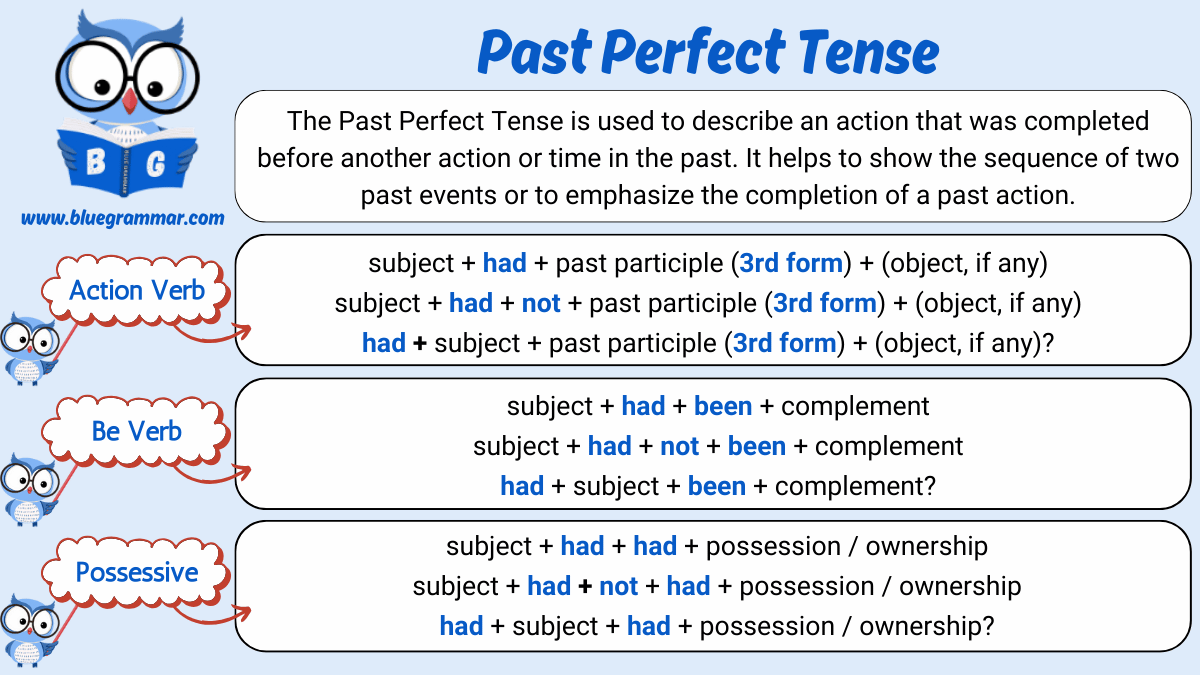
The Past Perfect Tense is used to describe an action that was completed before another action or a specific time in the past. It helps show the order of past events by making it clear which action happened first. The Past Perfect Tense is formed using had followed by the past participle (V3) of the main verb. It is commonly used to talk about completed actions, experiences, conditions, and events that occurred before another past action. In this comprehensive guide, you will learn the rules, sentence structures, uses, signal words, examples, common mistakes, and practice exercises for the Past Perfect Tense. You will also find free printable charts and worksheets to help you understand and use this tense with confidence.
Signal Words of the Past Perfect Tense
Signal words are words and phrases that often indicate the use of the Past Perfect Tense. They help us recognize that one action was completed before another action or a specific time in the past.
Common Signal Words
The following signal words are frequently used with the Past Perfect Tense:
- Before – She had finished her homework before her parents arrived.
- After – After they had eaten dinner, they went for a walk.
- By the time – By the time we reached the station, the train had left.
- Already – He had already completed the project.
- Just – She had just left when I called.
- Never – I had never seen snow before that trip.
- Ever – It was the best movie I had ever watched.
- Once – Once they had finished the meeting, they went home.
Common Time Expressions
The following time expressions are also commonly used with the Past Perfect Tense:
- Before 2020 – She had worked in Dubai before 2020.
- By last Friday – We had completed the report by last Friday.
- Before I arrived – They had left before I arrived.
- When I reached home – My mother had already prepared dinner when I reached home.
- Until then – He had never traveled abroad until then.
- By that time – By that time, the guests had gone home.
Note: Signal words help identify the Past Perfect Tense, but they are not required in every sentence. The relationship between two past events often makes the sequence of actions clear.
Forms of the Past Perfect Tense
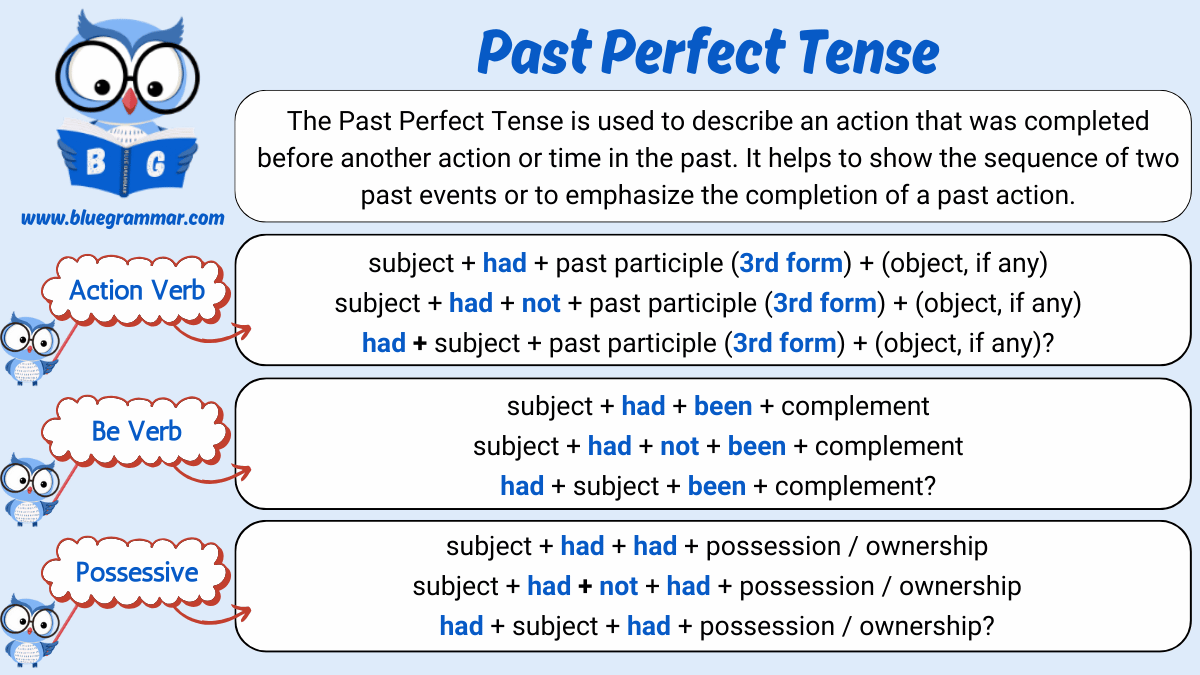
The Past Perfect Tense is commonly used in three forms, depending on the type of verb in the sentence. Each form follows its own sentence structure and is used to express completed actions, states, or possession before another past action or time.
1. Past Perfect with Action Verbs
Action verbs describe actions that were completed before another action or a specific time in the past. The Past Perfect is formed with had followed by the past participle (V3) of the main verb.
Examples:
- She had finished her homework before dinner.
- They had left before we arrived.
- I had written the email before the meeting started.
2. Past Perfect with the Verb "To Be"
The verb "to be" changes to its past participle been in the Past Perfect Tense. It is used to describe a person's identity, condition, location, profession, or characteristics before another point in the past.
Examples:
- She had been a teacher for ten years before she retired.
- He had been very tired before the journey ended.
- They had been at the airport before the storm began.
3. Past Perfect with the Verb "Have"
The verb have changes to its past participle had in the Past Perfect Tense. Together with the auxiliary had, it forms had had. This structure is used to describe possession, experiences, relationships, or other states that existed before another past action or time.
Examples:
- She had had the car for five years before she sold it.
- We had had lunch before the guests arrived.
- He had had a headache before taking the medicine.
In the following sections, you will learn how to form positive, negative, and interrogative sentences for each of these three forms, along with their rules, sentence structures, and examples.
Past Perfect Tense with Action Verbs
The Past Perfect Tense with action verbs is used to describe actions that were completed before another action or a specific time in the past. It helps show the sequence of past events by making it clear which action happened first. Action verbs express what a person, animal, or thing did, such as finish, write, visit, eat, and travel.

Positive Sentences
In positive sentences, use had followed by the past participle (V3) of the main verb.
Structure:
Subject + had + Past Participle (V3) + Object
Examples:
- I had finished my homework before dinner.
- She had visited her grandparents before moving abroad.
- They had completed the project before the deadline.
- He had written the report before the meeting.
- We had left the station before the train arrived.
Negative Sentences
In negative sentences, place not after had.
Structure:
Subject + had not + Past Participle (V3) + Object
Examples:
- I had not finished my homework.
- She had not visited London before that trip.
- They had not completed the project on time.
- He had not seen the movie before.
- We had not eaten breakfast before leaving.
Interrogative Sentences
In interrogative sentences, place had before the subject.
Structure:
Had + Subject + Past Participle (V3) + Object?
Examples:
- Had I finished my homework?
- Had she visited London before?
- Had they completed the project?
- Had he written the report?
- Had we eaten before the guests arrived?
Regular and Irregular Verbs
Action verbs in the Past Perfect Tense use the past participle (V3). Past participles are divided into two groups: regular verbs and irregular verbs.
Regular Verbs
Regular verbs form the past participle by adding -ed to the base verb. For regular verbs, the past simple and past participle forms are the same.
Examples:
- play → played → played
- work → worked → worked
- visit → visited → visited
- clean → cleaned → cleaned
- wash → washed → washed
Irregular Verbs
Irregular verbs do not follow a fixed pattern. Their past participle forms must be learned individually.
Examples:
- go → went → gone
- eat → ate → eaten
- write → wrote → written
- see → saw → seen
- buy → bought → bought
Remember: Every Past Perfect sentence requires the auxiliary verb had followed by the past participle (V3) of the main verb. The auxiliary had remains the same for all subjects.
Examples:
- She had finished her homework.
- She had not finished her homework.
- Had she finished her homework?
Past Perfect Tense with the Verb "To Be"
The verb "to be" changes to its past participle form "been" in the Past Perfect Tense. It is used to describe a person's identity, condition, location, profession, age, or characteristics that existed before another action or a specific time in the past. This form helps show that a state or condition had already existed before another past event occurred.

The Past Perfect form of the verb "to be" is:
- Had been – used with all subjects (I, you, he, she, it, we, they, and singular and plural nouns).
Positive Sentences
Structure:
Subject + had been + Complement
The complement may be a noun, an adjective, or a prepositional phrase.
Examples:
- She had been a teacher for ten years before she retired.
- He had been very tired after the long journey.
- They had been at the airport before the storm began.
- I had been busy all morning before you called.
- We had been close friends for many years.
Negative Sentences
Structure:
Subject + had not been + Complement
Examples:
- She had not been a member of the club.
- He had not been ready for the interview.
- They had not been at home all day.
- I had not been interested in that subject.
- We had not been aware of the problem.
Interrogative Sentences
Structure:
Had + Subject + been + Complement?
Examples:
- Had she been a teacher before moving abroad?
- Had he been ready for the interview?
- Had they been at the station before the train arrived?
- Had you been busy that morning?
- Had we been friends before college?
When Do We Use "Had Been"?
We use had been to describe a state, condition, identity, profession, age, location, or characteristic that existed before another action or time in the past.
Identity or Profession
Examples:
- She had been a nurse before becoming a lecturer.
- He had been a police officer for fifteen years.
Condition or State
Examples:
- I had been sick before the holidays started.
- They had been very excited about the trip.
Location
Examples:
- We had been at the museum before visiting the park.
- She had been in London before moving to Canada.
Characteristics or Relationships
Examples:
- They had been good friends since childhood.
- He had been an honest employee throughout his career.
Remember: The verb "to be" always changes to been in the Past Perfect Tense. The auxiliary verb had is used with every subject, followed by been and a complement.
Past Perfect Tense with the Verb "Have"
The verb "have" changes to its past participle form "had" in the Past Perfect Tense. Together with the auxiliary verb had, it forms the structure had had. This form is used to describe possession, ownership, relationships, experiences, health conditions, or completed activities that existed before another action or a specific time in the past.

The Past Perfect form of the verb "have" is:
- Had had – used with all subjects (I, you, he, she, it, we, they, and singular and plural nouns).
Positive Sentences
Structure:
Subject + had had + Object
Examples:
- She had had the same car for five years before she sold it.
- He had had a headache before taking the medicine.
- They had had enough time to prepare for the competition.
- We had had lunch before the meeting started.
- I had had several opportunities to visit the city.
Negative Sentences
Structure:
Subject + had not had + Object
Examples:
- She had not had any experience before getting the job.
- He had not had breakfast before leaving home.
- They had not had enough money to buy the house.
- We had not had any problems until then.
- I had not had the chance to speak with her.
Interrogative Sentences
Structure:
Had + Subject + had + Object?
Examples:
- Had she had the car for many years?
- Had he had breakfast before school?
- Had they had enough time to finish the project?
- Had we had any previous experience?
- Had you had the opportunity to meet the manager?
When Do We Use "Had Had"?
We use had had to describe possession, ownership, relationships, experiences, health conditions, or completed activities that existed before another action or time in the past.
Possession or Ownership
Examples:
- She had had the house for ten years before selling it.
- He had had the same bicycle since childhood.
Experiences or Opportunities
Examples:
- I had had the opportunity to study abroad.
- They had had several exciting adventures before returning home.
Meals or Activities
Examples:
- We had had dinner before the guests arrived.
- She had had a meeting before coming to the office.
Health or Physical Conditions
Examples:
- He had had a fever before visiting the doctor.
- I had had a terrible cold the week before.
Remember: Although had had may look unusual, it is grammatically correct. The first had is the auxiliary verb, and the second had is the past participle of the verb "have". This structure is used with all subjects in the Past Perfect Tense.
Examples of the Past Perfect Tense
The following examples demonstrate how the Past Perfect Tense is used in different situations. They include completed actions before another past action, experiences, conditions, possession, and examples with the verbs "to be" and "have".
Completed Actions Before Another Past Action
- She had finished her homework before her parents arrived.
- They had left the station before the train arrived.
- I had completed the report before the meeting started.
- He had locked the door before going to bed.
- We had eaten dinner before watching the movie.
Past Experiences
- I had never visited Paris before that trip.
- She had already seen the movie before we watched it together.
- They had traveled to many countries before moving to Canada.
- He had never driven a truck before getting the job.
- We had met each other before the conference.
Examples with the Verb "To Be"
- She had been a teacher before becoming a principal.
- He had been very tired after the long journey.
- They had been at the airport before the flight was delayed.
- I had been busy all morning before you called.
- We had been close friends since childhood.
Examples with the Verb "Have"
- She had had the same car for five years before selling it.
- He had had breakfast before leaving for work.
- They had had enough time to finish the project.
- We had had dinner before the guests arrived.
- I had had a headache before taking the medicine.
Using Time Expressions
- By the time I reached home, everyone had gone to bed.
- After she had completed the assignment, she went outside.
- Before we arrived, the guests had already left.
- The movie had started before we entered the cinema.
- They had cleaned the house before the visitors arrived.
Common Mistakes in the Past Perfect Tense
Students often make mistakes when using the Past Perfect Tense, especially with the auxiliary verb had, the past participle (V3), and the verbs "to be" and "have". Understanding these common errors will help you use the tense correctly.
1. Using the Simple Past Instead of the Past Participle
Always use the past participle (V3) after had, not the simple past form.
Incorrect: She had went home.
Correct: She had gone home.
Incorrect: He had ate breakfast.
Correct: He had eaten breakfast.
2. Omitting the Auxiliary Verb "Had"
Every Past Perfect sentence requires the auxiliary verb had.
Incorrect: She finished her homework before dinner.
Correct: She had finished her homework before dinner.
Incorrect: They left before we arrived.
Correct: They had left before we arrived.
3. Using "Had" with the Wrong Verb Form
After had, always use the past participle (V3), not the base form.
Incorrect: We had finish the project.
Correct: We had finished the project.
Incorrect: She had write the letter.
Correct: She had written the letter.
4. Using the Past Perfect Without a Clear Past Reference
The Past Perfect Tense is generally used to show that one action happened before another past action or time.
Incorrect: I had finished my homework yesterday.
Correct: I finished my homework yesterday.
Correct: I had finished my homework before my friend arrived.
5. Confusing "Had Been" with "Was/Were"
Use had been when describing a state or condition that existed before another past event.
Incorrect: She was a teacher before she retired.
Correct: She had been a teacher before she retired.
Incorrect: They were at the station before the train arrived.
Correct: They had been at the station before the train arrived.
6. Confusing "Had Had"
Remember that had had is grammatically correct. The first had is the auxiliary verb, and the second had is the past participle of "have".
Incorrect: She had a car before she moved.
Correct: She had had a car before she moved.
Incorrect: We had breakfast before leaving.
Correct: We had had breakfast before leaving.
Tip: Before writing or speaking in the Past Perfect Tense, check the following:
- Did you use the auxiliary verb had?
- Is the main verb in the past participle (V3) form?
- Does the sentence show an action completed before another past action or time?
- Did you use had been correctly with the verb "to be"?
- Did you use had had correctly with the verb "have"?
Practice Exercise
Test your understanding of the Past Perfect Tense by completing the following exercises. Try to answer each question before checking the correct answers.
Exercise 1: Fill in the Blanks
Complete each sentence with the correct form of the verb in brackets.
- She __________ her homework before dinner. (finish)
- They __________ before we arrived. (leave)
- I __________ the email before the meeting started. (write)
- We __________ lunch before the guests arrived. (have)
- He __________ very tired after the long journey. (be)
- The train __________ before we reached the station. (depart)
- She __________ the movie before watching it again. (see)
- They __________ the project by last Friday. (complete)
- I __________ a headache before taking the medicine. (have)
- He __________ in London before moving to Canada. (live)
Exercise 2: Make the Sentences Negative
Rewrite the following sentences in the negative form.
- She had finished the report.
- They had had breakfast.
- He had been busy all day.
- We had completed the assignment.
- I had visited Dubai before.
Exercise 3: Change the Sentences into Questions
Rewrite the following sentences as interrogative sentences.
- She had finished her homework.
- They had left the office.
- He had been a teacher.
- We had had dinner.
- I had written the email.
Exercise 4: Choose the Correct Answer
Choose the correct option.
- She ________ her homework before dinner.
a) finished
b) had finished
c) has finished - They ________ before we arrived.
a) had left
b) left
c) leave - He ________ very tired after the trip.
a) had been
b) was being
c) has been - We ________ lunch before the meeting started.
a) had had
b) had
c) have had - I ________ the report before the deadline.
a) had completed
b) completed
c) complete
Exercise 5: Correct the Mistakes
Find and correct the mistake in each sentence.
- She had went home before sunset.
- They had finish the project.
- He had a headache before taking the medicine.
- We had been at the station before the train arrived yesterday morning.
- I had ate breakfast before school.
Tip: Practice regularly with different sentence patterns to become confident in using the Past Perfect Tense. You can also download our free printable worksheets for additional exercises and revision.
Short Summary
The Past Perfect Tense is used to describe an action, state, or condition that was completed before another action or a specific time in the past. It is formed with the auxiliary verb had followed by the past participle (V3) of the main verb. The Past Perfect Tense is commonly used to show the sequence of past events, describe earlier experiences, and express previous states or possession using forms such as had been and had had. By understanding the rules, sentence structures, signal words, and common mistakes, you can use the Past Perfect Tense accurately and confidently in both spoken and written English.
Download Free Past Perfect Tense Worksheets
Master the Past Perfect Tense with our free printable worksheets. These worksheets are designed for students, teachers, parents, and English language learners to practice sentence formation, verb forms, and correct tense usage through a variety of engaging exercises.
You can download and print the worksheets for classroom lessons, homework, self-study, revision, or exam preparation.
Visit our page Past Tense Worksheets to download A4 size printable worksheets.