
Introduction
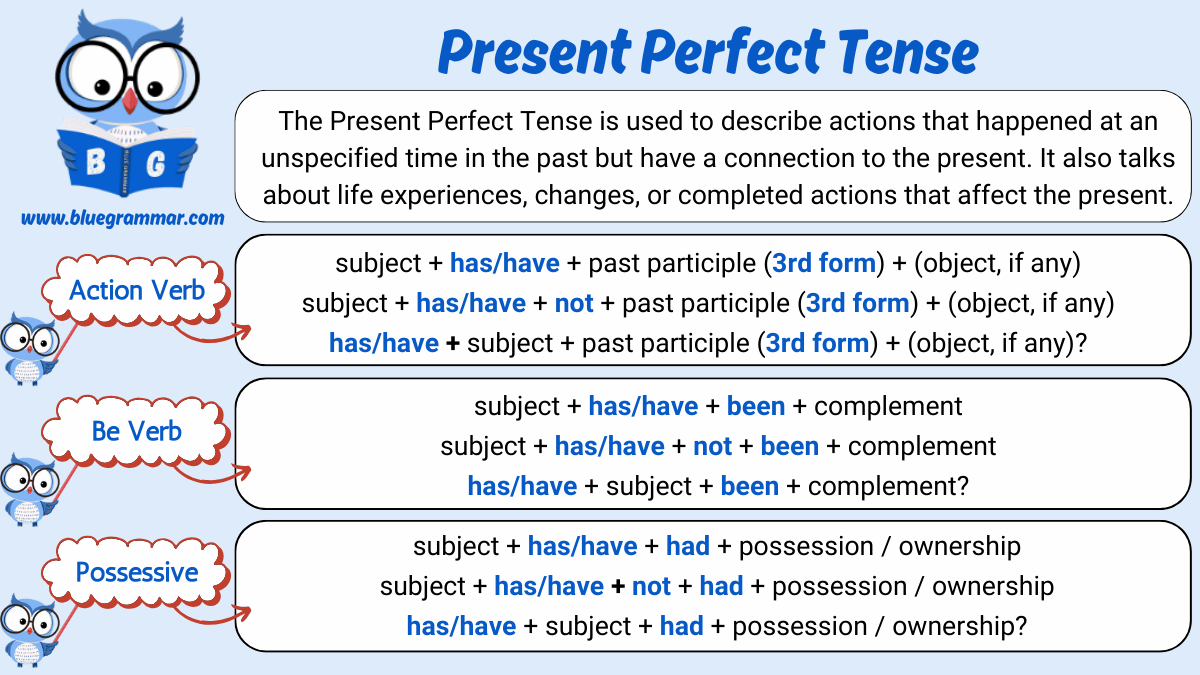
The Present Perfect Tense is used to describe actions or events that happened at an unspecified time in the past but are connected to the present. It is commonly used to talk about completed actions with present results, life experiences, actions that started in the past and continue to the present, and recently completed activities.
The Present Perfect Tense is formed using the helping verbs has or have followed by the past participle (third form) of the main verb. For example, I have finished my homework, She has visited London, and They have lived here for ten years.
In this complete guide, you will learn when to use the Present Perfect Tense, its sentence structures, signal words, rules for forming the past participle, common mistakes, examples, practice exercises, and free printable worksheets to help you master this important English tense.
What Is the Present Perfect Tense?
The Present Perfect Tense is used to describe actions or events that happened in the past but have a connection to the present. It emphasizes the result or effect of the action rather than the exact time it happened. Because the specific time is not mentioned, the Present Perfect Tense is often used to talk about experiences, achievements, completed actions with present results, and situations that continue up to the present.
The Present Perfect Tense is formed using the helping verbs has or have followed by the past participle (third form) of the main verb.
Examples:
- I have finished my homework.
- She has visited London.
- They have lived here for ten years.
- We have completed the project.
- He has lost his keys.
Remember: The Present Perfect Tense does not usually mention a specific past time such as yesterday, last week, or in 2024. If a specific past time is mentioned, the Past Simple Tense is normally used instead.
When Do We Use the Present Perfect Tense?
The Present Perfect Tense is used to describe actions or situations that happened in the past but are connected to the present. It is commonly used for completed actions with present results, life experiences, actions that continue up to the present, recently completed actions, and actions where the exact time is not important.
1. Completed Actions with Present Results
Use the Present Perfect Tense to describe actions that have been completed, where the result or effect is important now.
Examples:- She has finished her homework.
- I have lost my wallet.
- They have cleaned the classroom.
- He has broken his glasses.
- We have completed the project.
2. Life Experiences
Use the Present Perfect Tense to talk about experiences without mentioning when they happened.
Examples:- I have visited Dubai.
- She has traveled to Turkey.
- They have never seen snow.
- We have ridden a camel.
- He has climbed a mountain.
3. Actions That Started in the Past and Continue to the Present
Use the Present Perfect Tense to describe actions or situations that began in the past and are still true now. These sentences often include for and since.
Examples:- I have lived here for ten years.
- She has worked at this company since 2020.
- They have known each other since childhood.
- We have studied English for five years.
- He has taught mathematics since January.
4. Recently Completed Actions
Use the Present Perfect Tense with words such as just, recently, and lately to describe actions that happened a short time ago.
Examples:- I have just finished my lunch.
- She has recently joined our team.
- They have just arrived at the station.
- We have recently moved to a new house.
- He has just called me.
5. Actions with Already, Yet, and Still
Use the Present Perfect Tense with already, yet, and sometimes still to describe completed or expected actions.
Examples:- I have already finished my assignment.
- She has already left the office.
- Have you finished your homework yet?
- They haven't arrived yet.
- He still hasn't replied to my email.
6. Accomplishments and Achievements
Use the Present Perfect Tense to talk about achievements or accomplishments when the exact time is not important.
Examples:- She has won several awards.
- They have published three books.
- I have passed the driving test.
- We have reached our goal.
- He has learned three languages.
Remember: The Present Perfect Tense is used when the connection to the present is important or the exact time of the action is unknown or unnecessary. If you mention a specific past time such as yesterday, last week, or in 2023, use the Past Simple Tense instead.
Signal Words of the Present Perfect Tense
Signal words help identify when the Present Perfect Tense should be used. These words and phrases usually indicate that an action has been completed, has a connection to the present, or started in the past and continues until now.
Common signal words include:
- Already – She has already finished her homework.
- Just – I have just eaten lunch.
- Yet – Have you finished your project yet?
- Ever – Have you ever visited Paris?
- Never – He has never ridden a horse.
- Recently – They have recently moved to a new city.
- Lately – I have been very busy lately.
- So far – We have completed five chapters so far.
- Until now – She has answered all the questions until now.
- Up to now – Up to now, they have raised enough money.
- To date – The company has completed twenty projects to date.
- For – I have lived here for ten years.
- Since – She has worked here since 2021.
- Today (when the time period has not finished) – I have had three meetings today.
- This week – We have learned two new grammar rules this week.
- This month – He has read four books this month.
- This year – They have visited three countries this year.
Remember: Signal words are useful clues, but they do not always determine the tense by themselves. Always consider whether the action has a connection to the present or whether the exact time is unimportant. If a specific past time is mentioned, such as yesterday, last week, or in 2024, the Past Simple Tense is usually the correct choice.
Forms of the Present Perfect Tense
The Present Perfect Tense is commonly used in three forms, depending on the type of verb and the meaning of the sentence. Each form follows a different sentence structure and is used in specific situations.
1. Present Perfect with Action Verbs
Action verbs describe actions that have been completed at an unspecified time in the past or actions whose results are important in the present. This is the most common use of the Present Perfect Tense.
Examples:
- She has written a letter.
- They have completed the project.
- I have finished my homework.
2. Present Perfect with the Verb "To Be"
The verb "to be" uses been, the past participle of be, in the Present Perfect Tense. It is used to describe states, conditions, or situations that have existed or changed before the present.
Examples:
- I have been busy all day.
- She has been absent from school.
- They have been very helpful.
3. Present Perfect with the Verbs "Have" and "Has"
When have is the main verb, its past participle is had. The Present Perfect Tense is formed with have had or has had. This form is used to describe possession, experiences, or situations that have occurred before the present.
Examples:
- She has had a headache since morning.
- We have had many opportunities.
- They have had three meetings today.
Note: In the Present Perfect Tense, had is the past participle of have. Do not confuse it with the helping verb had, which is used to form the Past Perfect Tense.
In the following sections, you will learn how to form positive, negative, and interrogative sentences for each of these three forms, along with their rules, sentence structures, and examples.
Forming the Past Participle (Regular & Irregular Verbs)
The Present Perfect Tense is formed with has or have followed by the past participle (third form) of the main verb. Regular verbs form the past participle by adding -ed, while irregular verbs have unique past participle forms that must be learned individually.
1. Regular Verbs: Add -ed
Most regular verbs form the past participle by adding -ed to the base verb.
Examples:- work → worked
- play → played
- clean → cleaned
- visit → visited
- watch → watched
2. Verbs Ending in -e: Add -d
If a verb ends in -e, simply add -d.
Examples:- live → lived
- move → moved
- arrive → arrived
- love → loved
- change → changed
3. Verbs Ending in Consonant + y: Change y to i and Add -ed
If a verb ends in a consonant followed by y, change the y to i before adding -ed.
Examples:- study → studied
- carry → carried
- try → tried
- cry → cried
- worry → worried
Exception: If the verb ends in a vowel followed by y, simply add -ed.
Examples:- play → played
- enjoy → enjoyed
- stay → stayed
4. One-Syllable Verbs Ending in Consonant–Vowel–Consonant (CVC)
Double the final consonant before adding -ed.
Examples:- stop → stopped
- plan → planned
- shop → shopped
- drop → dropped
- beg → begged
5. Irregular Verbs
Irregular verbs do not follow a fixed spelling rule. Their past participle forms must be memorized.
Examples:- be → been
- begin → begun
- break → broken
- come → come
- do → done
- eat → eaten
- go → gone
- see → seen
- speak → spoken
- write → written
Remember: Always use the past participle (third form) of the verb after has or have. Do not use the base form or the simple past form.
Examples:- I have written a letter. ✔
I have wrote a letter.✘- She has gone home. ✔
She has went home.✘
Present Perfect Tense with Action Verbs
The Present Perfect Tense is most commonly used with action verbs to describe actions that have been completed at an unspecified time in the past, actions whose results are important in the present, or situations that started in the past and continue until now.
Action verbs describe physical or mental activities, such as write, read, play, eat, study, work, and finish. In the Present Perfect Tense, these verbs are used with the helping verbs has or have followed by the past participle (third form) of the main verb.

For example:
- She has written a letter.
- They have completed the project.
- I have finished my homework.
Making Positive Sentences
Structure:
Subject + has/have + past participle (third form) + object (if any)
Examples with Object:
- She has written a letter.
- They have completed the project.
- We have finished our homework.
Examples without Object:
- He has arrived.
- I have graduated.
- The train has left.
Making Negative Sentences
Structure:
Subject + has/have + not + past participle (third form) + object (if any)
Examples with Object:
- She has not written a letter.
- We have not completed the assignment.
- He has not finished his homework.
Examples without Object:
- I have not arrived.
- They have not left.
- The bus has not come.
Making Interrogative Sentences
Structure:
Has/Have + subject + past participle (third form) + object (if any)?
Examples with Object:
- Has she written a letter?
- Have they completed the project?
- Have you finished your homework?
Examples without Object:
- Has he arrived?
- Have they left?
- Has the train departed?
Remember: Always use the past participle (third form) after has or have. Do not use the base form or the simple past form.
She has write a letter.- She has written a letter.
They have went home.- They have gone home.
Present Perfect with the Verb "To Be"
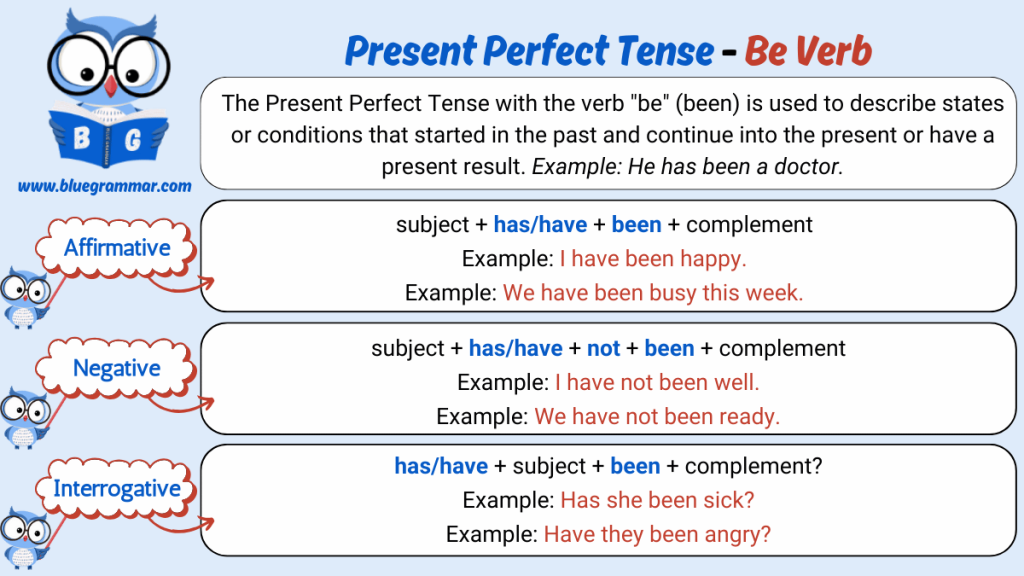
The verb "to be" can also be used as the main verb in the Present Perfect Tense. In this case, the past participle been is used after the helping verbs has or have.
Unlike the Present Simple Tense, which describes present states, the Present Perfect with been describes states, conditions, or situations that began in the past and continue to the present or have a connection to the present.
For example:
- She has been very busy today.
- He has been absent from school.
- They have been good friends for many years.
- I have been happy since morning.
- We have been ready for the meeting.
When Do We Use Been?
Use been to describe:
- States or conditions that continue to the present
- Temporary or permanent situations connected to the present
- People's feelings or physical conditions
- Locations or situations that have existed until now
Making Positive Sentences
Structure:
Subject + has/have + been + complement
Examples:
- She has been busy all day.
- He has been ill since Monday.
- They have been very supportive.
- I have been tired lately.
- We have been ready for the exam.
Making Negative Sentences
Structure:
Subject + has/have + not + been + complement
Examples:
- She has not been available today.
- He has not been well this week.
- They have not been honest.
- I have not been busy recently.
- We have not been late this month.
Making Interrogative Sentences
Structure:
Has/Have + subject + been + complement?
Examples:
- Has she been busy today?
- Have they been helpful?
- Have you been tired lately?
- Has he been absent from school?
- Have we been careful enough?
Remember: The word been is the past participle (third form) of the verb be. Always use been after has or have in the Present Perfect Tense.
She has be very busy.- She has been very busy.
They have be good friends.- They have been good friends.
Present Perfect with the Verbs "Have" and "Has"
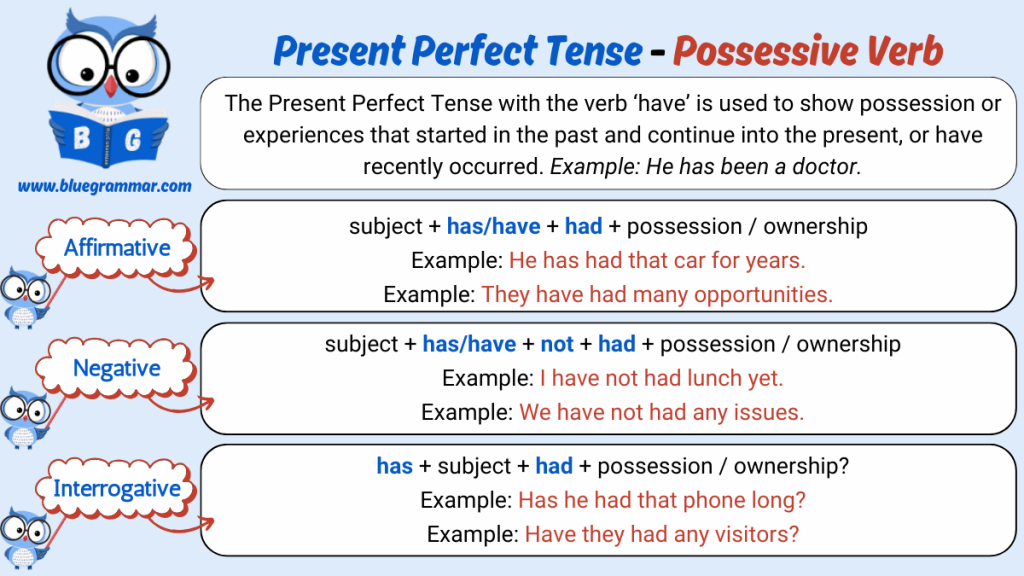
When have is the main verb, its past participle is had. In the Present Perfect Tense, the verbs have and has are used with the past participle had to form have had or has had. This structure is used to describe possession, experiences, relationships, or situations that began in the past and have a connection to the present.
Although the words have and had appear together, they perform different functions. Have or has acts as the helping verb, while had is the past participle (third form) of the main verb have.
When Do We Use Have Had and Has Had?
Use have had or has had to describe:
- Possession or ownership connected to the present
- Experiences in life
- Health problems or illnesses
- Meals, conversations, meetings, or other completed experiences
- Situations that started in the past and continue until now
Examples:
- I have had this laptop for five years.
- She has had a headache since morning.
- They have had several meetings this week.
- We have had many wonderful experiences together.
- He has had the same job since 2020.
Making Positive Sentences
Structure:
Subject + has/have + had + object
Examples:
- She has had a busy day.
- They have had two lessons today.
- We have had enough practice.
- I have had this phone for three years.
- He has had several opportunities.
Making Negative Sentences
Structure:
Subject + has/have + not + had + object
Examples:
- She has not had breakfast yet.
- They have not had any problems.
- We have not had enough time.
- I have not had a holiday this year.
- He has not had any experience in teaching.
Making Interrogative Sentences
Structure:
Has/Have + subject + had + object?
Examples:
- Have you had lunch yet?
- Has she had her interview?
- Have they had enough practice?
- Has he had any problems?
- Have we had this discussion before?
Remember: In the Present Perfect Tense, had is the past participle (third form) of the verb have. It is not the helping verb used in the Past Perfect Tense.
She has have a new car.- She has had a new car for two years.
They have have many opportunities.- They have had many opportunities.
Present Perfect vs. Past Simple
The Present Perfect Tense and the Past Simple Tense both describe actions that happened in the past, but they are used in different situations. The Present Perfect emphasizes the connection between the past and the present, while the Past Simple describes completed actions at a specific time in the past.
When to Use the Present Perfect Tense
Use the Present Perfect Tense when the exact time of the action is unknown, unimportant, or the action has a result that affects the present.
Examples:
- I have finished my homework.
- She has visited London.
- They have lived here for ten years.
- We have completed the project.
- He has lost his keys.
When to Use the Past Simple Tense
Use the Past Simple Tense when the action happened at a specific time in the past. The time may be stated directly or understood from the context.
Examples:
- I finished my homework yesterday.
- She visited London in 2023.
- They lived here for ten years before moving away.
- We completed the project last Friday.
- He lost his keys this morning.
Common Time Expressions
Present Perfect:
- already
- just
- yet
- ever
- never
- recently
- lately
- so far
- for
- since
Past Simple:
- yesterday
- last week
- last month
- last year
- ago
- in 2024
- on Monday
- this morning (when the time has finished)
Compare the Sentences
- I have seen that movie. (The experience is important; the time is not mentioned.)
- I saw that movie last weekend. (The exact time is given.)
- She has lost her phone. (She still does not have it.)
- She lost her phone yesterday, but she found it later. (A completed past event.)
- We have lived here for five years. (We still live here.)
- We lived there for five years. (We no longer live there.)
Remember: Do not use the Present Perfect Tense with specific past time expressions such as yesterday, last week, last year, or in 2023. When a definite past time is mentioned, use the Past Simple Tense instead.
I have visited Lahore yesterday.- I visited Lahore yesterday.
She has finished her homework last night.- She finished her homework last night.
Examples of the Present Perfect Tense
The following examples demonstrate how the Present Perfect Tense is used in different situations. They include sentences with action verbs, completed actions, life experiences, actions that continue to the present, and the verbs "to be", "have", and "has".
Completed Actions with Present Results
- I have finished my homework.
- She has cleaned her room.
- We have completed the project.
- He has broken his glasses.
- They have locked the door.
Life Experiences
- I have visited Dubai.
- She has traveled to Turkey.
- We have ridden a camel.
- He has climbed a mountain.
- They have never seen snow.
Actions That Continue to the Present
- I have lived here for ten years.
- She has worked at this company since 2020.
- We have known each other since childhood.
- He has studied English for five years.
- They have stayed in the same neighborhood since 2018.
Recently Completed Actions
- I have just finished my lunch.
- She has recently joined our team.
- We have already completed the assignment.
- He has just arrived home.
- They have not left yet.
Achievements and Accomplishments
- She has won several awards.
- They have published three books.
- I have passed the driving test.
- We have reached our goal.
- He has learned three languages.
Examples with the Verb "To Be"
- I have been busy all day.
- She has been absent from school.
- We have been ready since morning.
- He has been very helpful.
- They have been close friends for years.
Examples with Have and Has
- I have had this laptop for three years.
- She has had a headache since morning.
- We have had several meetings this week.
- He has had many opportunities.
- They have had a wonderful vacation.
Note: In the Present Perfect Tense, use has or have followed by the past participle (third form) of the main verb. Do not use the Present Perfect with specific past time expressions such as yesterday, last week, or in 2024. Use the Past Simple Tense instead.
Common Mistakes in the Present Perfect Tense
Learners often make mistakes when using the Present Perfect Tense, especially with the helping verbs has and have, the past participle (third form) of verbs, and the difference between the Present Perfect and the Past Simple Tense. Understanding these common errors will help you use the tense correctly in both spoken and written English.
1. Using the Base Form Instead of the Past Participle
Always use the past participle (third form) of the verb after has or have.
She has write a letter.- She has written a letter.
They have go home.- They have gone home.
2. Using the Simple Past Instead of the Past Participle
Many irregular verbs have different past simple and past participle forms.
He has went to school.- He has gone to school.
I have ate my lunch.- I have eaten my lunch.
3. Using the Wrong Helping Verb
Use has with singular third-person subjects and have with I, you, we, and they.
She have finished her work.- She has finished her work.
They has completed the project.- They have completed the project.
I has seen that movie.- I have seen that movie.
4. Using the Present Perfect with a Specific Past Time
Do not use the Present Perfect Tense with specific past time expressions such as yesterday, last week, or in 2024.
She has visited Lahore yesterday.- She visited Lahore yesterday.
We have finished the project last Friday.- We finished the project last Friday.
5. Omitting the Helping Verb
Every Present Perfect sentence requires the helping verb has or have.
She finished her homework.(if you mean Present Perfect)- She has finished her homework.
They completed the assignment.(if you mean Present Perfect)- They have completed the assignment.
6. Confusing Been and Gone
Been means someone went somewhere and returned, while gone means the person has gone and has not returned yet.
She has gone to London twice.- She has been to London twice.
- He has gone to the supermarket. (He is still there.)
7. Incorrect Word Order in Questions
In interrogative sentences, place has or have before the subject.
She has finished her homework?- Has she finished her homework?
They have completed the project?- Have they completed the project?
8. Using For and Since Incorrectly
Use for with a period of time and since with a starting point.
I have lived here since five years.- I have lived here for five years.
She has worked here for 2021.- She has worked here since 2021.
Tip: Before writing or speaking in the Present Perfect Tense, check that:
- You have used has or have correctly.
- The main verb is in the past participle (third form).
- You have not used a specific past time expression with the Present Perfect.
- You have used been, gone, and had correctly.
- Questions begin with Has or Have.
Practice Exercise
Test your understanding of the Present Perfect Tense by completing the following exercises. Try to answer each question without looking at the rules. Once you finish, check your answers and identify any mistakes.
Exercise 1: Fill in the Blanks
Complete each sentence with the correct form of the verb in brackets.
- She __________ her homework. (finish)
- They __________ to London twice. (travel)
- I __________ this book before. (read)
- He __________ his keys. (lose)
- We __________ the project successfully. (complete)
- The children __________ all the cookies. (eat)
- My father __________ at this company for ten years. (work)
- You __________ a great job. (do)
- She __________ very busy today. (be)
- They __________ lunch yet. (have)
Exercise 2: Make the Sentences Negative
Rewrite the following sentences in the negative form.
- She has finished her homework.
- They have visited Turkey.
- He has been very helpful.
- We have completed the assignment.
- I have had breakfast.
Exercise 3: Change the Sentences into Questions
Rewrite the following sentences as interrogative sentences.
- She has written a letter.
- They have completed the project.
- He has had lunch.
- We have been ready since morning.
- The students have finished the test.
Exercise 4: Correct the Mistakes
Find and correct the mistake in each sentence.
- She has write a letter.
- They has completed the project.
- I have went to Dubai.
- He has visited Lahore yesterday.
- Have she finished her homework?
Tip: The Present Perfect Tense is formed with has or have followed by the past participle (third form) of the main verb. Pay special attention to irregular verbs, the correct use of has and have, and avoid using the Present Perfect with specific past time expressions such as yesterday or last week.
Short Summary
The Present Perfect Tense is used to describe actions or events that happened in the past but have a connection to the present. It is commonly used for completed actions with present results, life experiences, actions that started in the past and continue to the present, and recently completed actions. The tense is formed using has or have followed by the past participle (third form) of the main verb. By learning its rules, sentence structures, signal words, common mistakes, and practicing with examples and worksheets, you can use the Present Perfect Tense accurately and confidently in everyday English.
Download Free Present Perfect Worksheets
Improve your understanding of the Present Perfect Tense with our free printable worksheets. These worksheets are designed for students, teachers, parents, and ESL/EFL learners and provide a variety of exercises to strengthen your grammar skills.
You can download and print the worksheets for classroom activities, homework, self-study, revision, or test preparation.
Our Present Perfect worksheets include:
- Fill in the blanks
- Sentence transformation exercises
- Positive, negative, and interrogative sentence practice
- Error correction activities
- Regular and irregular verb practice
- Present Perfect vs. Past Simple exercises
- For and since practice
- Already, just, yet, ever, and never exercises
- Answer keys for self-checking
- Printable PDF worksheets for classroom and home use
Download the worksheets below and practice regularly to improve your understanding of the Present Perfect Tense and build greater confidence in English grammar.
Visit our page Present Tense Worksheets to download A4 size printable worksheets.