
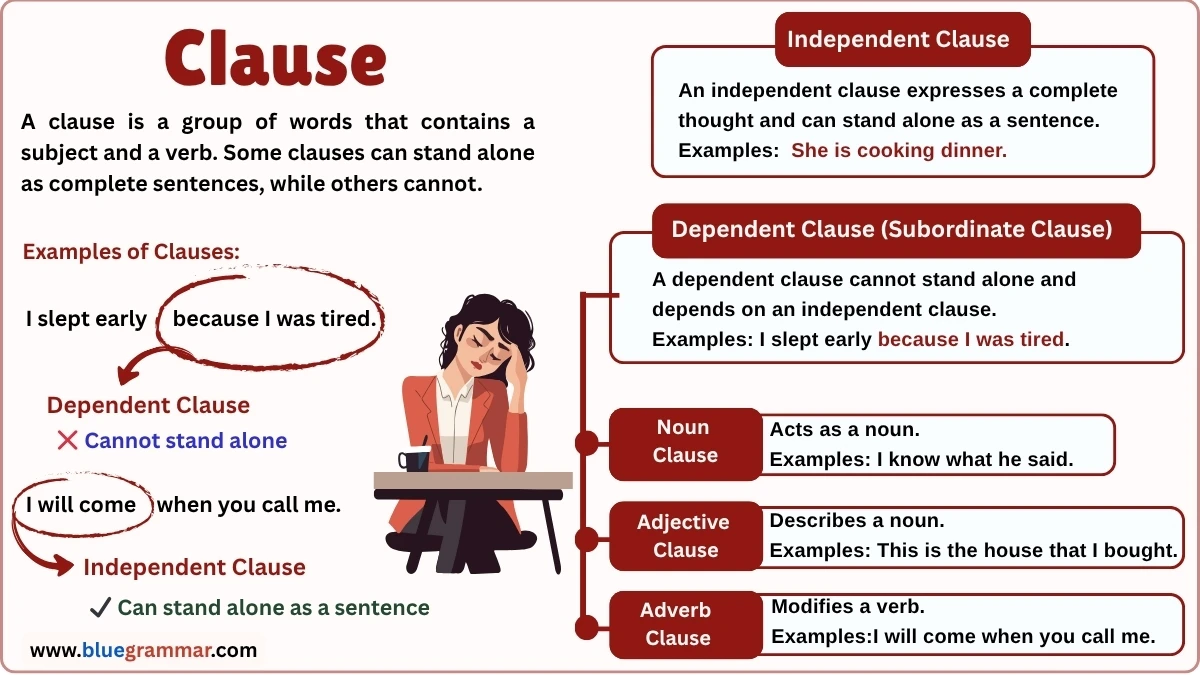
A clause is a group of words that contains a subject and a verb. Unlike a phrase, a clause can sometimes express a complete thought. Clauses are important in forming sentences and are mainly divided into two types: independent clauses and dependent clauses.
Types of Clauses
Understanding the different types of clauses helps in writing correct and meaningful sentences.
Independent Clause
An independent clause is a group of words that has a subject and a verb and expresses a complete thought. It can stand alone as a sentence.
Examples
- Sentence: She is reading a book.
- Analysis: “She is reading a book” is the clause. It is an independent clause because it has a subject (She), a verb (is reading), and gives complete meaning.
- Sentence: They went to the market.
- Analysis: “They went to the market” is the clause. It is an independent clause because it can stand alone as a complete sentence.
Dependent Clause (Subordinate Clause)
A dependent clause also has a subject and a verb but does not express a complete thought. It cannot stand alone and depends on an independent clause.
Examples
- Clause: because she was tired
- Analysis: “she was tired” has a subject and verb, but the word “because” makes it incomplete. It is a dependent clause because it needs more information.
- Clause: when the teacher arrived
- Analysis: “the teacher arrived” is complete, but “when” makes it dependent. It is a dependent clause because it cannot stand alone.
Types of Dependent Clauses
Dependent clauses are further divided based on their function in a sentence.
a) Noun Clause
A noun clause acts as a noun in a sentence. It can be a subject, object, or complement.
Examples
- Sentence: I know what he said.
- Analysis: “what he said” is the clause. It is a noun clause because it acts as the object of the verb “know.”
- Sentence: What she believes is true.
- Analysis: “What she believes” is the clause. It is a noun clause because it acts as the subject of the sentence.
b) Adjective Clause (Relative Clause)
An adjective clause describes a noun or pronoun. It usually begins with words like who, which, that, whose, or whom.
Examples
- Sentence: The boy who is playing is my brother.
- Analysis: “who is playing” is the clause. It is an adjective clause because it describes “the boy.”
- Sentence: This is the house that I bought.
- Analysis: “that I bought” is the clause. It is an adjective clause because it gives more information about “the house.”
c) Adverb Clause
An adverb clause modifies a verb, adjective, or another adverb. It tells when, why, how, where, or under what condition something happens.
Examples
- Sentence: I will come when you call me.
- Analysis: “when you call me” is the clause. It is an adverb clause because it tells when I will come.
- Sentence: She stayed home because it was raining.
- Analysis: “because it was raining” is the clause. It is an adverb clause because it tells why she stayed home.
Key Points to Remember
- A clause always has a subject and a verb.
- Independent clauses can stand alone; dependent clauses cannot.
- Dependent clauses function as nouns, adjectives, or adverbs.
- Words like because, when, if, who, and that often introduce dependent clauses.
Conclusion
Clauses are essential building blocks of sentences. Independent clauses form complete sentences, while dependent clauses add extra information. By understanding noun clauses, adjective clauses, and adverb clauses, you can create more complex and meaningful sentences.
Practice identifying clauses in everyday sentences to strengthen your grammar skills.