
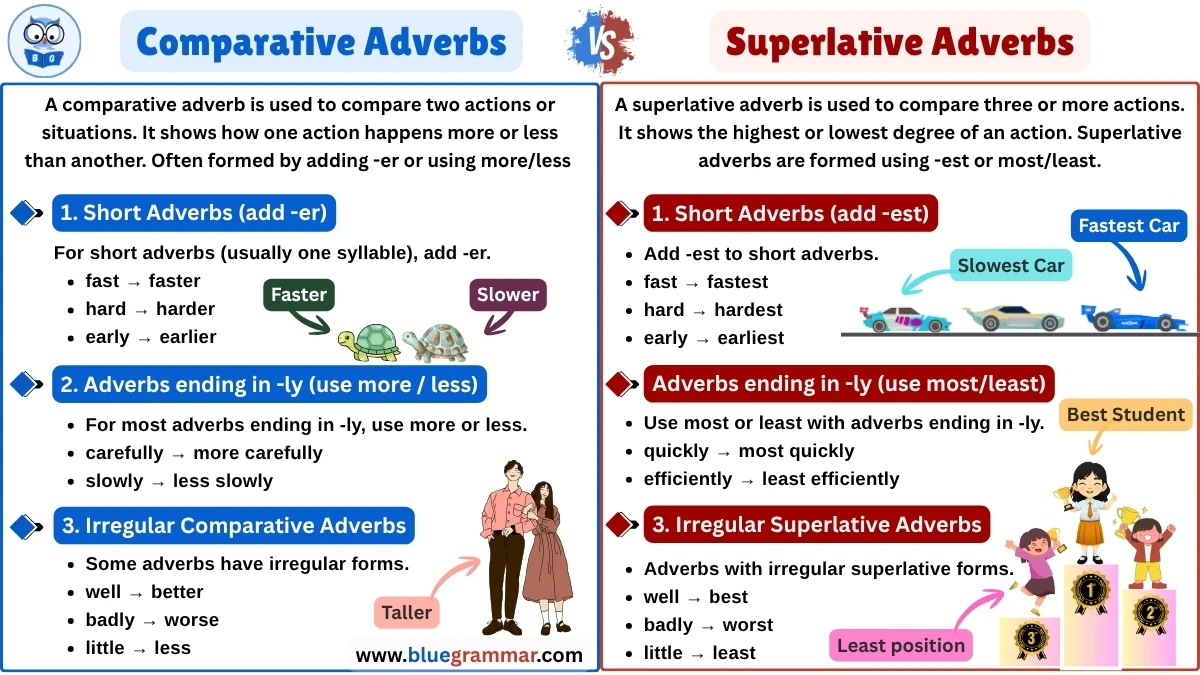
Comparative and superlative adverbs are important parts of English grammar. They help us compare actions and describe how something is done in relation to others. A clear understanding of these forms allows learners to express differences and extremes more accurately in speaking and writing.
This guide explains what comparative and superlative adverbs are, how they are formed, and how to use them correctly with examples.
What is an Adverb?
An adverb describes a verb, an adjective, or another adverb. It usually tells us how, when, where, or to what extent something happens.
Examples:
- She sings beautifully.
- He runs fast.
- They arrived early.
Adverbs often end in -ly, but not always.
What are Comparative Adverbs?
A comparative adverb is used to compare two actions or situations. It shows how one action happens more or less than another. Comparative adverbs are often formed by adding -er or using more/less before the adverb.
Formation of Comparative Adverbs
1. Short Adverbs (add -er)
For short adverbs (usually one syllable), add -er.
- fast → faster
- hard → harder
- early → earlier
Sentences:
- He runs faster than his brother.
- She works harder than before.
- They arrived earlier than us.
2. Adverbs ending in -ly (use more/less)
For most adverbs ending in -ly, use more or less.
- quickly → more quickly
- carefully → more carefully
- slowly → less slowly
Sentences:
- She speaks more clearly than him.
- He drives more carefully now.
- They reacted less quickly this time.
3. Irregular Comparative Adverbs
Some adverbs have irregular forms.
- well → better
- badly → worse
- little → less
- much → more
Sentences:
- She sings better than me.
- He performed worse than expected.
What are Superlative Adverbs?
A superlative adverb is used to compare three or more actions. It shows the highest or lowest degree of an action. Superlative adverbs are formed using -est or most/least.
Formation of Superlative Adverbs
1. Short Adverbs (add -est)
Add -est to short adverbs.
- fast → fastest
- hard → hardest
- early → earliest
Sentences:
- He runs the fastest in the team.
- She works the hardest of all.
- They arrived the earliest.
2. Adverbs ending in -ly (use most/least)
Use most or least with adverbs ending in -ly.
- quickly → most quickly
- carefully → most carefully
- efficiently → least efficiently
Sentences:
- She answered the questions most clearly.
- He drives the most carefully.
- They worked the least efficiently.
3. Irregular Superlative Adverbs
Some adverbs have irregular superlative forms.
- well → best
- badly → worst
- little → least
- much → most
Sentences:
- She sings the best in the class.
- He performed the worst.
Important Rules to Remember
Use “than” with comparatives
Comparative adverbs are usually followed by than.
Example: She speaks more clearly than her sister.
Use “the” with superlatives
Superlative adverbs usually take the.
Example: He runs the fastest.
Examples (Comparative vs Superlative)
- She sings better than me. (comparative)
- She sings the best in the group. (superlative)
- He runs faster than John.
- He runs the fastest in the class.
- They worked more carefully than before.
- They worked the most carefully of all.
- She arrived earlier than us.
- She arrived the earliest.
- He performed worse than last time.
- He performed the worst.
Common Mistakes
Using adjective instead of adverb
Incorrect: She runs quick
Correct: She runs quickly
Wrong comparative form
Incorrect: more faster
Correct: faster
Missing “the” in superlative
Incorrect: He runs fastest
Correct: He runs the fastest
Practice Exercise (Fill in the Blanks)
Fill in the blanks with correct comparative or superlative adverbs:
- She runs ______ (fast) than me.
- He speaks the ______ (clearly) in the class.
- They worked ______ (hard) than before.
- She sings the ______ (well) in the group.
- He arrived ______ (early) than expected.
Conclusion
Comparative and superlative adverbs help us compare actions and express differences clearly. Comparative adverbs focus on two actions, while superlative adverbs describe the highest or lowest degree among three or more.
A strong understanding of these forms improves both accuracy and fluency in English. With regular practice, learners can easily master their usage in everyday communication.