
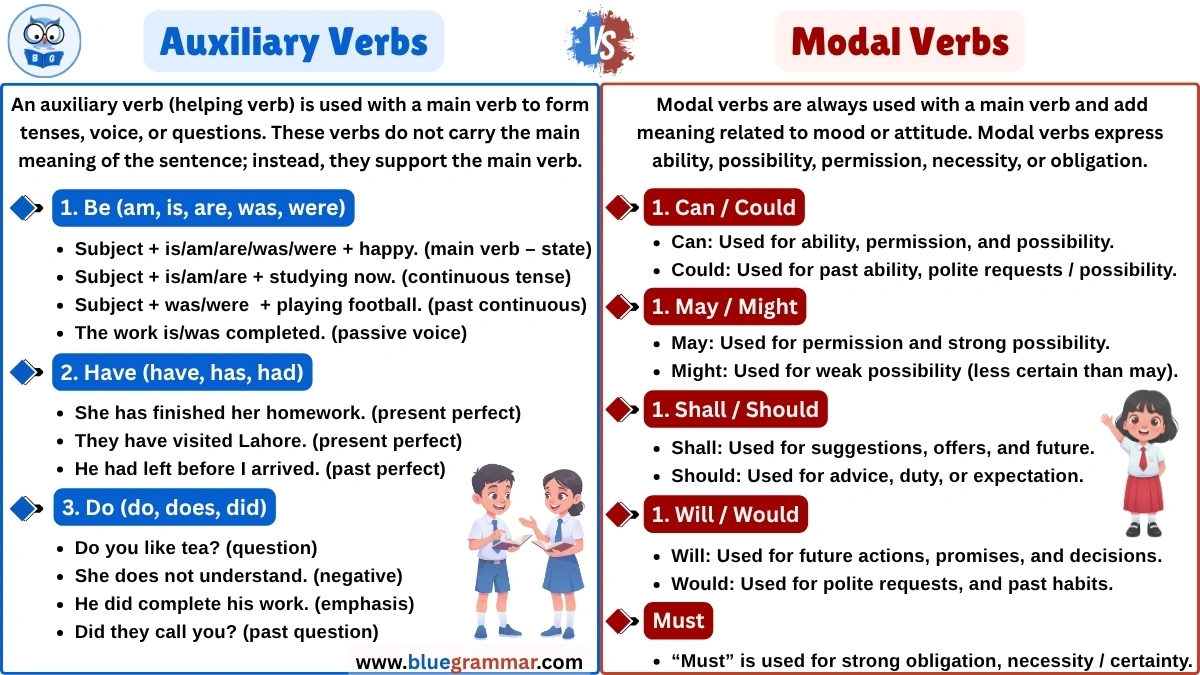
Auxiliary verbs and modal verbs are essential for forming clear and correct sentences. These verbs are often confused because modal verbs are actually a type of auxiliary verb. However, their functions, structures, and usage differ in important ways. In this guide, you will learn what auxiliary verbs and modal verbs are, how they work, their key differences, and how to use them correctly in sentences.
What is an Auxiliary Verb?
An auxiliary verb (also called a helping verb) is used with a main verb to form tenses, voice, or questions. These verbs do not carry the main meaning of the sentence; instead, they support the main verb.
Common auxiliary verbs include:
- Be (am, is, are, was, were)
- Have (have, has, had)
- Do (do, does, did)
Auxiliary & Modal Verbs Explained (With Uses & Examples)
1. Be (am, is, are, was, were)
The verb “be” is used as an auxiliary to form continuous tenses and the passive voice. It can also act as a main verb to describe a state or condition. We use am/is/are for present and was/were for past.
- She is studying now. (continuous tense)
- They were playing football. (past continuous)
- The work is completed. (passive voice)
- He is happy. (main verb – state)
2. Have (have, has, had)
The verb “have” is used to form perfect tenses, showing that an action is completed or connected to another time. We use has for singular subjects, have for plural, and had for past.
- She has finished her homework. (present perfect)
- They have visited Lahore. (present perfect)
- He had left before I arrived. (past perfect)
- I have seen that movie.
3. Do (do, does, did)
The verb “do” is used to form questions, negatives, and emphasis in simple tenses. We use does for singular, do for plural, and did for past.
- Do you like tea? (question)
- She does not understand. (negative)
- He did complete his work. (emphasis)
- Did they call you? (past question)
What is a Modal Verb?
A modal verb is a special type of auxiliary verb that expresses ability, possibility, permission, necessity, or obligation. Modal verbs are always used with a main verb and add meaning related to mood or attitude.
Common Modal Verbs: Modal verbs express ability, permission, possibility, advice, or obligation. They are always followed by the base form of the verb.
Can / Could
- Can: Used for ability, permission, and possibility.
- Could: Used for past ability, polite requests, and possibility.
- She can swim. (ability)
- You can go now. (permission)
- It can be dangerous. (possibility)
- He could run fast when he was young. (past ability)
- Could you help me? (polite request)
- It could rain later. (possibility)
May / Might
- May: Used for permission and strong possibility.
- Might: Used for weak possibility (less certain than “may”).
- You may enter the room. (permission)
- She may come today. (possibility)
- He might join us. (weak possibility)
Shall / Should
- Shall: Used for suggestions, offers, and future (formal use).
- Should: Used for advice, duty, or expectation.
- Shall we start the meeting? (suggestion)
- I shall return soon. (formal future)
- You should study harder. (advice)
- They should arrive by now. (expectation)
Will / Would
- Will: Used for future actions, promises, and decisions.
- Would: Used for polite requests, past habits, and hypothetical situations.
- I will call you tomorrow. (future)
- She will help you. (promise)
- Would you like some tea? (polite request)
- He would play outside every evening. (past habit)
- I would travel if I had money. (hypothetical)
Must
“Must” is used for strong obligation, necessity, or certainty.
- You must follow the rules. (obligation)
- She must be tired. (certainty)
- We must finish this today. (necessity)
Key Functions of Modal Verbs
- Ability → She can drive.
- Permission → May I enter?
- Possibility → It might rain.
- Obligation → You must finish this.
- Advice → You should rest.
Auxiliary Verbs vs Modal Verbs (Main Difference)
All modal verbs are auxiliary verbs, but not all auxiliary verbs are modal verbs. Auxiliary verbs include be, have, do, while modal verbs include can, may, must, should, etc. Auxiliary verbs mainly deal with grammar (tense, structure), while modal verbs deal with meaning (possibility, ability, etc.).
Key Differences Between Auxiliary Verbs and Modal Verbs
1. Function
Auxiliary verbs help form tenses and sentence structures. While modal verbs express meaning such as ability, permission, or necessity.
- She is reading. (auxiliary for tense)
- She can read. (modal for ability)
2. Verb Forms
Auxiliary verbs change form (is, are, was, were, has, had). On the other hand, modal verbs do not change form (no -s, -ing, -ed).
- He is working.
- He can work. (not "cans work")
3. Use with Main Verb
Auxiliary verbs can be followed by different verb forms (V1, V3, V-ing). While, modal verbs are always followed by the base form (V1).
- She has eaten.
- She can eat.
4. Meaning vs Structure
Auxiliary verbs focus on structure, but modal verbs focus on meaning and mood.
Examples of Auxiliary/Modal in Sentences
- She is playing. (Auxiliary)
- She can play. (Modal)
- They have completed the work. (Auxiliary)
- They must complete the work. (Modal)
- He did not go. (Auxiliary)
- He might go. (Modal)
- We are learning English. (Auxiliary)
- We should learn English. (Modal)
- I have written a letter. (Auxiliary)
- I will write a letter. (Modal)
Can Auxiliary and Modal Verbs Be Used Together?
Yes, modal verbs can be used with auxiliary verbs in the same sentence.
In such cases:
- Modal verb comes first
- Auxiliary verb follows
- Main verb changes form accordingly
Examples
- She should have finished her work.
- He might be sleeping now.
- They will have completed the project.
Common Mistakes to Avoid
Using “to” after modal verbs
Incorrect: She can to swim
Correct: She can swim
Adding -s or -ed to modal verbs
Incorrect: He cans drive
Correct: He can drive
Confusing “have” as modal
“Have” is usually an auxiliary, not a modal verb.
Quick Tips to Remember
- Use auxiliary verbs for grammar (tense, question, negative).
- Use modal verbs for meaning (ability, permission, advice).
- Modal verbs are always followed by base verb (V1).
- Modal verbs never change form.
Practice Exercise (Fill in the Blanks)
Fill in the blanks with correct auxiliary or modal verbs:
- She ______ playing in the garden.
- You ______ finish your homework.
- They ______ completed the task.
- ______ you like coffee?
- He ______ drive a car.
Conclusion
Auxiliary verbs and modal verbs are closely related but serve different purposes in English grammar. Auxiliary verbs help build the structure of sentences, while modal verbs add meaning and attitude.
Once you understand their differences, you can use them more accurately in both speaking and writing. Mastering these verbs will significantly improve your grammar and communication skills.