
Understanding the difference between adverbs and adjectives is essential for improving your English grammar and writing skills. These two parts of speech are often confused because they both describe other words. However, they serve different purposes and follow different rules.
In this guide, you will learn what adjectives and adverbs are, how to use them correctly, key differences, examples, common mistakes, and practice exercises.
What is an Adverb?
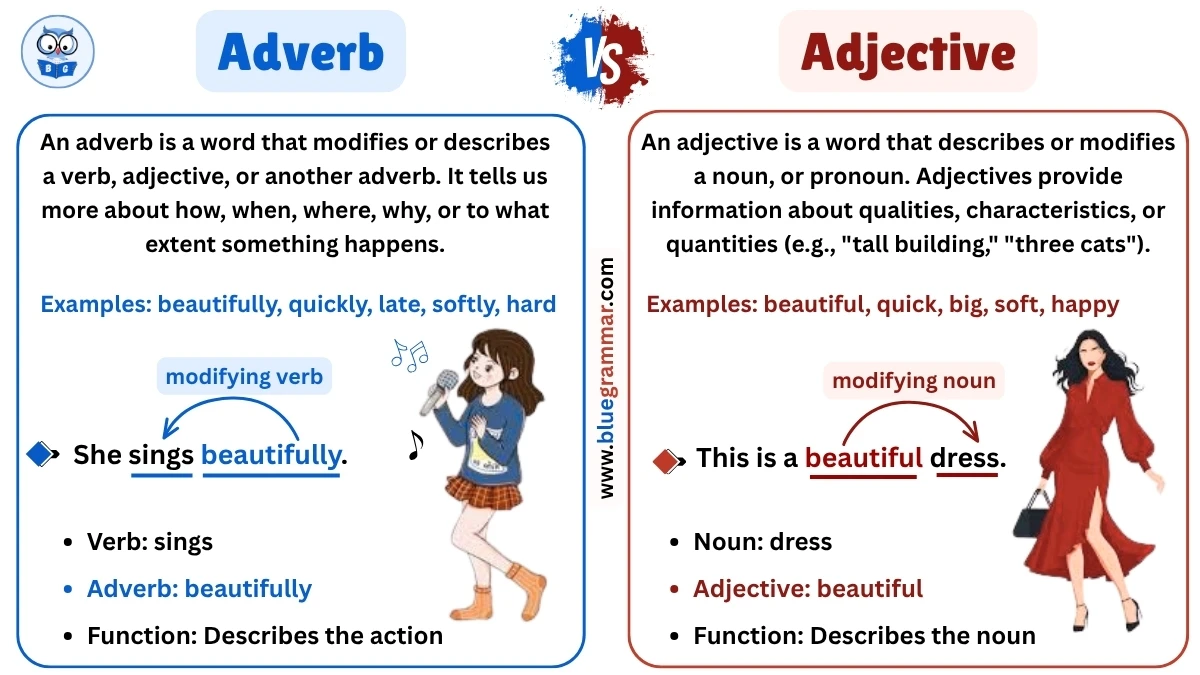
An adverb is a word that modifies or describes a verb, adjective, or another adverb. It tells us more about how, when, where, why, or to what extent something happens.
Many adverbs are formed by adding -ly to adjectives, but not all adverbs follow this pattern.
Adverbs answer questions like:
- How?
- When?
- Where?
- How often?
- To what extent?
Examples of Adverbs
- She sings beautifully.
- He runs quickly.
- They arrived late.
- She speaks softly.
- He works hard.
In these sentences, the adverbs modify verbs and describe how actions are performed.
What is an Adjective?
An adjective is a word that describes or modifies a noun or pronoun. It gives more information about a person, place, thing, or idea. Adjectives help make sentences more detailed and meaningful.
Adjectives answer questions like:
- What kind?
- Which one?
- How many?
They usually appear before a noun or after linking verbs such as is, am, are, seem, become, etc.
Examples of Adjectives
- She is a happy girl.
- This is a big house.
- He bought a new car.
- The weather is cold today.
- They live in a beautiful city.
In all these examples, the adjectives describe nouns and provide extra detail.
Key Differences Between Adverbs and Adjectives
Although both adjectives and adverbs describe things, their functions are different. Understanding these differences will help you avoid common grammar mistakes.
1. Function
Adjectives describe nouns or pronouns, while adverbs describe verbs, adjectives, or other adverbs. This is the most important difference between the two.
- She is a careful driver. (Adjective modifying noun)
- She drives carefully. (Adverb modifying verb)
2. Form
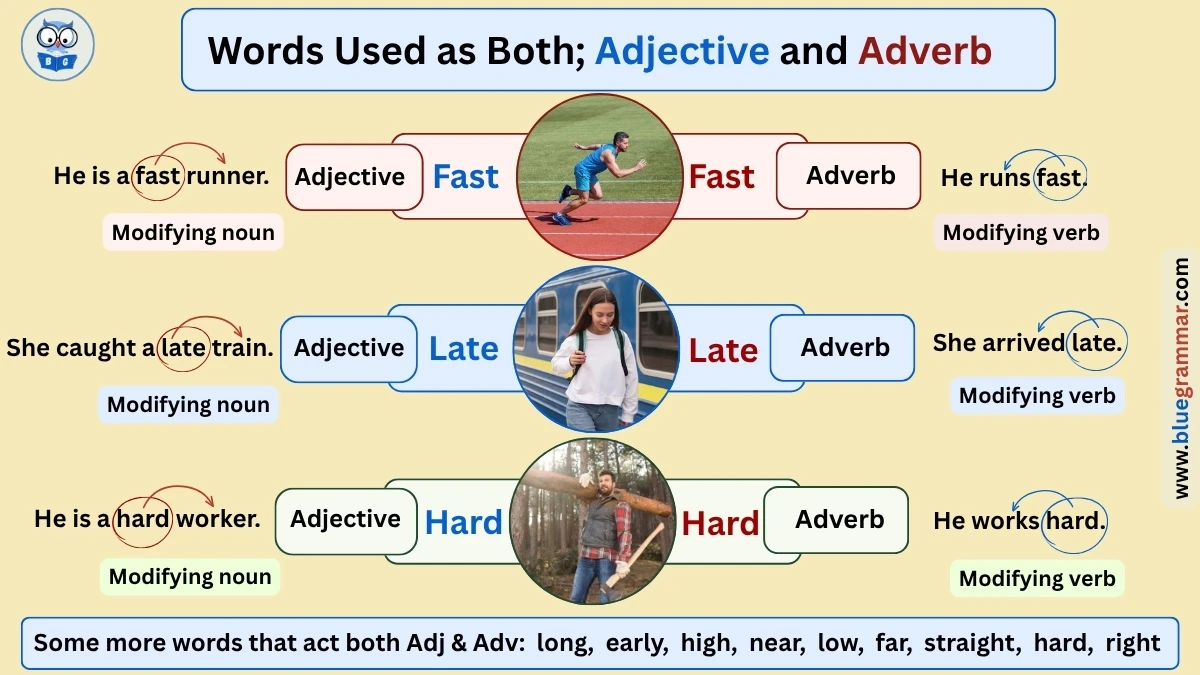
Adjectives usually do not end in -ly, whereas many adverbs do. However, there are exceptions like fast, hard, late, which can function as both adjectives and adverbs.
- He is a fast runner. (Adjective)
- He runs fast. (Adverb)
3. Position in Sentence
Adjectives are commonly placed before nouns or after linking verbs. Adverbs can appear in different positions depending on what they modify.
- She is happy. (Adjective after linking verb)
- She quickly finished her work. (Adverb before verb)
4. Types
Adjectives have types like descriptive, quantitative, demonstrative, and possessive. Adverbs have types such as manner, time, place, frequency, and degree.
- Adjective: Three books (quantity)
- Adverb: She runs daily (frequency)
Examples: Adjective vs Adverb in Sentences
Here are clear comparisons to help you understand:
- He is a slow learner. (Adjective)
- He learns slowly. (Adverb)
- She has a loud voice. (Adjective)
- She speaks loudly. (Adverb)
- It is a quick response. (Adjective)
- He responded quickly. (Adverb)
- They are happy people. (Adjective)
- They live happily. (Adverb)
- This is a bad idea. (Adjective)
- He behaved badly. (Adverb)
Common Mistakes to Avoid
Many learners confuse adjectives and adverbs, especially when forming sentences. One common mistake is using an adjective instead of an adverb when modifying a verb.
Incorrect: She sings beautiful.
Correct: She sings beautifully.
Another mistake is using adverbs after linking verbs instead of adjectives.
Incorrect: She feels happily.
Correct: She feels happy.
Linking verbs describe a state, so they require adjectives, not adverbs.
Special Cases to Remember
Some words can act as both adjectives and adverbs without changing form. These include words like fast, hard, late, and early.
- He is a hard worker. (Adjective)
- He works hard. (Adverb)
Also, some adverbs do not end in -ly, such as very, well, often, and too. These must be memorized through practice.
Tips to Identify Adverbs and Adjectives
To easily identify whether a word is an adjective or an adverb, follow these simple tips:
- Check what the word is modifying: If it describes a noun, it is an adjective. If it describes a verb or another modifier, it is an adverb.
- Look at the sentence structure: Words after linking verbs are usually adjectives.
- Test its role: Try replacing the word with another known adjective or adverb to test its function in the sentence.
Practice Exercise: Fill in the Blanks
Choose the correct word (adjective or adverb) to complete each sentence.
- She completed the task ________ (quick / quickly).
- He is a ________ (careful / carefully) driver.
- The baby slept ________ (peaceful / peacefully).
- This is a very ________ (interesting / interestingly) book.
- She spoke ________ (soft / softly) to the child.
- They are ________ (happy / happily) with the results.
- He answered the question ________ (correct / correctly).
- It was a ________ (bad / badly) decision.
- The dog barked ________ (loud / loudly).
- She looks ________ (beautiful / beautifully).
Conclusion
Adverbs and adjectives are essential parts of speech that add detail and clarity to your sentences. While adjectives describe nouns and pronouns, adverbs modify verbs, adjectives, and other adverbs. Understanding their differences will help you write more accurately and confidently.