
Exclamatory sentences express strong emotions such as happiness, sorrow, surprise, anger, or admiration. They usually end with an exclamation mark (!) and often begin with words like what, how, alas, hurrah, oh, etc.
When we change an exclamatory sentence from direct speech to indirect speech, we do not keep the exclamatory form. Instead, we convert the emotion into words using appropriate reporting verbs.
What Changes in Exclamatory Sentences?
When transforming exclamatory sentences into indirect speech, focus on these key changes:
1. Change the Reporting Verb
The reporting verb said is replaced with a verb that expresses emotion. Common replacements include:
- exclaimed with joy → happiness
- exclaimed with sorrow / sadness → sadness
- exclaimed with surprise / astonishment → surprise
- exclaimed with regret → regret
- exclaimed with delight / admiration → praise
- exclaimed in anger → anger
Why this matters: Exclamatory sentences show feelings. In indirect speech, we must express that feeling clearly through the reporting verb.
2. Remove Interjections
Words like hurrah, alas, oh, ah, and wow are removed in indirect speech. Instead of using these words, we express their meaning through the reporting verb.
3. Change into a Statement
Exclamatory sentences are converted into assertive (statement) sentences.
- Remove the exclamation mark (!)
- Add “that” to connect the clause
4. Adjust Pronouns, Tense, and Expressions
Follow the general rules of reported speech:
- Change pronouns according to the speaker and listener
- Change tense (usually one step back)
- Adjust time and place expressions if needed
Change of Direct to Indirect Speech in Exclamatory Sentences
1. Exclamatory Sentences Showing Happiness or Admiration
These often begin with Hurrah, What a, or How.
Examples:
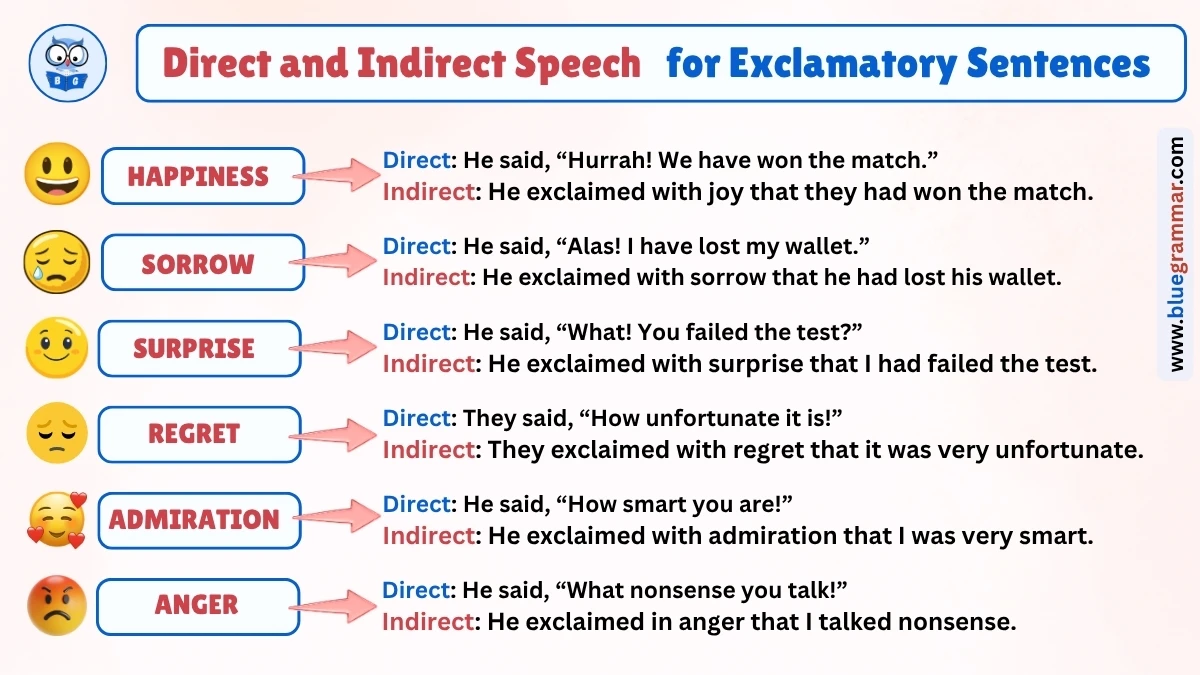
- Direct: He said, “Hurrah! We have won the match.”
- Indirect: He exclaimed with joy that they had won the match.
Explanation: “Hurrah” shows happiness, so it is replaced with exclaimed with joy. “We” changes to “they”.
- Direct: She said, “What a beautiful flower it is!”
- Indirect: She exclaimed with delight that it was a very beautiful flower.
Explanation: “What a” expresses admiration. We convert it into “very beautiful” and use exclaimed with delight.
- Direct: He said, “How smart you are!”
- Indirect: He exclaimed with admiration that I was very smart.
Explanation: “How” becomes “very”, and the sentence is turned into a statement.
2. Exclamatory Sentences Showing Sorrow or Regret
These often include Alas, Oh, or How sad.
Examples:
- Direct: He said, “Alas! I have lost my wallet.”
- Indirect: He exclaimed with sorrow that he had lost his wallet.
Explanation: “Alas” expresses sadness, so we use exclaimed with sorrow.
- Direct: She said, “Oh! My brother is ill.”
- Indirect: She exclaimed with sadness that her brother was ill.
Explanation: “Oh” shows concern or sadness, so it is replaced accordingly.
- Direct: They said, “How unfortunate it is!”
- Indirect: They exclaimed with regret that it was very unfortunate.
Explanation: “How unfortunate” becomes “very unfortunate”.
3. Exclamatory Sentences Showing Surprise or Shock
These may begin with What!, Oh!, Really!, etc.
Examples:
- Direct: He said, “What! You failed the test?”
- Indirect: He exclaimed with surprise that I had failed the test.
Explanation: “What!” expresses shock, so we use exclaimed with surprise.
- Direct: She said, “Oh! He has resigned from his job.”
- Indirect: She exclaimed with astonishment that he had resigned from his job.
Explanation: “Oh!” here shows surprise, not sadness—so context matters.
4. Exclamatory Sentences Showing Anger
These express irritation or anger.
Examples:
- Direct: He said, “What nonsense you talk!”
- Indirect: He exclaimed in anger that I talked nonsense.
Explanation: The tone is angry, so we use exclaimed in anger.
Important Transformation Patterns
Here are some common structures and how they change:
- What + noun phrase → very + adjective + noun
What a beautiful day! → a very beautiful day - How + adjective → very + adjective
How tall he is! → very tall
Common Mistakes to Avoid
- Keeping the exclamation mark (!) in indirect speech
- Using “said” instead of an emotional reporting verb
- Keeping interjections like hurrah, alas
- Not converting into a statement
Summary
When converting exclamatory sentences into indirect speech, remember to remove interjections (hurrah, alas, oh), use a reporting verb that expresses emotion, convert the sentence into a statement form, replace what/how structures with very, and follow all general rules of reported speech. For more practice exercises and English grammar lessons, visit bluegrammar.com.