
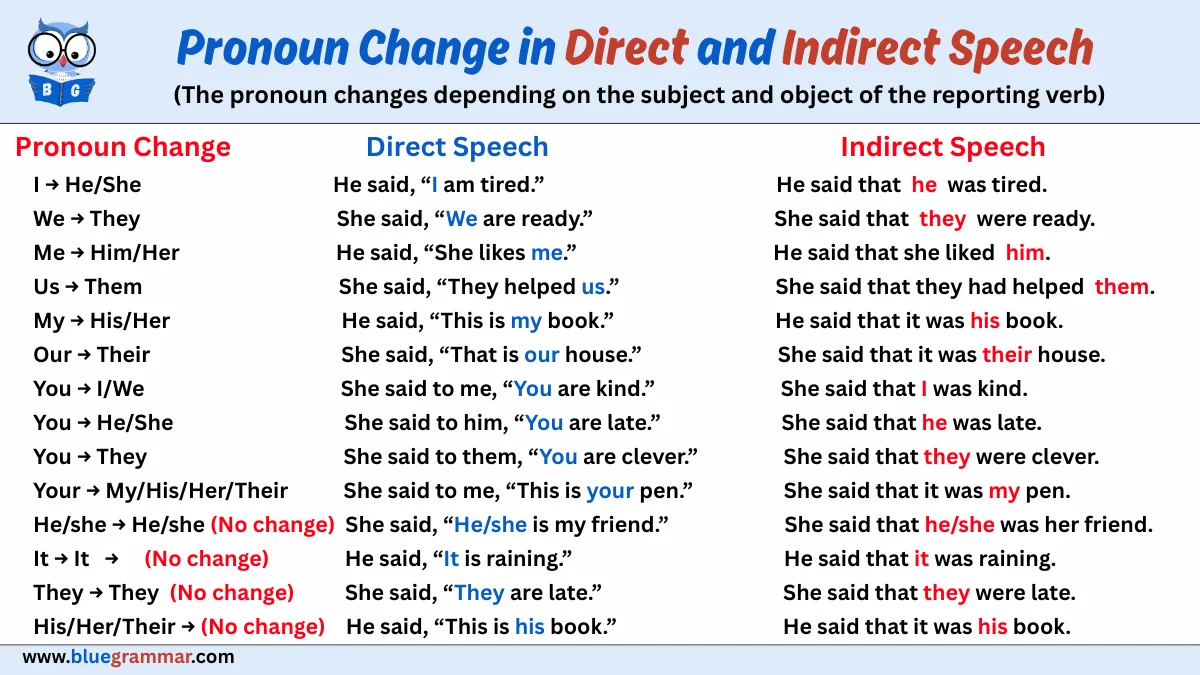
Change of Pronouns in Direct and Indirect Speech
When converting direct speech into indirect speech, pronouns must be adjusted carefully to maintain clarity and accuracy. The change of pronouns depends primarily on the relationship between the speaker, the listener, and the context of the statement. In general, pronouns are modified according to the subject or object of the reporting verb.
1. Change of First Person Pronouns (I, we, me, us, my, our)
First person pronouns such as I, we, me, us, my, and our are changed according to the subject of the reporting verb. This is because these pronouns refer to the original speaker, who becomes the subject in indirect speech.
Examples:
- Direct: Ali said, “I am tired.”
- Indirect: Ali said that he was tired.
In this example, the pronoun I refers to Ali, who is the subject of the reporting verb. Therefore, I is changed to he.
- Direct: Sara said, “We are going to the park.”
- Indirect: Sara said that they were going to the park.
Here, the pronoun we refers to Sara and her group. Since the group is being reported from an external perspective, we changes to they.
In summary, first person pronouns are always adjusted to match the subject of the reporting clause.
Pronoun Change Summary:
- I → he / she
- We → they
- Me → him / her
- Us → them
- My → his / her
- Our → their
2. Change of Second Person Pronouns (you, your)
Second person pronouns such as you and your are changed according to the object of the reporting verb. These pronouns refer to the person being addressed, so their form depends on who is receiving the statement.
Examples:
- Direct: He said to me, “You are late.”
- Indirect: He told me that I was late.
In this case, you refers to me, which is the object of the reporting verb. Therefore, you changes to I.
- Direct: She said to Ali, “You should work hard.”
- Indirect: She told Ali that he should work hard.
Here, you refers to Ali, the object of the reporting verb. As a result, you changes to he.
Thus, second person pronouns vary depending on the listener and must be interpreted within the context of the sentence.
Pronoun Change Summary:
- You → I / we / he / she / they (depending on object)
- Your → my / his / her / their (depending on object)
3. Change of Third Person Pronouns (he, she, it, they, his, her, their)
Third person pronouns such as he, she, it, they, his, her, and their generally remain unchanged in indirect speech. This is because they already refer to persons or things outside the immediate speaker-listener relationship.
Examples:
- Direct: He said, “She is my friend.”
- Indirect: He said that she was his friend.
In this sentence, the pronoun she does not change because it refers to a third person independent of the reporting structure.
- Direct: Ali said, “They are playing.”
- Indirect: Ali said that they were playing.
Similarly, they remains unchanged because it already refers to a group separate from both the speaker and the listener.
Pronoun Change Summary:
- He → he
- She → she
- It → it
- They → they
- His → his
- Her → her
- Their → their
Summary
The correct use of pronouns in indirect speech is essential for preserving the intended meaning of a statement. First person pronouns align with the subject of the reporting verb, second person pronouns correspond to the object, and third person pronouns usually remain unchanged. Careful attention to these relationships ensures grammatical accuracy and clarity in reported speech.