
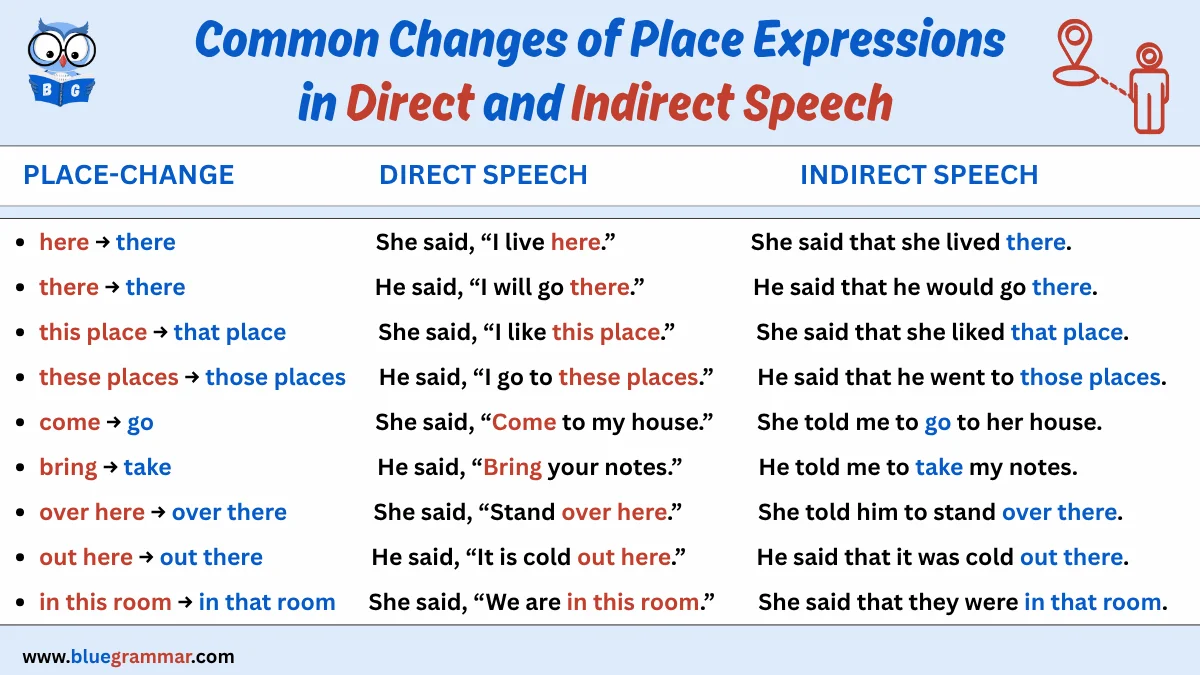
When converting direct speech into indirect speech, it is often necessary to modify expressions of place in addition to change of pronouns, verb tenses, and time expressions. This adjustment occurs because the perspective shifts from the original speaker’s viewpoint to that of the person reporting the statement. As a result, words that indicate proximity or location must be adapted to fit the new context.
Understanding how place expressions change is essential for maintaining clarity and accuracy in reported speech.
General Rule
Place expressions such as here, this, and these are modified to reflect a shift in perspective from the original speaker to the reporter. When the reporting verb is in the past tense, these expressions typically change to indicate distance or a different point of reference. However, if the reporting verb is in the present or future tense, such changes may not be necessary.
Common Changes of Place Expressions in Direct and Indirect Speeches
Here to There
The word here refers to a location close to the speaker. In indirect speech, it usually changes to there to indicate a place that is no longer the speaker’s immediate location.
Example:
- Direct: He said, “I am standing here.”
- Indirect: He said that he was standing there.
There to There or At that place
The word there may remain unchanged if the location remains clear in context. In some cases, it may be expanded to at that place for greater clarity.
Example:
- Direct: She said, “I will meet you there.”
- Indirect: She said that she would meet me there.
This to That
The word this refers to something close to the speaker. In indirect speech, it generally changes to that to indicate distance from the reporter’s point of view.
Example:
- Direct: He said, “I like this book.”
- Indirect: He said that he liked that book.
These to Those
The word these, which indicates objects near the speaker, changes to those in indirect speech to reflect a more distant perspective.
Example:
- Direct: She said, “I bought these shoes yesterday.”
- Indirect: She said that she had bought those shoes the previous day.
Examples in Context
The following examples illustrate how place expressions change within complete sentences:
- Direct: He said, “I will stay here until tomorrow.”
- Indirect: He said that he would stay there until the next day.
- Direct: She said, “You can put your bag here.”
- Indirect: She said that I could put my bag there.
- Direct: John said, “Look at this picture.”
- Indirect: John said to look at that picture.
- Direct: They said, “We are selling these houses.”
- Indirect: They said that they were selling those houses.
Special Note
In some situations, the change of place expressions depends on the context rather than strict grammatical rules. If the person reporting the statement is in the same location as the original speaker, the word here may remain unchanged.
Example (In the same location):
- Direct: She said, “I am waiting here.”
- Indirect: She said that she was waiting here.
However, if the reporting takes place in a different location, here is typically changed to there.
Example (In a different location):
- Indirect: She said that she was waiting there.
Similarly, the words this and these may sometimes change to the instead of that or those, depending on the intended meaning and emphasis.
Example:
- Direct: He said, “Take care of this child.”
- Indirect: He said to take care of the child.
Summary
The transformation of place expressions in indirect speech depends largely on the shift in perspective from the speaker to the reporter. Words that indicate closeness are usually replaced with those that suggest distance. However, contextual factors may influence whether a change is required. Careful attention to these elements ensures that the reported statement remains accurate, clear, and contextually appropriate. For more comprehensive English grammar guides, visit bluegrammar.com.