
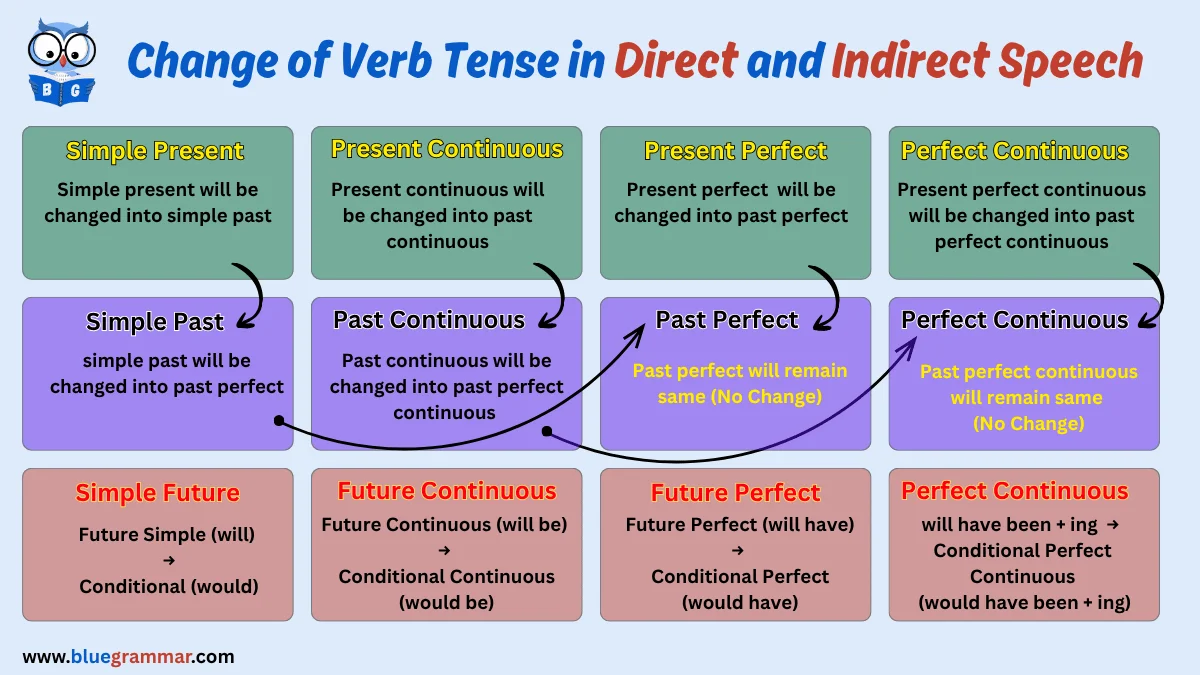
One of the most important aspects of converting direct speech into indirect speech is the correct handling of verb tense. This process is commonly referred to as the sequence of tenses, which ensures that the reported statement reflects the correct time relationship.
In general, when the reporting verb is in the past tense, the verb in the reported speech shifts one step back in time. However, if the reporting verb is in the present or future tense, no change in tense is usually required.
General Rule
If the reporting verb is in the past tense, the tense of the verb in the reported clause typically shifts backward. This change indicates that the statement is being reported after it was originally spoken.
Examples:
- Direct: She says, “I am happy.”
- Indirect: She says that she is happy.
In this example, the reporting verb is in the present tense, so no tense change occurs.
- Direct: She said, “I am happy.”
- Indirect: She said that she was happy.
Here, the reporting verb is in the past tense, so the verb shifts from present to past.
Tense Change Rules in Direct and Indirect Speech
1. Present Simple to Past Simple
The present simple tense changes to the past simple tense when the reporting verb is in the past. This reflects that the action was originally stated in the present but is now being reported later.
Example:
- Direct: He said, “I like tea.”
- Indirect: He said that he liked tea.
2. Present Continuous to Past Continuous
The present continuous tense changes to the past continuous tense to maintain the sense of an ongoing action in the past.
Example:
- Direct: She said, “I am reading a book.”
- Indirect: She said that she was reading a book.
3. Present Perfect to Past Perfect
The present perfect tense shifts to the past perfect tense to indicate that the action was completed before the time of reporting.
Example:
- Direct: Ali said, “I have finished my work.”
- Indirect: Ali said that he had finished his work.
4. Present Perfect Continuous to Past Perfect Continuous
The present perfect continuous tense changes to the past perfect continuous tense to show an action that was ongoing before a past point in time.
Example:
- Direct: They said, “We have been waiting for hours.”
- Indirect: They said that they had been waiting for hours.
5. Past Simple to Past Perfect
The past simple tense changes to the past perfect tense to indicate that the action occurred before another past action.
Example:
- Direct: He said, “I bought a new car.”
- Indirect: He said that he had bought a new car.
6. Past Continuous to Past Perfect Continuous
The past continuous tense shifts to the past perfect continuous tense to emphasize the duration of an action before another past event.
Example:
- Direct: She said, “I was cooking.”
- Indirect: She said that she had been cooking.
7. Past Perfect Remains Unchanged
The past perfect tense usually does not change because it already refers to an action completed before a past time.
Example:
- Direct: He said, “I had finished my homework.”
- Indirect: He said that he had finished his homework.
8. Future Simple to Conditional
The future simple tense, formed with “will,” changes to the conditional form “would” in indirect speech. This reflects a future action viewed from a past perspective.
Example:
- Direct: She said, “I will help you.”
- Indirect: She said that she would help me.
9. Future Continuous to Conditional Continuous
The future continuous tense changes to the conditional continuous tense to maintain the idea of an ongoing future action from a past viewpoint.
Example:
- Direct: He said, “I will be working tomorrow.”
- Indirect: He said that he would be working the next day.
10. Future Perfect to Conditional Perfect
The future perfect tense changes to the conditional perfect tense to indicate a completed action relative to a past reference point.
Example:
- Direct: She said, “I will have finished by evening.”
- Indirect: She said that she would have finished by evening.
Exceptions: When Tense Does Not Change
Universal Truths and General Facts
If the statement expresses a universal truth or a scientific fact, the tense remains unchanged because such facts are always true.
Example:
- Direct: The teacher said, “The sun rises in the east.”
- Indirect: The teacher said that the sun rises in the east.
Habitual Actions
If the statement describes a habitual or regular action that is still true, the tense may remain unchanged.
Example:
- Direct: He said, “I go to school every day.”
- Indirect: He said that he goes to school every day.
Reporting Verb in Present or Future Tense
If the reporting verb is in the present or future tense, the tense of the reported speech does not change.
Example:
- Direct: He says, “I am tired.”
- Indirect: He says that he is tired.
Practice Sentences
Convert the following sentences into indirect speech:
- He said, “I am learning English.”
- She said, “I have done my homework.”
- They said, “We will visit Lahore tomorrow.”
- Ali said, “I was reading a novel.”
- The teacher said, “The earth moves around the sun.”
For more detailed practice and resources, visit bluegrammar.com.
Summary
The correct handling of verb tense is a fundamental aspect of transforming direct speech into indirect speech. By applying the sequence of tenses and understanding the relevant exceptions, learners can report statements accurately and effectively. Mastery of these rules contributes significantly to clarity and precision in both written and spoken English. Learn more grammar rules and examples on bluegrammar.com.