
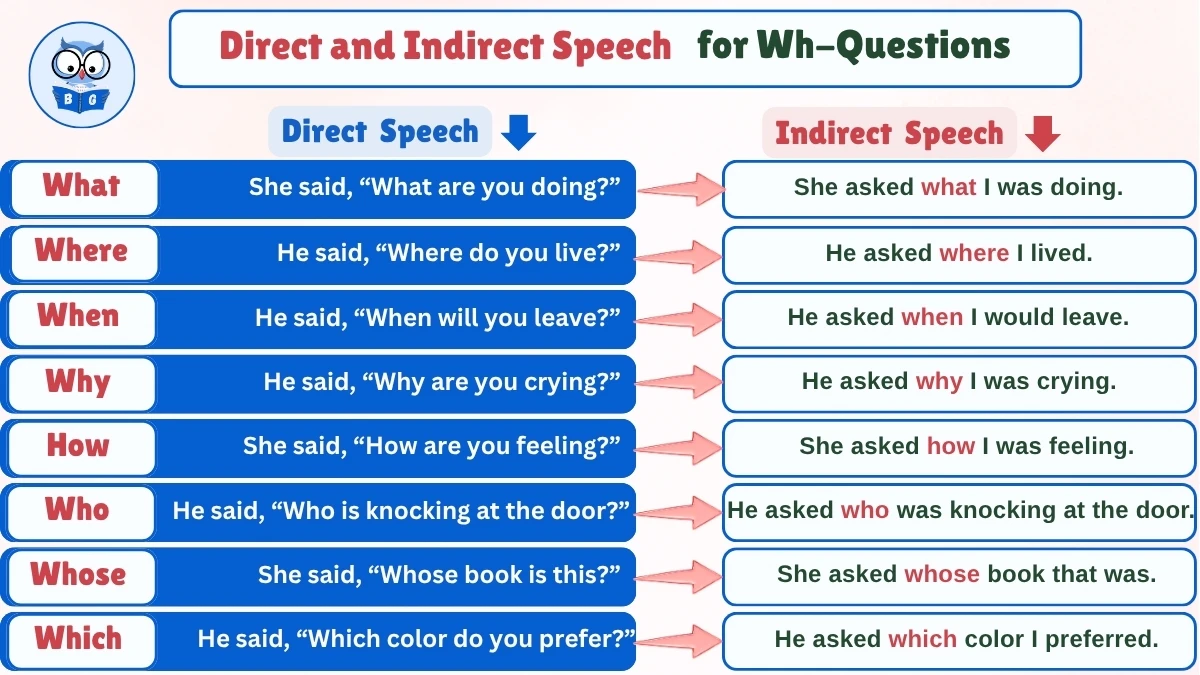
Wh-questions begin with question words such as what, where, when, who, why, which, whose, and how. They ask for specific information rather than a yes-or-no answer.
When converting Wh-questions from direct speech to indirect speech, the structure changes significantly. Unlike Yes/No questions, do not use if
or whether
. Instead, retain the Wh-word and convert the sentence into statement form.
What Happens When We Change Wh-Questions?
In indirect speech, a question is no longer asked directly. Because it is reported, the sentence structure becomes a statement rather than a question.
General Rules for Changing Wh-Questions
1. Change the Reporting Verb
In interrogative sentences, replace the reporting verb said
with verbs that reflect asking:
asked
inquired
wanted to know
2. Retain the Wh-word
Keep the Wh-word unchanged in indirect speech. Do not replace it with if
or whether
.
- Direct:
He said,
Where are you going?
- Indirect:
- He asked where I was going.
whereremains the same because it carries the main meaning of the question.
3. Change Question Form into Statement Form
Shift the auxiliary verb after the subject to form a normal declarative structure:
- Direct speech (question): Auxiliary Verb + Subject
- Indirect speech (statement): Subject + Verb
- Direct:
Where are you going?
- Indirect:
- ...where I was going (not
was I going
)
4. Remove Question Marks
Remove the question mark (?
) so the sentence becomes a declarative statement ending with a period.
5. Change Tense, Pronouns, and Time/Place Expressions
Apply standard reported speech backshifting rules:
- Tenses shift one step back into the past.
- Pronouns adjust to match the speaker and listener context.
- Time and place words shift (e.g.,
now
→then
,here
→there
).
Examples by Question Word
Questions with What (Things / Actions)
- Direct:
She said,
What are you doing?
- Indirect:
- She asked what I was doing.
Whatis retained, and present continuous shifts to past continuous statement order.
- Direct:
He said,
What did you buy?
- Indirect:
- He asked what I had bought.
did buy) shifts to past perfect (
had bought).
Questions with Where (Location)
- Direct:
He said,
Where do you live?
- Indirect:
- He asked where I lived.
dois removed in statement form.
- Direct:
She said,
Where are they going?
- Indirect:
- She asked where they were going.
Questions with When (Time)
- Direct:
He said,
When will you leave?
- Indirect:
- He asked when I would leave.
willshifts to
would.
- Direct:
She said,
When did you arrive?
- Indirect:
- She asked when I had arrived.
Questions with Why (Reasons)
- Direct:
He said,
Why are you crying?
- Indirect:
- He asked why I was crying.
I was crying).
Quick Reference Summary
| Element | Direct Speech | Indirect Speech |
|---|---|---|
| Reporting Verb | said |
asked, inquired, wanted to know |
| Connector | Quotes / Question mark | Retain Wh-word (No if/ whether) |
| Word Order | Auxiliary Verb + Subject | Subject + Verb (Statement) |
| Punctuation | Question mark (?) |
Period (.) |