
Imperative sentences are used to express commands, requests, advice, suggestions, or instructions. These sentences usually begin with the base form of a verb (like open, go, sit, help) and often do not mention the subject directly.
When we change imperative sentences from direct speech to indirect speech, the structure is different from statements and questions. Instead of reporting what someone said, we report what they told, asked, advised, or requested someone to do.
General Rules for Imperative Sentences
1. Change the Reporting Verb
In imperative sentences, the reporting verb said is replaced according to the speaker’s intention:
- For commands/orders: told, ordered, commanded, instructed
- For requests: requested, asked, begged
- For advice/suggestions: advised, suggested, recommended
Explanation: The reporting verb must reflect the tone and purpose of the sentence. For example, a strict instruction uses ordered, while a polite sentence uses requested. Choosing the correct verb helps convey the exact meaning in indirect speech.
2. Change the Verb into Infinitive Form
The main verb in an imperative sentence (base form) changes into an infinitive form (to + verb) in indirect speech.
Explanation: Imperative sentences give directions or instructions. In indirect speech, these are expressed using “to + verb”, which clearly shows that someone is being told or asked to do something.
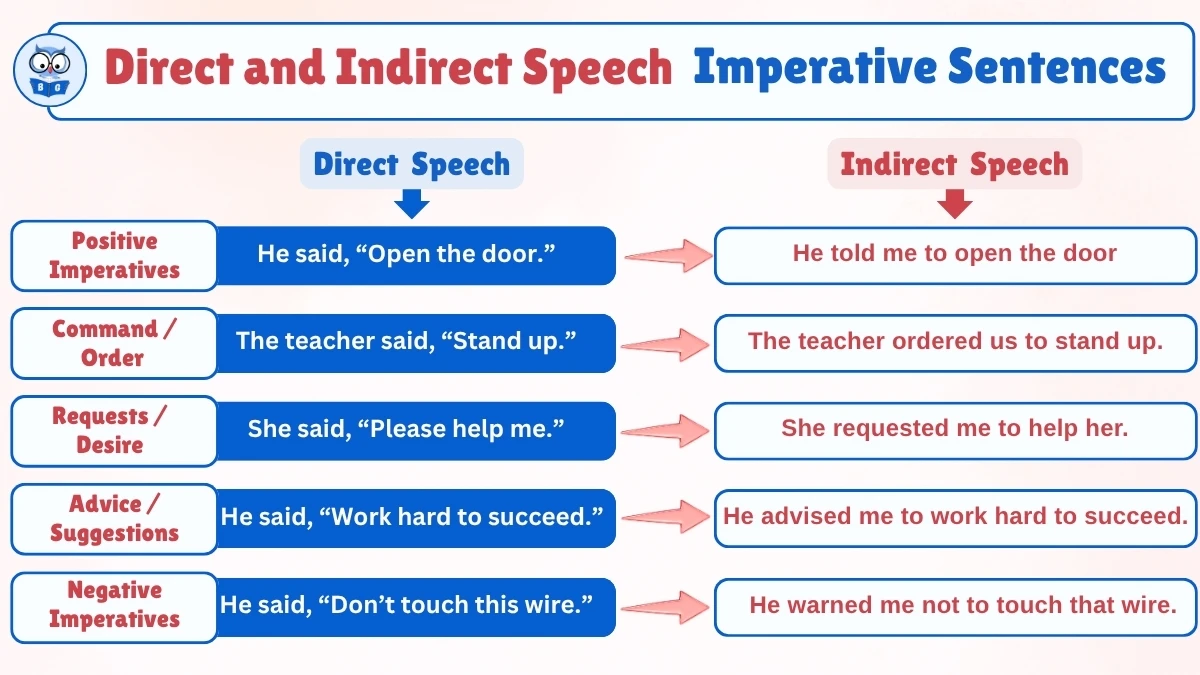
- Direct: He said, “Open the door.”
- Indirect: He told me to open the door.
Explanation of example: “Open” (base verb) becomes “to open”; “said” changes to “told” because it is a command; “me” is added as the object (the person receiving the command).
3. Use Object (Person Receiving the Action)
In indirect speech, we usually mention who is being told or asked.
Explanation: Imperative sentences often do not mention the subject in direct speech, but in indirect speech, we must include an object (me, him, her, them, us) to show who should perform the action.
Example: “He said, ‘Sit down.’” → He told me to sit down.
4. Negative Imperatives
For negative sentences, we use: not + to + verb.
Explanation: Words like don’t or do not are removed and replaced with “not” before the infinitive. This keeps the negative meaning clear.
- Direct: She said, “Do not be late.”
- Indirect: She told me not to be late.
Explanation of example: “Do not be” becomes “not to be”. The structure becomes simpler and more formal.
5. No Use of “That”
Unlike statements, we do not use “that” in imperative sentences.
Explanation: Imperative sentences follow the structure: subject + reporting verb + object + to + verb. There is no clause introduced by “that”, because the sentence expresses an action, not a statement.
Change of Direct to Indirect Speech for Imperative Sentences
1. Commands / Orders
These sentences give strict instructions or authority-based directions. Commands are usually direct and firm, so we use reporting verbs like told, ordered, or commanded depending on the level of authority.
Examples:
-
Direct: The teacher said, “Stand up.”
Indirect: The teacher ordered us to stand up.
Explanation: “said” → “ordered” (command); “Stand” → “to stand”; “us” shows who received the order. -
Direct: He said, “Close the window.”
Indirect: He told me to close the window.
Explanation: “told” is used for a simple instruction; verb changes to infinitive form.
2. Requests
These sentences are polite and often include words like “please.” Requests are softer than commands, so we use verbs like requested, asked, or begged. The tone of politeness must be reflected in indirect speech.
Examples:
-
Direct: She said, “Please help me.”
Indirect: She requested me to help her.
Explanation: “Please” shows politeness → use “requested”; “me” changes to “her” (pronoun change). -
Direct: He said, “Lend me your book, please.”
Indirect: He asked me to lend him my book.
Explanation: “asked” is used for a polite request; pronouns change: “me” → “him”, “your” → “my”.
3. Advice / Suggestions
These sentences give guidance or recommendations. Advice is not forceful, so we use verbs like advised, suggested, or recommended. Sometimes, suggested may also be followed by “that + clause”.
Examples:
-
Direct: He said, “Work hard to succeed.”
Indirect: He advised me to work hard to succeed.
Explanation: “advised” shows guidance; verb becomes “to work”. -
Direct: She said, “Try this method.”
Indirect: She suggested that I try that method.
Explanation: “suggested” can be followed by “that + subject + verb”; “this” changes to “that”.
4. Negative Imperatives
These sentences express prohibition or warning. Negative imperatives tell someone what not to do. We use not before the infinitive, and sometimes verbs like warned are more suitable.
Examples:
-
Direct: He said, “Don’t touch this wire.”
Indirect: He warned me not to touch that wire.
Explanation: “Don’t touch” → “not to touch”; “warned” is used because it is a warning. -
Direct: She said, “Do not waste your time.”
Indirect: She told me not to waste my time.
Explanation: Negative structure is maintained using “not to”; pronoun changes correctly.
Common Mistakes to Avoid
- Using “that” in imperative sentences (except with certain uses of suggested).
- Forgetting to add the object (me, him, her, etc.).
- Not converting the verb into “to + verb”.
- Using the wrong reporting verb (e.g., said instead of told/requested).
Final Summary
When converting imperative sentences into indirect speech:
- Change the reporting verb according to the purpose (order, request, advice)
- Use
object + to + verbstructure - Convert the main verb into an infinitive (
to + verb) - Use
notbefore the infinitive for negative sentences - Do not use “that”