
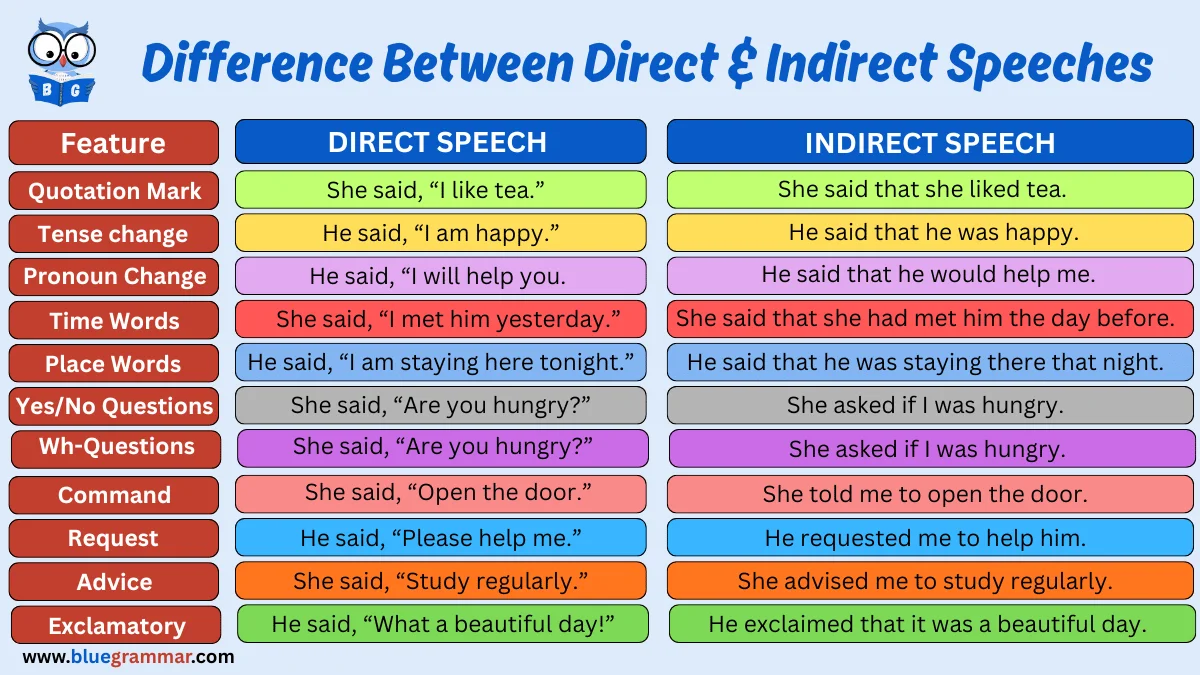
In English grammar, it is often necessary to report what another person has said. This can be done in two ways: direct speech and indirect speech, also known as reported speech. Understanding the distinction between these two forms is essential for accurate communication, particularly in academic writing, formal contexts, and examinations.
Direct speech reproduces the exact words spoken by a speaker, while indirect speech conveys the meaning of those words without quoting them exactly. Both forms follow specific grammatical rules involving punctuation, tense, pronouns, and expressions of time and place.
What is Direct Speech?
Direct speech refers to the exact words spoken by a person, presented within quotation marks. It preserves the original structure and wording of the speaker’s statement.
Example: He said, “I am learning English.”
In this sentence, the words “I am learning English” are the speaker’s exact words and are not changed in any way.
What is Indirect Speech?
Indirect speech, or reported speech, expresses the meaning of what someone has said without using their exact words. Quotation marks are not used, and the sentence is adjusted to fit grammatical rules.
Example: He said that he was learning English.
In this case, the original message is reported, but the wording has been modified.
Difference Between Direct and Indirect Speech
Direct speech uses quotation marks and keeps the original form of the sentence exactly as spoken. Indirect speech does not use quotation marks and usually involves changes in tense, pronouns, and expressions of time and place. Direct speech reflects the speaker’s exact words, whereas indirect speech focuses on the meaning of those words.
Rules for Changing Direct Speech into Indirect Speech
Change of Pronouns
Pronouns must be changed according to the perspective of the speaker and the listener. This ensures that the sentence remains meaningful in its new form.
- Direct: She said, “I love my mother.”
- Indirect: She said that she loved her mother.
In this example, “I” changes to “she” and “my” changes to “her” to match the reporting context.
Change of Verb Tense
When the reporting verb is in the past tense, the tense of the original sentence usually shifts backward. Present forms typically change to past forms, and past forms may change to past perfect.
- Direct: He said, “I am working.”
- Indirect: He said that he was working.
This shift in tense helps indicate that the statement is being reported after it was originally spoken.
Change of Time Expressions
Words that refer to time are often changed to reflect the time of reporting rather than the time of speaking. For example, “now” may become “then,” “today” may become “that day,” “tomorrow” may become “the next day,” and “yesterday” may become “the previous day.”
- Direct: She said, “I will meet you tomorrow.”
- Indirect: She said that she would meet me the next day.
Note: Read an article on Change of Time Expressions in Direct Indirect Speech here.
Change of Place Expressions
Words indicating place may also need to be adjusted. For instance, “here” can become “there,” “this” can become “that,” and “these” can become “those.”
These changes depend on the position of the speaker at the time of reporting.
Note: Read an article on Change of Place Words in Direct Indirect Speech here.
Types of Sentences in Direct and Indirect Speech
Declarative Sentences
Declarative sentences are statements that express facts or opinions. In indirect speech, they are usually introduced with the word “that.”
- Direct: He said, “I like English grammar.”
- Indirect: He said that he liked English grammar.
Interrogative Sentences
When questions are reported, they are changed into statement form. The word order becomes that of a normal statement, and auxiliary verbs are adjusted accordingly. Words such as “if” or “whether” are used for yes or no questions.
- Direct: She asked, “Where are you going?”
- Indirect: She asked where I was going.
- Direct: He asked, “Do you like cricket?”
- Indirect: He asked if I liked cricket.
Imperative Sentences
Imperative sentences express commands, requests, or advice. In indirect speech, they are usually converted into an infinitive form using “to” plus the base verb.
- Direct: He said, “Close the door.”
- Indirect: He told me to close the door.
- Direct: She said, “Please help me.”
- Indirect: She requested me to help her.
Exclamatory Sentences
Exclamatory sentences express strong feelings such as surprise, joy, or anger. In indirect speech, they are introduced using verbs that reflect the emotion.
- Direct: He said, “What a beautiful day!”
- Indirect: He exclaimed that it was a beautiful day.
Reporting Verbs in Direct Indirect Speeches
Different reporting verbs are used depending on the type of sentence. For statements, verbs such as said, told, explained, and mentioned are common. For questions, verbs like asked, inquired, and wanted to know are used. For commands and requests, verbs such as told, ordered, requested, and advised are appropriate. For exclamations, verbs like exclaimed, shouted, cried, and cheered are used to convey emotion.
Special Cases in Direct Indirect Speeches
Universal Truths
If the reported statement expresses a universal truth or a general fact, the tense does not change even in indirect speech.
- Direct: He said, “The sun rises in the east.”
- Indirect: He said that the sun rises in the east.
Modal Verbs
Some modal verbs change form in indirect speech. For example, “can” becomes “could,” “may” becomes “might,” and “must” often becomes “had to.”
- Direct: She said, “I can solve it.”
- Indirect: She said that she could solve it.
Common Mistakes to Avoid
Learners often make errors when converting direct speech into indirect speech. Common mistakes include failing to change pronouns correctly, using incorrect tense after the reporting verb, keeping quotation marks in indirect speech, and forgetting to adjust time and place expressions.
Practice Exercises
Convert the following sentences into indirect speech:
- He said, “I am reading a book.”
- She asked, “Do you know him?”
- They said, “We will go to Lahore tomorrow.”
- The teacher said, “Be quiet!”
- Ali said, “What a surprise!”
Conclusion
Direct and indirect speech are essential components of English grammar that enable clear and accurate reporting of spoken information. Direct speech preserves the speaker’s exact words, while indirect speech focuses on conveying the meaning in a grammatically appropriate form.
A strong understanding of pronoun changes, tense shifts, and contextual adjustments allows learners to use both forms effectively. With consistent practice, students can develop greater confidence in writing and speaking, particularly in academic and professional contexts.