
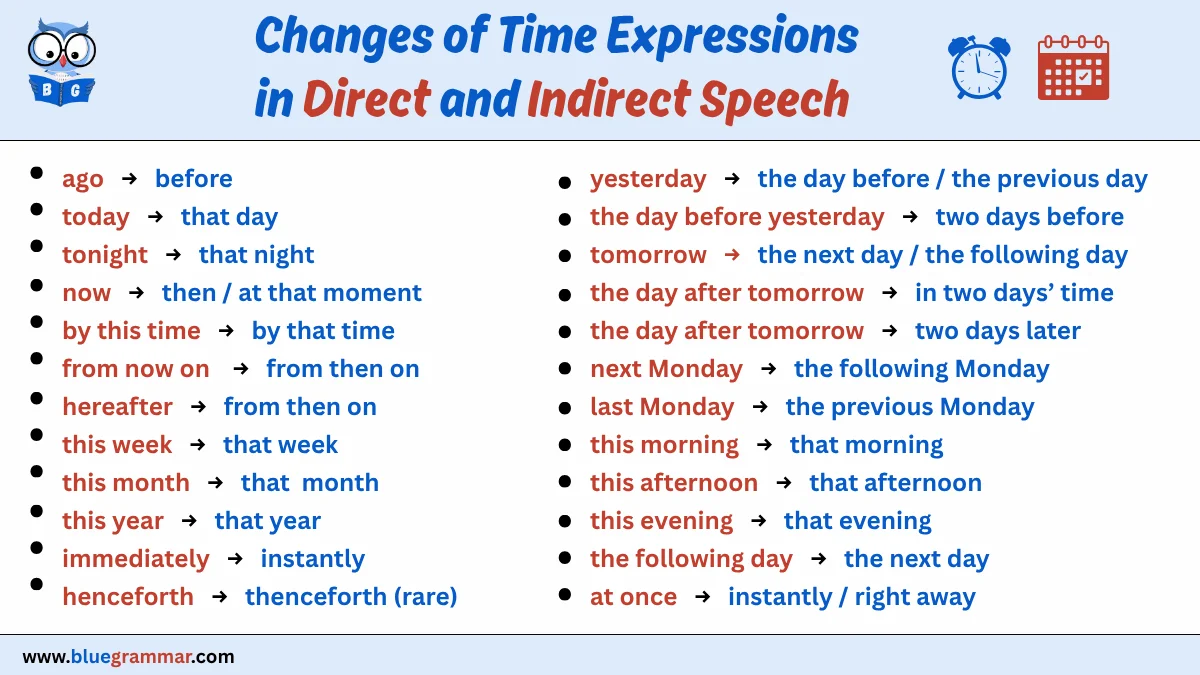
When converting direct speech into indirect speech, it is necessary to adjust not only pronouns and verb tenses but also expressions of time. This adjustment occurs because reported speech often reflects a shift in the time frame, usually from the present to the past. As a result, time-related words such as today, tomorrow, and yesterday must be modified to maintain logical and contextual accuracy.
A clear understanding of these changes is essential for producing grammatically correct and meaningful indirect speech.
General Rule
When the reporting verb is in the past tense, time expressions in the reported clause typically shift backward to reflect the change in time perspective. However, if the reporting verb is in the present or future tense, time expressions usually remain unchanged.
Common Changes of Time Expressions in Direct and Indirect Speeches
Now to Then or At that time
The word now refers to the present moment and therefore changes to then or at that time when reported from a past perspective.
Example:
- Direct: He said, “I am busy now.”
- Indirect: He said that he was busy then.
Today to That day
The word today changes to that day because the reference shifts from the present day to a specific day in the past.
Example:
- Direct: She said, “I have a meeting today.”
- Indirect: She said that she had a meeting that day.
Tonight to That night
The word tonight changes to that night to indicate the same time period from a past viewpoint.
Example:
- Direct: He said, “We will go out tonight.”
- Indirect: He said that they would go out that night.
Yesterday to The previous day or The day before
The word yesterday shifts to the previous day or the day before to reflect a time prior to the reporting moment.
Example:
- Direct: I said, “I finished my work yesterday.”
- Indirect: I said that I had finished my work the previous day.
Tomorrow to The next day or The following day
The word tomorrow changes to the next day or the following day because the future time is being reported from a past perspective.
Example:
- Direct: She said, “I will call you tomorrow.”
- Indirect: She said that she would call me the next day.
The day before yesterday to Two days before
This expression refers to a time two days in the past and is therefore adjusted accordingly in indirect speech.
Example:
- Direct: He said, “I met her the day before yesterday.”
- Indirect: He said that he had met her two days before.
The day after tomorrow to Two days later
This phrase indicates a time two days in the future and is modified to reflect a future point relative to the past.
Example:
- Direct: She said, “I will travel the day after tomorrow.”
- Indirect: She said that she would travel two days later.
Ago to Before
The word ago is replaced by before to express time relative to a past reference point.
Example:
- Direct: He said, “I met her two years ago.”
- Indirect: He said that he had met her two years before.
Last night to The previous night
Expressions such as last night change to the previous night to indicate the same time frame from a past perspective.
Example:
- Direct: She said, “I stayed home last night.”
- Indirect: She said that she had stayed home the previous night.
Next week, month, or year to The following week, month, or year
Future time expressions such as next week, next month, or next year change to the following forms when reported.
Example:
- Direct: He said, “We will go to London next week.”
- Indirect: He said that they would go to London the following week.
Special Note
If the reporting verb is in the present or future tense, time expressions generally remain unchanged because the time reference has not shifted.
Example:
- Direct: She says, “I am busy today.”
- Indirect: She says that she is busy today.
In certain contexts, such as universal truths, fixed schedules, or situations that are still true at the time of reporting, time expressions may also remain unchanged.
Summary
When converting direct speech into indirect speech, it is essential to consider the tense of the reporting verb before making any changes. If the reporting verb is in the past tense, time expressions should be adjusted to reflect the shift in time. If it is in the present or future tense, such changes are usually unnecessary. Careful attention to these details ensures clarity, accuracy, and grammatical correctness in reported speech. For more guides and grammar lessons, visit bluegrammar.com.