
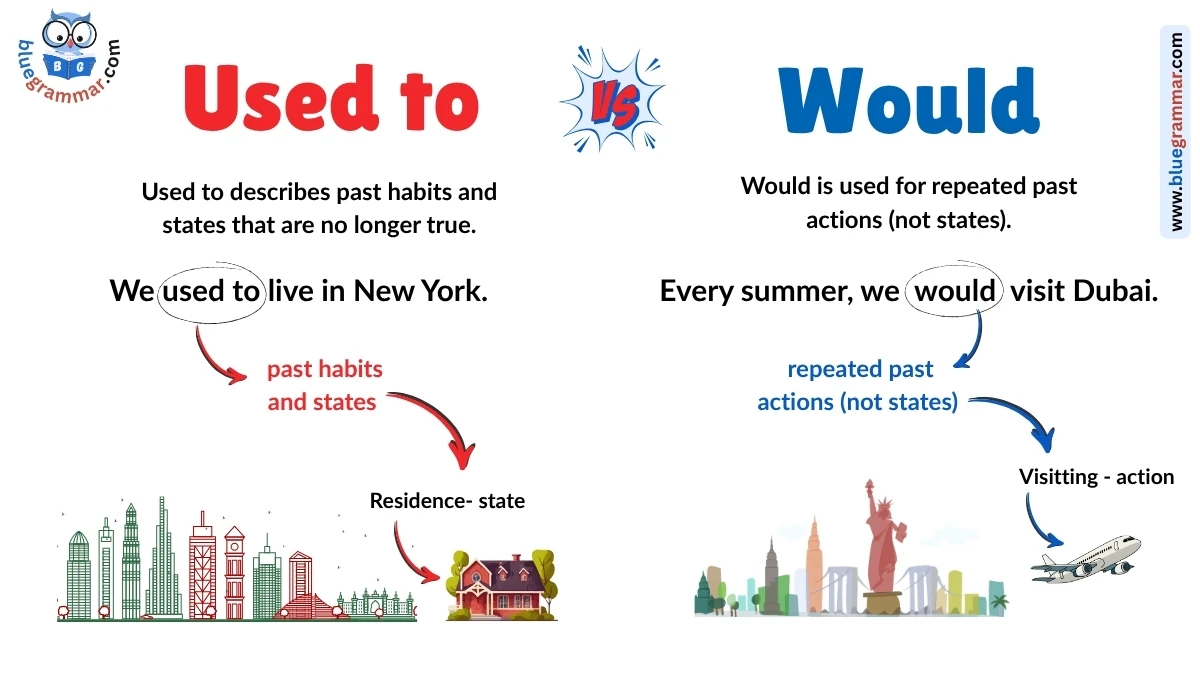
Talking about the past can be tricky, especially when choosing between used to and would. Both are used to describe past habits, but they are not always interchangeable. Used to can describe both past actions and past states, while would is only used for repeated actions.
1. Past Habits: Repeated Actions vs. General Past States
Both would and used to are commonly used to talk about the past, especially repeated actions or habits. However, would is mainly used to describe repeated actions that happened regularly, often in storytelling or when recalling memories. It focuses on what someone did again and again. In contrast, used to can describe both repeated actions and past states or situations, making it more flexible. This means used to can talk about things that were true in the past but are no longer true.
- Would (Repeated Actions):
Example: “When we were kids, we would play outside every evening.” - Used to (Actions + States):
Example: “I used to play outside every evening.”
Example: “I used to live in Lahore.”
2. Actions vs. States (Key Difference)
A major difference is that would cannot be used to describe past states, while used to can. States include things like feelings, conditions, or situations (e.g., live, know, believe, be). Would only works with action verbs, so it cannot describe situations that existed in the past. Used to, however, works with both action verbs and state verbs, making it the correct choice when describing past conditions or situations.
- Would (Incorrect for States):
Example: “I would live in Lahore.” (incorrect) - Used to (Correct for States):
Example: “I used to live in Lahore.” (correct)
3. Need for Context
Would usually requires a clear past context to make sense. It is often used after setting the scene, such as mentioning a time period or situation. Without context, would can sound confusing or incomplete. Used to, however, does not need additional context and can stand alone clearly. This makes used to easier to use when introducing past habits or situations.
- Would (Needs Context):
Example: “When I was a child, I would visit my grandparents every summer.” - Used to (No Context Needed):
Example: “I used to visit my grandparents every summer.”
4. Frequency and Emphasis
Would often emphasizes repeated or habitual actions and can make a story sound more vivid or descriptive. It highlights the idea of something happening again and again in the past. Used to, on the other hand, simply states that something was true or happened regularly, without emphasizing repetition as strongly. It is more neutral and straightforward.
- Would (Emphasizes Repetition):
Example: “Every winter, we would sit by the fire and tell stories.” - Used to (Neutral Habit):
Example: “We used to sit by the fire in winter.”
5. Storytelling vs. General Statements
Would is commonly used in storytelling, narratives, and descriptive writing to create a vivid picture of past habits. It often appears in longer sentences where events are being described in sequence. Used to, however, is more commonly used for general statements about the past, especially when simply stating facts. This makes would more stylistic and used to more practical.
- Would (Storytelling):
Example: “After dinner, we would gather in the living room and talk for hours.” - Used to (General Statement):
Example: “We used to gather in the living room after dinner.”
6. Past vs. Present Contrast
Both would and used to imply that something was true in the past but is not true now. However, used to makes this contrast clearer and more explicit. It directly signals that a past habit or situation has changed. Would suggests the same idea, but the contrast is often understood from context rather than clearly stated.
- Would (Implied Change):
Example: “We would travel every summer.” (implies we don’t now) - Used to (Clear Contrast):
Example: “We used to travel every summer.” (clearly not now)
7. Negative Forms: Didn’t Use to vs. Wouldn’t
The negative forms of these expressions differ in structure and meaning. Didn’t use to is used to describe something that was not true or did not happen in the past. Wouldn’t, however, is often used to describe refusal or unwillingness in the past, rather than simply the absence of a habit. This difference is important because wouldn’t can carry a different meaning.
- Didn’t Use to (Past Negative Habit/State):
Example: “I didn’t use to like coffee.” - Wouldn’t (Refusal/Unwillingness):
Example: “He wouldn’t listen to me.” (he refused)
8. Questions: Common vs. Less Common
Used to is commonly used in questions about past habits or states, especially in everyday conversation. It is clear and widely accepted. Would is rarely used in questions about past habits unless the context is already established. This makes used to the preferred choice in most question forms.
- Used to (Common Question):
Example: “Did you use to play cricket?” - Would (Less Common):
Example: “Would you play cricket when you were young?” (needs context)
9. Formality and Usage
Both would and used to are acceptable in standard English, but they differ slightly in usage style. Would is more common in descriptive or literary contexts, especially when telling stories. Used to is more common in everyday speech and writing when talking about past habits or situations. This makes used to more practical for learners.
- Would (Narrative Style):
Example: “She would spend hours reading by the window.” - Used to (Everyday Use):
Example: “She used to spend hours reading.”
10. Certainty and Clarity
Used to is generally clearer and more direct when talking about past habits or states. It leaves little room for confusion and clearly indicates that something belonged to the past. Would, however, depends more on context and may not always clearly show that the action is in the past unless the time is mentioned. This makes used to more beginner-friendly.
- Would (Context-Dependent):
Example: “We would go there often.” - Used to (Clear Meaning):
Example: “We used to go there often.”
Quick Comparison Summary | Used to vs. Would
| Feature | Used to | Would |
|---|---|---|
| Verb Types Supported | Action verbs & State verbs (live, be, know). | Action verbs ONLY. (Not state verbs) |
| Context Requirement | Can stand alone without prior time context. | Requires explicit past time context or scene setting. |
| Primary Purpose | Clear contrast between past state/habit and present. | Nostalgic storytelling, vivid narrative memory. |
| Questions & Negatives | Standard: Did you use to...? / Didn't use to... | Rare in past questions; Wouldn't implies past refusal. |
Pro Tip: When in doubt, use used to—it works for both actions and states and doesn't require setting up a scene. Reserve would for when you are setting a nostalgic scene or telling a story about repeated past actions (e.g., “When I was young, we would...”).