
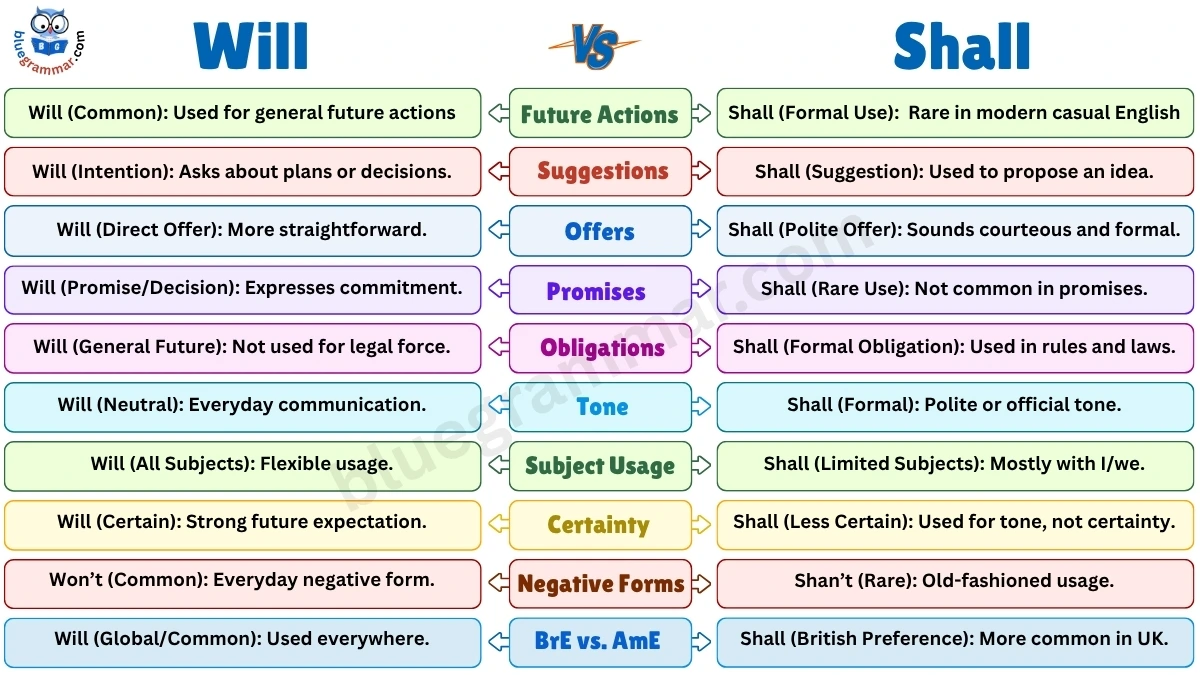
Both will and shall are used to talk about the future, but they are not used in the same way. While will is common in everyday English, shall is mostly used in polite suggestions or formal situations.
1. Future Actions: Common vs. Formal
The most basic use of both will and shall is to talk about the future. However, in modern English, will is the standard choice for expressing future actions in everyday speech and writing. It is natural, simple, and widely accepted with all subjects. On the other hand, shall is rarely used for simple future statements today and sounds formal or old-fashioned. It may still appear in formal writing or traditional usage, especially with “I” and “we.”
- Will (Common): Used for general future actions.
Example: “I will call you tomorrow.” - Shall (Formal/Old Use): Rare in modern casual English.
Example: “I shall return soon.”
2. Suggestions: Neutral vs. Polite
Both will and shall can appear in questions, but their purpose is different. Shall is commonly used to make suggestions, especially with “we.” It invites the other person to agree or decide together. Will, however, is not typically used for suggestions; instead, it asks about intention or future action.
- Shall (Suggestion): Used to propose an idea.
Example: “Shall we go for a walk?” - Will (Intention): Asks about plans or decisions.
Example: “Will we go for a walk?”
3. Offers: Direct vs. Polite
When offering help, shall is more polite and traditional, especially in British English. It is often used with “I” to offer assistance in a respectful way. Will, on the other hand, can be used for offers but sounds more direct and less formal.
- Shall (Polite Offer): Sounds courteous and formal.
Example: “Shall I help you with that?” - Will (Direct Offer): More straightforward.
Example: “I will help you with that.”
4. Promises and Decisions
Will is commonly used to express promises, decisions, and willingness. It shows commitment or determination at the moment of speaking. Shall is not typically used in this way in modern English, except in very formal contexts.
- Will (Promise/Decision): Expresses commitment.
Example: “I will always support you.” - Shall (Rare Use): Not common in modern promises.
Example: “I shall never forget this.” (formal tone)
5. Questions: Plan vs. Suggestion
Both words are used in questions, but they create different meanings. Will is used to ask about someone’s plans, willingness, or future actions. Shall, however, is used to suggest or offer something politely, especially with “I” and “we.”
- Will (Plan/Request): Asking about future action.
Example: “Will you join us?” - Shall (Suggestion/Offer): Asking for opinion or offering help.
Example: “Shall we begin?”
6. Formal Rules and Obligations
One important use of shall is in legal, official, or formal documents. It is used to express strong obligation, rules, or requirements. Will is generally not used in this strict legal sense.
- Shall (Formal Obligation): Used in rules and laws.
Example: “The tenant shall pay rent on time.” - Will (General Future): Not used for legal force.
Example: “The tenant will pay rent.” (less strict)
7. Tone: Neutral vs. Formal
The tone of these two modal verbs is quite different. Will sounds natural, neutral, and is suitable for almost all situations. Shall, however, sounds more formal, polite, or even old-fashioned depending on the context.
- Will (Neutral): Everyday communication.
Example: “I will see you later.” - Shall (Formal): Polite or official tone.
Example: “Shall we proceed?”
8. Subject Usage
Will can be used with all subjects (I, you, he, she, they) without restriction. Shall, however, is mainly used with “I” and “we,” especially in questions and suggestions.
- Will (All Subjects): Flexible usage.
Example: “They will arrive soon.” - Shall (Limited Subjects): Mostly with I/we.
Example: “Shall we start?”
9. British vs. American Usage
There is also a regional difference. Shall is more commonly used in British English, especially in polite questions. In American English, it is much less common, and will is preferred in almost all situations.
- Will (Global/Common): Used everywhere.
Example: “I will call you.” - Shall (British Preference): More common in the UK.
Example: “Shall we go?”
10. Certainty and Strength
Will expresses a stronger sense of certainty or determination about the future. It often shows that something is expected to happen. Shall, on the other hand, does not usually express certainty; instead, it focuses on suggestions or formal instructions.
- Will (Certain): Strong future expectation.
Example: “This plan will succeed.” - Shall (Less About Certainty): Used for tone, not certainty.
Example: “Shall we try this plan?”
11. Negative Forms: Won’t vs. Shan’t
The negative form of will is won’t, which is very common in everyday English. The negative form of shall is shan’t, but it is rarely used today and sounds outdated or very formal.
- Won’t (Common): Everyday negative form.
Example: “I won’t go.” - Shan’t (Rare): Old-fashioned usage.
Example: “I shan’t attend.”
12. Will Be vs. Shall Be
Both forms can describe future states, but will be is the standard choice in modern English. Shall be is mostly used in formal, legal, or official contexts.
- Will Be (Common Future): Everyday usage.
Example: “She will be happy.” - Shall Be (Formal): Legal or official tone.
Example: “The agreement shall be valid for one year.”
Quick Comparison Summary | Will vs. Shall
| Feature | Will | Shall |
|---|---|---|
| Tense / Modern Standard | Modern standard for all future references. | Formal, old-fashioned, or restricted contexts. |
| Tone | Neutral and natural. | Polite, formal, or official. |
| Key Functions | Decisions, promises, predictions, intentions. | Polite suggestions, offers, legal/formal rules. |
| Subject Agreement | Works with all subjects (I, you, he, she, it, we, they). | Mainly used with I and we. |
| Negative Form | Won't (Very common) | Shan't (Rare/Outdated) |
Pro Tip: If you’re unsure, use will. Use shall mainly for polite suggestions (e.g., “Shall we…?”) or in formal/legal writing.