
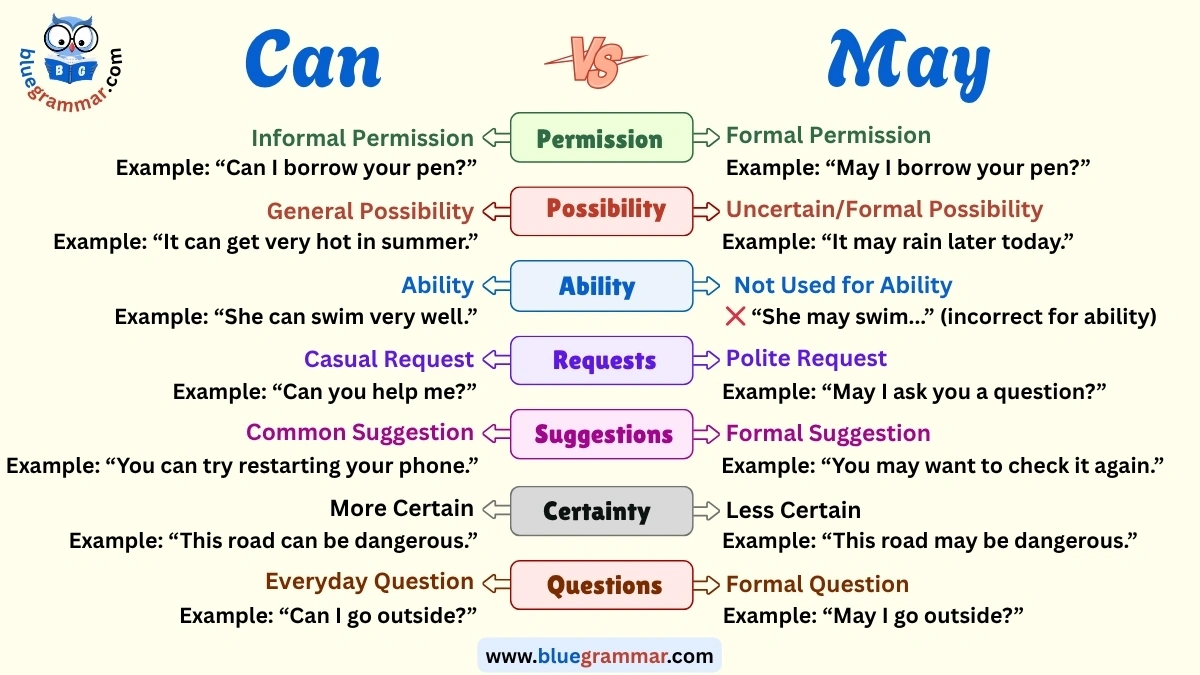
Understanding can vs. may is essential for using English correctly in both everyday and formal situations. Although both are used to express permission and possibility, their meanings and usage are different. Can is commonly used in informal conversations, while may is preferred in formal contexts and polite communication.
1. Permission: Informal vs. Formal
The most important difference between can and may is how they are used to ask for or give permission. Can is commonly used in everyday conversation and sounds natural in informal situations such as talking to friends or family. However, may is considered more formal, polite, and traditionally correct in formal writing, schools, or professional environments. While modern English accepts “can” for permission, using “may” shows a higher level of politeness and respect.
- Can (Informal Permission):
Example: “Can I borrow your pen?” - May (Formal Permission):
Example: “May I borrow your pen?”
2. Possibility: Practical vs. Formal/Uncertain
Both can and may can express possibility, but they differ slightly in tone and usage. Can is used for general or practical possibilities—things that are known to happen or are realistically possible. On the other hand, may is often used in formal contexts to express possibility, especially when the outcome is uncertain. It sounds more cautious and less definite than “can.”
- Can (General Possibility):
Example: “It can get very hot in summer.” - May (Uncertain/Formal Possibility):
Example: “It may rain later today.”
3. Ability vs. Permission
One key difference is that can is used to express ability, while may is not used for ability at all. Can describes what someone is capable of doing physically or mentally. In contrast, may is strictly used for permission or possibility, and using it to express ability would be incorrect. This makes can more versatile in everyday English.
- Can (Ability):
Example: “She can swim very well.” - May (Not Used for Ability):
Incorrect: “She may swim very well.” (incorrect when expressing physical ability)
4. Requests: Casual vs. Polite
When making requests, both can and may are used, but they create different impressions. Can is more direct and is commonly used in casual speech. May, however, is more polite and formal, making it suitable for respectful or professional communication. Using may can make your request sound more refined and courteous.
- Can (Casual Request):
Example: “Can you help me?” - May (Polite Request):
Example: “May I ask you a question?”
5. Giving Permission: Friendly vs. Official
Both words can be used to give permission, but the tone changes depending on which one you choose. Can is used when granting permission in a relaxed or friendly manner. May, however, is often used in formal rules, instructions, or official statements. It is commonly seen in written notices, policies, and academic contexts.
- Can (Friendly Permission):
Example: “You can leave early today.” - May (Official Permission):
Example: “Students may leave the classroom after submitting their papers.”
6. Certainty vs. Uncertainty
Another important difference is the level of certainty expressed. Can is used when something is generally true or commonly happens, making it sound more certain. May, on the other hand, expresses uncertainty and is used when something is possible but not guaranteed. This makes may more cautious and less definite in meaning.
- Can (More Certain):
Example: “This road can be dangerous.” - May (Less Certain):
Example: “This road may be dangerous at night.”
7. Suggestions and Advice
Although both words can be used in suggestions, may is less common in everyday advice compared to “can.” Can is typically used to suggest practical solutions or actions that someone is able to do. May is sometimes used in formal or polite suggestions, but it can sound less direct and slightly old-fashioned in casual conversation.
- Can (Common Suggestion):
Example: “You can try restarting your phone.” - May (Formal Suggestion):
Example: “You may want to check your settings.”
8. Negative Forms: Can’t vs. May Not
The negative forms of can and may also differ in meaning. Can’t is used to express inability or impossibility—it means something is not possible. May not, however, is used to deny permission or indicate that something is not allowed. This difference is important because confusing them can change the meaning of a sentence.
- Can’t (Inability/Impossibility):
Example: “I can’t swim.” - May Not (No Permission):
Example: “You may not enter this room.”
9. Questions: Everyday vs. Formal Tone
When asking questions, both can and may are grammatically correct, but the tone differs. Can is more common in everyday conversations and sounds natural and relaxed. May is more formal and is often taught in traditional grammar rules, especially in schools or professional communication.
- Can (Everyday Question):
Example: “Can I go outside?” - May (Formal Question):
Example: “May I go outside?”
10. Can Be vs. May Be
Both expressions are used to describe situations, but they differ in certainty. Can be is used for general truths or things that happen regularly. May be suggests a possibility that is uncertain or not confirmed. This makes may be more tentative in meaning.
- Can Be (General Truth):
Example: “Learning English can be challenging.” - May Be (Possibility):
Example: “Learning English may be challenging for beginners.”
11. Formal Writing vs. Spoken English
In modern English, can is widely used in both spoken and informal written communication. It sounds natural and is accepted in most everyday contexts. May, however, is more common in formal writing, academic texts, legal documents, and official communication. Choosing between the two often depends on the level of formality required.
- Can (Common in Speech):
Example: “Can I take a break?” - May (Formal Writing):
Example: “Employees may take a break after two hours of work.”
Quick Comparison Summary | Can vs. May
| Feature | Can | May |
|---|---|---|
| Core Focus | Physical/mental ability, practical possibility. | Formal permission, uncertain possibility. |
| Permission Style | Informal, casual, everyday conversation. | Formal, polite, official contexts. |
| Certainty Level | More certain (general truths, practical scenarios). | Less certain (speculative, tentative possibilities). |
| Negative Forms | Can't = Inability or impossibility. | May not = Lack of permission or refusal. |
| Best Usage Context | Spoken English, friendly dialogue. | Academic texts, professional writing, formal settings. |
Pro Tip: Remember the classic rule: can is about capability ("Are you physically able to do it?"), while may is about authorization ("Do you have permission to do it?"). In modern spoken English, can is widely used for both, but may remains the clear winner for formal and polite communication.