
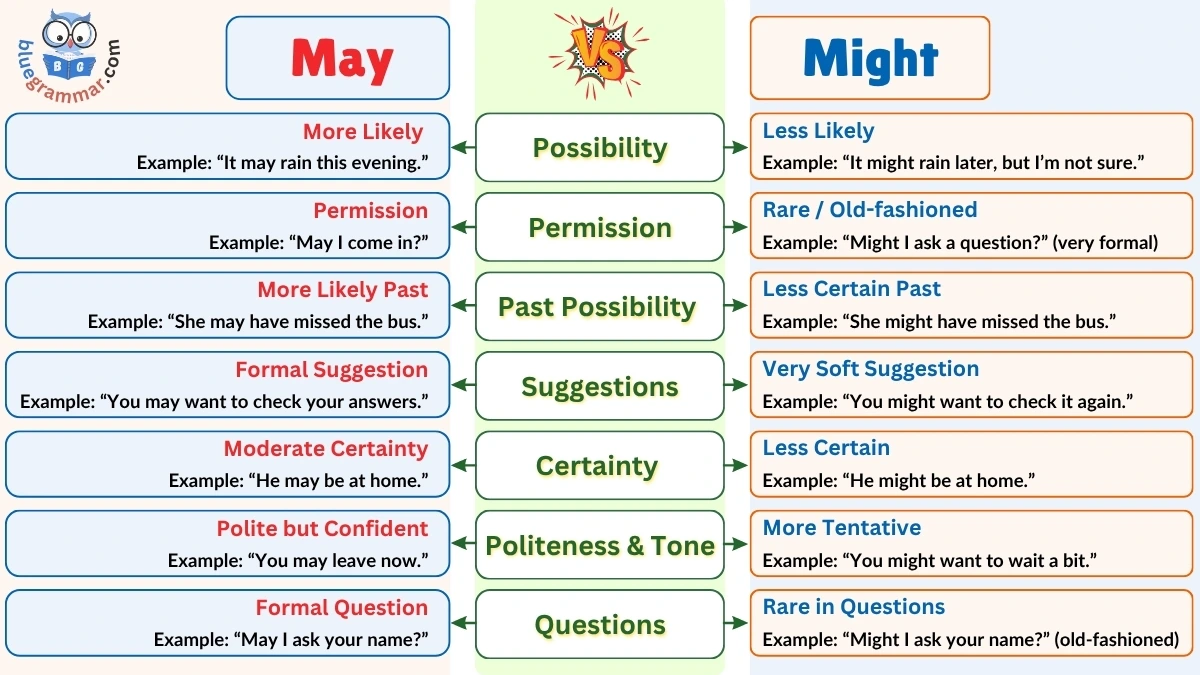
The difference between may vs. might is important when expressing possibility, permission, and uncertainty in English. Both modal verbs are often used in similar situations, but they vary in tone, level of certainty, and formality. May is commonly used for more likely possibilities and formal permission, while might is used for less certain or more cautious statements.
1. Possibility: More Likely vs. Less Likely
The primary use of both may and might is to express possibility, but they differ slightly in the degree of certainty. May is generally used when something is fairly possible or has a reasonable chance of happening. Might, on the other hand, suggests a weaker possibility—it indicates that something is less certain or more doubtful. In modern English, this difference is often subtle, but might still sounds more tentative and cautious than may.
- May (More Likely):
Example: “It may rain this evening.” - Might (Less Likely):
Example: “It might rain later, but I’m not sure.”
2. Permission: Formal vs. Rare/Uncommon
May is commonly used to ask for or give permission, especially in formal or polite situations. It is often preferred in schools, offices, and written communication where proper etiquette is important. Might, however, is rarely used for permission in modern English and can sound old-fashioned or overly formal. Because of this, may is almost always the better choice when dealing with permission.
- May (Permission):
Example: “May I come in?” - Might (Rare/Old-fashioned):
Example: “Might I ask a question?” (very formal)
3. Past Possibility (May Have vs. Might Have)
Both may have and might have are used to talk about possible events in the past, but might have usually expresses more doubt. May have suggests that something probably happened, while might have indicates a weaker possibility. These forms are useful when you are not sure about a past situation but want to suggest what could have occurred.
- May Have (More Likely Past):
Example: “She may have missed the bus.” - Might Have (Less Certain Past):
Example: “She might have missed the bus.”
4. Suggestions: Formal vs. Very Soft
Both may and might can be used to give suggestions, but they differ in tone. May is sometimes used in formal advice or recommendations, especially in written or professional contexts. Might is used to give very soft, indirect suggestions, allowing the listener complete freedom to decide. Because of this, might sounds more polite and less forceful than may.
- May (Formal Suggestion):
Example: “You may want to check your answers.” - Might (Very Soft Suggestion):
Example: “You might want to check your answers again.”
5. Hypothetical Situations
In hypothetical or imaginary situations, might is more commonly used than may. It emphasizes that the situation is unreal, unlikely, or dependent on certain conditions. May is less common in these contexts because it sounds more real or factual. Therefore, when discussing imagined scenarios, might is usually the better choice.
- May (Less Common in Hypotheticals):
Example: “If you hurry, you may catch the bus.” - Might (Hypothetical):
Example: “If I had more time, I might learn French.”
6. Certainty vs. Uncertainty
Another key difference is the level of certainty conveyed. May expresses a moderate level of certainty, meaning the speaker believes there is a reasonable chance something will happen. Might, however, expresses greater uncertainty and hesitation. It is often used when the speaker wants to avoid making a strong claim.
- May (Moderate Certainty):
Example: “He may be at home.” - Might (Less Certain):
Example: “He might be at home.”
7. Formal Writing vs. Spoken English
Both may and might are used in formal writing, but may is slightly more common in official, academic, or professional contexts. It is often used in reports, instructions, and policies. Might is also used in writing, but it is more common in conversational English when expressing uncertainty. The choice between the two often depends on tone and context.
- May (Formal Writing):
Example: “The results may vary depending on conditions.” - Might (Conversational Use):
Example: “The results might be different this time.”
8. Politeness and Tone
Both words are polite, but might often sounds softer and more tentative than may. When speaking carefully or trying not to sound too direct, might is often preferred. May is still polite, but it can sound slightly more confident or formal. Choosing between them can help you control how strong or gentle your statement sounds.
- May (Polite but Confident):
Example: “You may leave now.” - Might (More Tentative):
Example: “You might want to wait a bit.”
9. Negative Forms: May Not vs. Might Not
The negative forms of may and might also express possibility, but with uncertainty. May not suggests that something is possibly not true or not going to happen. Might not expresses even greater doubt, indicating a weaker chance. Both are used when the speaker is unsure, but might not is more cautious.
- May Not (Possible Negative):
Example: “He may not come today.” - Might Not (Less Certain Negative):
Example: “He might not come after all.”
10. Questions: Formal vs. Rare
May is sometimes used in formal questions, especially when asking for permission. It is grammatically correct and still taught in traditional English learning. Might, however, is rarely used in questions and can sound unnatural in modern conversation. For this reason, may is the preferred choice in most cases.
- May (Formal Question):
Example: “May I ask your name?” - Might (Rare in Questions):
Example: “Might I ask your name?” (very formal/old-fashioned)
Quick Comparison Summary | May vs. Might
| Feature | May | Might |
|---|---|---|
| Possibility Level | More likely / Moderate certainty. | Less likely / Weaker possibility / Uncertain. |
| Asking / Giving Permission | Standard & polite (e.g., “May I...?”). | Rare and old-fashioned (e.g., “Might I...?”). |
| Hypothetical Scenarios | Less common in unreal conditions. | Standard choice for unreal / hypothetical conditions. |
| Tone & Suggestions | Formal, direct, polite yet confident. | Soft, indirect, polite, and tentative. |
| Negative Forms | May not (Possible non-occurrence). | Might not (Cautious / weaker probability). |
Pro Tip: Use may when asking for formal permission or when an outcome is reasonably likely. Use might when expressing lower certainty, making soft/tentative suggestions, or dealing with hypothetical “if” scenarios.