
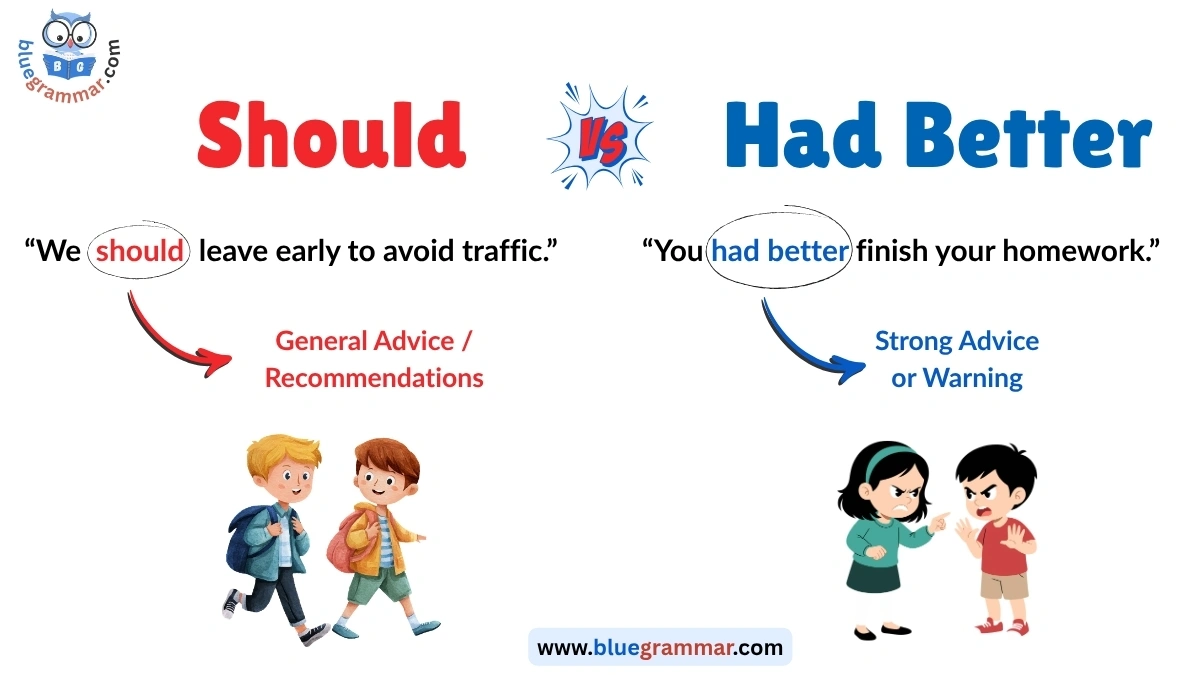
Choosing between should and had better can change the tone of your sentence more than you might expect. Both are used to give advice, but they don’t feel the same—should sounds gentle and general, while had better carries a sense of urgency or warning. In everyday English, this difference matters because it affects how your message is understood.
Uses and Explanation of Should
1. General Advice and Recommendations
Should is most commonly used to give advice, suggestions, or recommendations in everyday English. It is neutral in tone and does not sound very strong or strict. It simply tells someone what is the right or best thing to do according to the speaker’s opinion. Because of this flexibility, should is widely used in both spoken and written English. It is the standard choice when you want to guide someone politely.
- “You should drink more water.”
- “You should study for the test.”
- “We should leave early to avoid traffic.”
2. Moral Duty or Correct Behavior
Should is also used to talk about what is morally right or socially expected. It suggests what people are supposed to do according to rules, ethics, or common sense. However, even in this usage, it still sounds less strict than stronger expressions like “must.” It gives guidance without forcing action. This makes it suitable for general discussions about behavior and responsibility.
- “People should respect each other.”
- “You should always tell the truth.”
- “We should help those in need.”
3. Expectation or Probability
Should can also be used to express expectation or something likely to happen. It suggests that something is probably true or will happen based on logic or situation. It is often used when the speaker is fairly confident but not 100% certain. This usage is common in predictions or planning.
- “The bus should arrive soon.”
- “She should be at home now.”
- “This plan should work.”
4. Conditional Advice (If Clauses)
Should is often used in conditional sentences to give advice based on a situation. It helps express what is recommended if certain conditions are met. This makes it useful in problem-solving or instructional language. It keeps the tone polite and non-forceful.
- “If you are tired, you should rest.”
- “If it rains, you should take an umbrella.”
- “If you study regularly, you should pass the exam.”
Uses and Explanation of Had Better
1. Strong Advice or Warning
Had better is used to give strong advice, warnings, or urgent recommendations. It is much stronger than should and often implies that something bad will happen if the advice is not followed. Because of this, it can sound serious or even threatening depending on context. It is used when the speaker wants to emphasize urgency or importance.
- “You had better finish your homework.”
- “You had better be careful.”
- “We had better leave now.”
2. Implied Consequences
One important feature of had better is that it often implies negative consequences if the advice is ignored. Even if the consequence is not directly stated, it is understood. This makes it more forceful than should, which is softer and more optional. It is commonly used in warnings or urgent situations.
- “You had better study, or you will fail.”
- “He had better apologize, or he will lose his job.”
- “We had better hurry, or we’ll miss the train.”
3. Immediate Situations and Urgency
Had better is used when action needs to be taken immediately. It suggests that there is no time to delay or ignore the advice. This makes it useful in real-life urgent decisions. It often appears in spoken English when someone wants to act quickly.
- “You had better call a doctor right now.”
- “We had better leave immediately.”
- “You had better stop driving in this weather.”
4. Not Used for General Advice
Unlike should, had better is not used for general or everyday advice. It is too strong for casual suggestions. You would not normally use it for routine recommendations like studying, eating healthy, or exercising. It is reserved for specific situations where urgency or consequences exist.
- Incorrect (too strong): “You had better eat vegetables every day.”
- Correct (Should instead): “You should eat vegetables every day.”
5. Negative Form: Had Better Not
The negative form had better not is used to warn someone not to do something. It strongly advises against an action and suggests that something bad may happen if the warning is ignored. This form is very direct and often sounds like a serious warning. It is stronger than shouldn’t.
- “You had better not lie to me.”
- “He had better not be late again.”
- “You had better not touch that wire.”
Main Differences Between Should and Had Better
1. Strength of Advice
Should gives soft, polite, and general advice. It is flexible and does not sound strict. Had better, however, gives strong advice or warning and often implies serious consequences if ignored. This makes it much more forceful than should.
2. Level of Urgency
Should is used for normal situations where action is recommended but not urgent. Had better is used when immediate action is needed. It creates a sense of urgency and pressure, unlike the calm tone of should.
3. Consequences
Should does not usually imply negative consequences. It simply suggests what is right or best. Had better, on the other hand, often implies that something bad will happen if the advice is not followed. This is a key difference in meaning.
4. Usage Context
Should is used in general advice, daily conversation, formal writing, and instructions. Had better is used in warnings, urgent advice, or serious situations. It is not used for routine or general recommendations.
5. Tone Difference
Should sounds polite, neutral, and friendly. Had better sounds strong, serious, and sometimes threatening depending on context. This difference in tone makes them suitable for very different situations.
Quick Comparison Summary | Should vs. Had Better
| Feature | Should | Had Better |
|---|---|---|
| Strength of Advice | Soft, polite, optional recommendation. | Strong advice, firm requirement, or warning. |
| Urgency Level | Normal/Routine situations; no immediate pressure. | Immediate and urgent action required. |
| Consequences | No negative consequences implied. | Implies negative outcomes if ignored. |
| Tone | Friendly, neutral, helpful. | Serious, urgent, potentially stern. |
| Negative Form | Shouldn't (General negative advice). | Had better not (Direct warning/prohibition). |
Pro Tip: Use should when giving friendly tips, general suggestions, or everyday advice. Reserve had better for urgent situations or warnings where ignoring the advice could lead to trouble or negative consequences.