
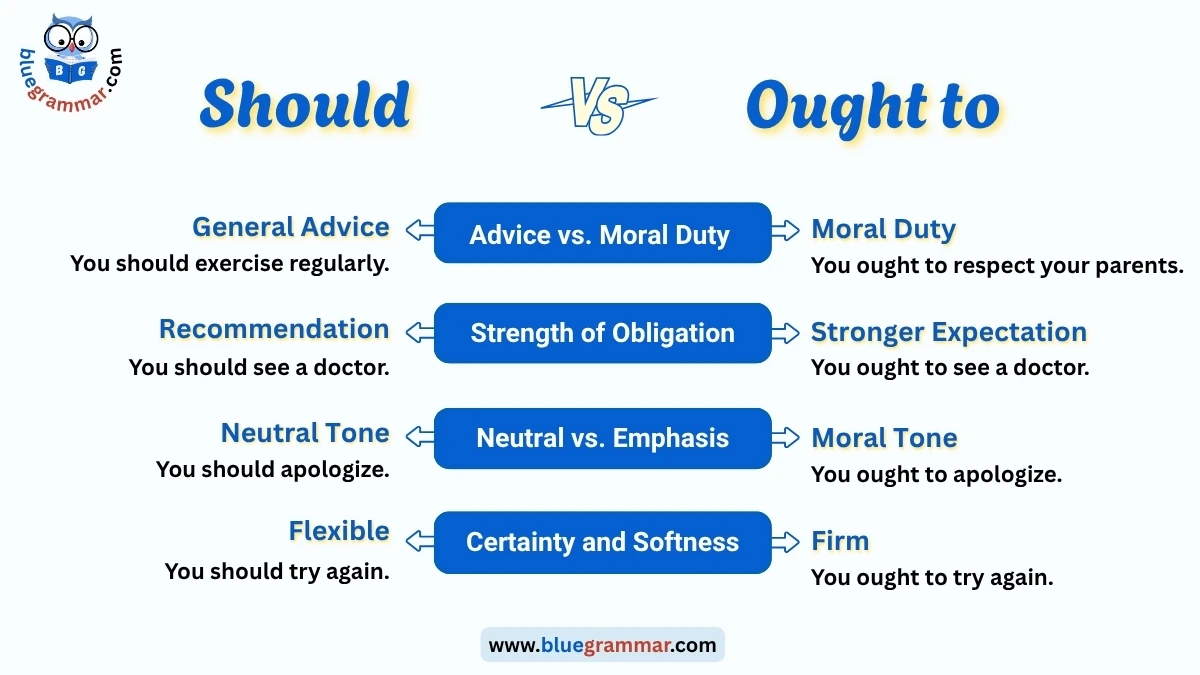
Both should and ought to are used to give advice or express duty, but they are not always used in the same way. While their meanings are often similar, the tone and usage can differ slightly in modern English.
1. Basic Meaning: Advice vs. Moral Duty
Both should and ought to are used to give advice, recommendations, or express what is the right thing to do. However, should is more commonly used in everyday English and sounds natural in both spoken and written communication. Ought to, on the other hand, often carries a slightly stronger sense of moral duty, responsibility, or correctness. It can sound more formal or traditional, especially in modern usage. In many situations, the two are interchangeable, but ought to may feel more serious.
- Should (General Advice):
Example: “You should exercise regularly.” - Ought to (Moral Duty):
Example: “You ought to respect your parents.”
2. Strength of Obligation
Although both words express obligation, ought to can sometimes suggest a stronger or more ethical responsibility than should. Should is often used for practical advice or suggestions, where the action is recommended but not required. Ought to, however, implies that something is the correct or proper thing to do, often based on rules, expectations, or moral standards. This makes ought to slightly stronger in tone.
- Should (Recommendation):
Example: “You should see a doctor.” - Ought to (Stronger Expectation):
Example: “You ought to see a doctor.” (sounds more serious)
3. Everyday Use vs. Formal Tone
Should is far more common in modern English and is used in both informal and formal situations. It sounds natural in conversations, emails, and everyday advice. Ought to, however, is less commonly used in daily speech and may sound formal, old-fashioned, or more careful in tone. Because of this, learners are usually encouraged to use should in most situations.
- Should (Common Use):
Example: “You should try this restaurant.” - Ought to (Less Common/Formal):
Example: “You ought to try this restaurant.”
4. Questions: Common vs. Rare
When forming questions, should is widely used and sounds natural in both spoken and written English. It is commonly used to ask for advice or suggestions. Ought to, however, is rarely used in questions and can sound awkward or overly formal. For this reason, should is strongly preferred in question forms.
- Should (Common Question):
Example: “Should I call him?” - Ought to (Rare Question):
Example: “Ought I to call him?” (very formal/rare)
5. Negative Forms: Shouldn’t vs. Ought Not To
The negative forms of these expressions also differ slightly in usage. Shouldn’t is very common and is used to give advice against something or warn someone. Ought not to is grammatically correct but is rarely used in modern English and may sound formal or old-fashioned. Most speakers prefer shouldn’t in everyday communication.
- Shouldn’t (Common Negative Advice):
Example: “You shouldn’t eat too much sugar.” - Ought Not To (Formal/Uncommon):
Example: “You ought not to eat too much sugar.”
6. Probability and Expectation
Both should and ought to can be used to express expectation or probability. In this sense, they suggest that something is likely to happen because it is logical or expected. Should is more commonly used for this purpose, while ought to is less frequent but still correct. The meaning is nearly the same in this context.
- Should (Expected Result):
Example: “The train should arrive soon.” - Ought to (Less Common):
Example: “The train ought to arrive soon.”
7. Past Forms: Should Have vs. Ought to Have
Both should have and ought to have are used to talk about past actions that were the right thing to do but did not happen. They often express regret, criticism, or missed responsibility. Should have is more common in modern English, while ought to have sounds more formal. The meaning is almost identical, but should have is preferred in most situations.
- Should Have (Common):
Example: “I should have studied harder.” - Ought to Have (Formal):
Example: “I ought to have studied harder.”
8. Tone: Neutral vs. Moral Emphasis
The tone of should is generally neutral and practical, making it suitable for everyday advice. It does not strongly judge the listener. Ought to, however, often carries a sense of moral correctness or duty, which can make it sound slightly more serious or judgmental. This subtle difference can affect how the message is received.
- Should (Neutral Tone):
Example: “You should apologize.” - Ought to (Moral Tone):
Example: “You ought to apologize.”
9. Softness and Correctness
Should is flexible and can be used for both soft advice and moderate certainty. It adapts easily to different tones depending on context. Ought to, however, often sounds firmer and less flexible because of its association with duty or correctness. This makes should more versatile in everyday communication.
- Should (Flexible):
Example: “You should try again.” - Ought to (Firm):
Example: “You ought to try again.”
10. Modern Usage Preference
In modern English, should is strongly preferred over ought to in most situations. It is simpler, more natural, and widely understood. Ought to is still correct but is used less frequently, especially in casual conversation. As a result, learners and speakers tend to rely on should for clarity and ease.
- Should (Preferred):
Example: “You should take a break.” - Ought to (Less Common):
Example: “You ought to take a break.”
Quick Comparison Summary | Should vs. Ought to
| Feature | Should | Ought to |
|---|---|---|
| Usage | Common, natural, flexible, everyday use. | Less common, formal, traditional. |
| Tone | Neutral and practical. | Moral duty, serious, firmer emphasis. |
| Questions | Very common (e.g., “Should I go?”). | Rare and awkward (e.g., “Ought I to go?”). |
| Negative Form | Shouldn't (Common). | Ought not to (Rare/Formal). |
| Past Form | Should have (Standard). | Ought to have (Formal). |
Pro Tip: Default to should in almost all situations for natural and modern communication. Use ought to when you explicitly want to emphasize a sense of moral obligation or duty.