
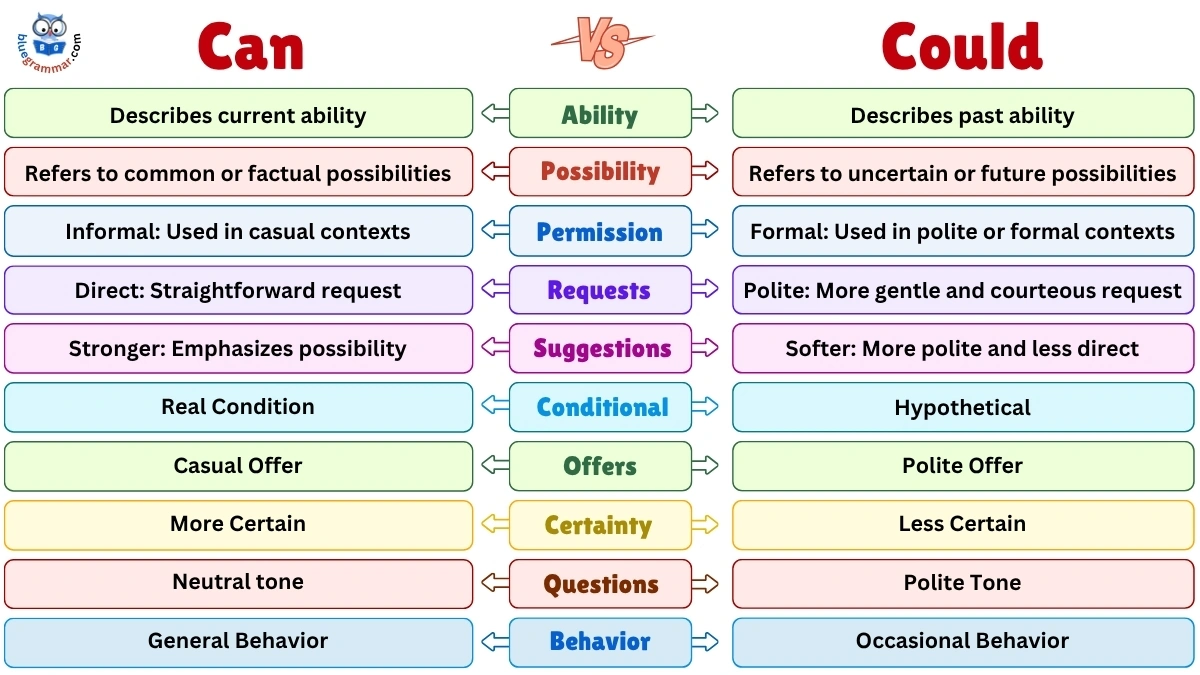
In English, can and could are modal verbs that often cause confusion because they overlap in meaning. While they both deal with ability, possibility, and permission, the primary difference lies in tense and tone.
1. Ability: Present vs. Past
The most basic difference between can and could is related to time and ability. Can is used to describe what someone is able to do right now, in the present moment. It expresses current skills, talents, or capabilities. On the other hand, could is used to talk about abilities in the past, especially things that someone was generally able to do over a period of time. However, when referring to a specific successful action in the past, “was/were able to” is often more accurate than “could.”
- Can (Present):
Example: “I can speak three languages fluently.” - Could (Past):
Example: “When I was ten, I could climb that tree in seconds.”
2. Possibility and Probability
Both can and could are used to talk about possibility, but they differ in the level of certainty they express. Can is used for general or known possibilities—things that are commonly true or expected to happen under certain conditions. It often reflects facts or regular occurrences. In contrast, could is used when something is possible but uncertain, meaning there is a chance it might happen, but it is not guaranteed. This makes could sound more tentative and less definite.
- Can (General/Stronger):
Example: “It can get very cold in winter.” - Could (Specific/Weaker):
Example: “It could rain later.”
3. Permission: Informal vs. Polite
Both can and could can be used to ask for or give permission, but the difference lies in tone and formality. Can is commonly used in everyday, informal situations such as conversations with friends or family. It is straightforward and widely accepted in spoken English. Could, however, is considered more polite and respectful, making it suitable for formal situations, professional settings, or when speaking to someone you do not know well. Using could helps soften the request and shows courtesy.
- Can (Informal):
Example: “Can I use your phone?” - Could (Polite/Formal):
Example: “Could I leave early today?”
4. Requests: Direct vs. Polite
When making requests, both can and could are grammatically correct, but they create different impressions. Can is more direct and is often used among friends, colleagues, or in informal conversations. It gets straight to the point without adding extra politeness. On the other hand, could makes a request sound softer, more polite, and less demanding. It is especially useful when you want to be respectful or avoid sounding too forceful.
- Can (Direct):
Example: “Can you help me?” - Could (Polite):
Example: “Could you help me, please?”
5. Suggestions: Strong vs. Soft
Both modal verbs can be used to give suggestions, but they differ in tone. Can is often used when suggesting something practical or when emphasizing that an option is available. It can sound slightly more confident or direct. In contrast, could is used to give softer, less forceful suggestions. It allows the listener to feel more freedom in accepting or rejecting the idea, which makes it sound more polite and less imposing.
- Can (Stronger Suggestion):
Example: “You can try restarting your phone.” - Could (Softer Suggestion):
Example: “You could try restarting your phone.”
6. Conditional Situations (If Clauses)
Could is commonly used in conditional sentences to describe hypothetical or unreal situations—things that are not true now but are imagined. It often appears in “if” clauses to show what might happen under different circumstances. Can, however, is used in real or possible conditions where the situation is likely or achievable. This makes could more suitable for imaginary scenarios, while can fits real-life possibilities.
- Can (Real Condition):
Example: “If you can finish early, we will go out.” - Could (Hypothetical Condition):
Example: “If I had more time, I could learn Spanish.”
7. Past Possibility (Could Have)
Could have is used to talk about something that was possible in the past but we are not sure if it actually happened. It expresses uncertainty about a past situation. This structure is often used when guessing or making assumptions about what might have occurred. It does not confirm the event, only suggests that it was a possibility.
- Could Have (Past Possibility):
Example: “She could have missed the bus.”
8. Regret or Missed Opportunity
Could have is also used to express regret or criticism about something that did not happen in the past but was possible. It highlights missed opportunities or actions that someone failed to take. This usage often carries an emotional tone, such as disappointment or frustration, because the speaker believes a better outcome was possible.
- Could Have (Missed Opportunity):
Example: “You could have told me earlier.”
9. Offers: Casual vs. Polite
Both can and could are used when offering help, but the difference lies in tone and politeness. Can is commonly used in everyday situations when offering assistance in a simple and direct way. It sounds friendly and natural in casual conversations. In contrast, could makes the offer sound more polite, respectful, and slightly more formal. It is often used in customer service, professional settings, or when speaking to someone you want to show extra courtesy to.
- Can (Casual Offer):
Example: “Can I help you?” - Could (Polite Offer):
Example: “Could I help you with that?”
10. Ability vs. Opportunity
Sometimes the difference between can and could is not just about ability, but also about opportunity or conditions. Can is used when something is possible because the ability or permission exists right now. Could, however, is often used when something is possible only under certain conditions. It suggests that the action depends on a situation being fulfilled.
- Can (Ability/Permission):
Example: “I can go to the party.” - Could (Conditional Opportunity):
Example: “I could go if I finish my work.”
11. General Truth vs. Occasional Behavior
Can is used to describe behavior or situations that happen regularly or are generally true about someone or something. It suggests a pattern or repeated action. Could, on the other hand, is used to describe behavior that happens only sometimes or under certain conditions. It makes the statement less absolute and more conditional.
- Can (General Behavior):
Example: “He can be very rude.” - Could (Occasional Behavior):
Example: “He could be rude if he’s tired.”
12. Certainty vs. Uncertainty
Another key difference is the level of certainty expressed. Can is used when the speaker feels more confident or certain about a possibility. It often reflects known facts or strong likelihoods. Could, however, introduces doubt or uncertainty and is used when the speaker is less sure about the outcome. This makes could more cautious in tone.
- Can (More Certain):
Example: “This road can be dangerous.” - Could (Less Certain):
Example: “This road could be dangerous at night.”
13. Negative Forms: Can’t vs. Couldn’t
The negative forms also reflect a difference in time and meaning. Can’t is used to express present inability or impossibility. It tells us that something is not possible right now. Couldn’t, however, refers to inability in the past, indicating that something was not possible at a previous time.
- Can’t (Present Inability):
Example: “I can’t swim.” - Couldn’t (Past Inability):
Example: “I couldn’t swim when I was a child.”
14. Questions: Tone Difference
When asking questions, both can and could are used, but they create different tones. Can is more neutral and commonly used in everyday conversations. Could, however, makes the question sound more polite and less direct. It is often preferred in formal or respectful communication.
- Can (Neutral Question):
Example: “Can you open the door?” - Could (Polite Question):
Example: “Could you open the door?”
15. Can Be vs. Could Be
Both forms describe states or situations, but with different levels of certainty. Can be is used for general truths or things that happen regularly. Could be suggests a possibility that is uncertain or dependent on conditions.
- Can Be (General Truth):
Example: “Life can be hard.” - Could Be (Possibility):
Example: “Life could be better.”
16. Can Have vs. Could Have
These forms differ greatly in meaning. Can have is used in present contexts, often to give permission or make offers. Could have, however, refers to the past and is used to express possibility, regret, or missed chances. It often reflects something that did not happen but was possible.
- Can Have (Present Permission):
Example: “You can have my seat.” - Could Have (Past Regret/Possibility):
Example: “I could have won the match.”
Quick Comparison Summary | Can vs. Could
| Feature | Can | Could |
|---|---|---|
| Time / Tense | Present / General timeline. | Past or Conditional timeline. |
| Ability Type | Current skills or capabilities. | Past general skills or hypothetical capability. |
| Possibility Level | General, factual, strong likelihood. | Specific, tentative, weak possibility. |
| Tone (Requests/Offers) | Direct, informal, casual. | Polite, soft, formal, respectful. |
| Negative Forms | Can't = Present inability / impossibility. | Couldn't = Past inability / impossibility. |
Pro Tip: If you are ever in doubt in a professional setting or when meeting someone for the first time, use could. It is safer, more polite, and shows a higher level of respect!