
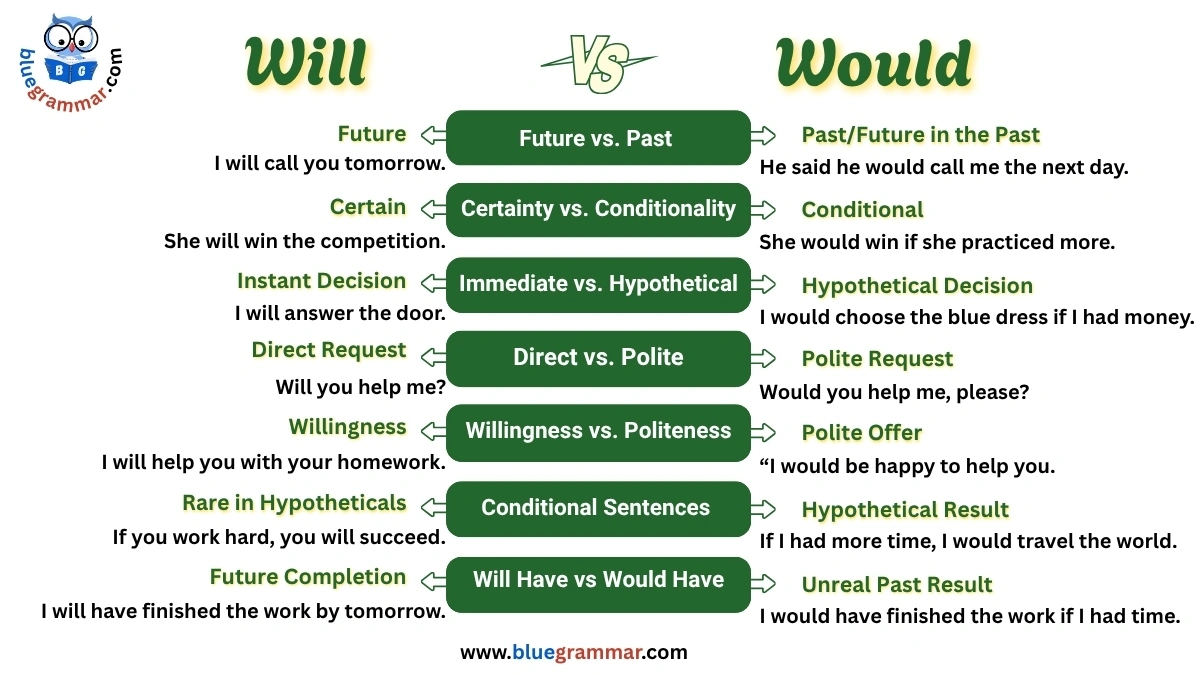
Choosing between will and would can be confusing because both relate to future or imagined situations. However, they are used in different contexts—will is commonly used for real future actions and decisions, while would is used for polite requests, hypothetical situations, and past habits.
1. Future vs. Past (Basic Time Difference)
The most fundamental difference between will and would is related to time. Will is used to talk about the future, especially when describing actions or events that are expected to happen. It expresses certainty, intention, or prediction about what lies ahead. Would, on the other hand, is often considered the past form of “will” and is used to describe future actions from a past perspective or in reported speech. This makes would more flexible, as it can also be used in hypothetical or imagined situations.
- Will (Future):
Example: “I will call you tomorrow.” - Would (Past/Future in the Past):
Example: “He said he would call me the next day.”
2. Certainty vs. Conditionality
Will is used when the speaker is fairly certain about something happening in the future. It expresses confidence, determination, or a clear expectation. In contrast, would is used in conditional or hypothetical situations, where the action depends on a condition being met. This makes would less definite and more dependent on circumstances.
- Will (Certain):
Example: “She will win the competition.” - Would (Conditional):
Example: “She would win if she practiced more.”
3. Decisions: Immediate vs. Hypothetical
Will is commonly used for decisions made at the moment of speaking. It reflects spontaneous choices or quick reactions to a situation. Would, however, is used to describe imagined or hypothetical decisions—what someone might choose under certain conditions. This makes would more reflective and less immediate.
- Will (Instant Decision):
Example: “I will answer the door.” - Would (Hypothetical Decision):
Example: “I would choose the blue dress if I had money.”
4. Requests: Direct vs. Polite
Both will and would are used to make requests, but the tone differs. Will is more direct and is commonly used in everyday situations. Would is more polite, indirect, and respectful, making it suitable for formal or courteous communication. Using would helps soften the request.
- Will (Direct Request):
Example: “Will you help me?” - Would (Polite Request):
Example: “Would you help me, please?”
5. Offers: Willingness vs. Politeness
Will is used to show willingness to do something or to make an offer in a straightforward way. It expresses readiness and intention. Would, however, is used to make more polite or formal offers, often sounding less forceful and more considerate. This difference is important in professional or respectful contexts.
- Will (Willingness):
Example: “I will help you with your homework.” - Would (Polite Offer):
Example: “I would be happy to help you.”
6. Habits: Present vs. Past
Will can be used to describe habitual or repeated actions, especially when talking about behavior that happens regularly. It is often used in storytelling or to describe typical actions. Would is used to describe repeated actions in the past, similar to “used to.” This creates a clear distinction between present habits and past habits.
- Will (Present Habit):
Example: “He will often forget his keys.” - Would (Past Habit):
Example: “When we were children, we would play outside every evening.”
7. Conditional Sentences (If Clauses)
In conditional sentences, would is commonly used to describe the result of an unreal or hypothetical condition. Will is generally not used in these types of “if” clauses because it expresses certainty rather than imagination. This makes would essential for expressing unreal or imagined outcomes.
- Will (Real Condition):
Example: “If you work hard, you will succeed.” - Would (Hypothetical Result):
Example: “If I had more time, I would travel the world.”
8. Preferences and Desires
Would is frequently used to express preferences, desires, or choices, especially in polite or formal situations. It helps make statements sound softer and more respectful. Will is not typically used in this way, as it focuses more on future actions rather than personal preferences.
- Would (Preference):
Example: “I would like a cup of tea.” - Will (Incorrect for Preference):
Example: “I will like a cup of tea.” (incorrect in this context)
9. Past vs. Hypothetical Result (Would Have)
Would have is used to describe the result of a condition that did not happen in the past. It expresses certainty about what the outcome would have been. While will have is used for future perfect situations, would have focuses on unreal past outcomes. This makes it important for expressing regret, explanation, or imagined results.
- Will Have (Future Completion):
Example: “I will have finished the work by tomorrow.” - Would Have (Unreal Past Result):
Example: “I would have finished the work if I had time.”
10. Negative Forms: Won’t vs. Wouldn’t
The negative forms of will and would also show important differences. Won’t (will not) is used to express refusal, future denial, or something that will not happen. Wouldn’t is used to describe refusal in the past or in hypothetical situations. It often suggests unwillingness or imagined negative outcomes.
- Won’t (Future Refusal):
Example: “I won’t go there.” - Wouldn’t (Past/Hypothetical Refusal):
Example: “He wouldn’t listen to me.”
11. Questions: Future vs. Polite Tone
In questions, will is used to ask about future actions or willingness. It is direct and commonly used in everyday speech. Would is used to make questions more polite and less direct. This makes would more suitable in formal or respectful situations.
- Will (Direct Question):
Example: “Will you come tomorrow?” - Would (Polite Question):
Example: “Would you like to come tomorrow?”
12. Certainty vs. Softness in Tone
Overall, will expresses stronger certainty, confidence, and direct intention. It is clear and straightforward in meaning. Would, however, softens statements and makes them less direct or more hypothetical. This makes would especially useful in polite communication and imagined situations.
- Will (Strong/Definite):
Example: “This plan will work.” - Would (Softer/Conditional):
Example: “This plan would work if we follow it properly.”
Quick Comparison Summary | Will vs. Would
| Feature | Will | Would |
|---|---|---|
| Time Focus | Real future; present habits. | Past perspective; past habits. |
| Certainty & Condition | High certainty; real conditions. | Hypothetical, conditional, or unreal scenarios. |
| Tone & Requests | Direct and straightforward. | Polite, soft, and respectful. |
| Decisions & Offers | Instant decisions and direct offers. | Hypothetical choices and polite/formal offers. |
| Negative Forms | Won't (Future refusal / non-occurrence). | Wouldn't (Past refusal / hypothetical non-occurrence). |
Pro Tip: Use will when discussing definite plans, real future possibilities, or making direct statements. Switch to would when you want to soft-pedal a request politely, express a preference (“I would like...”), or discuss hypothetical “what-if” scenarios.