
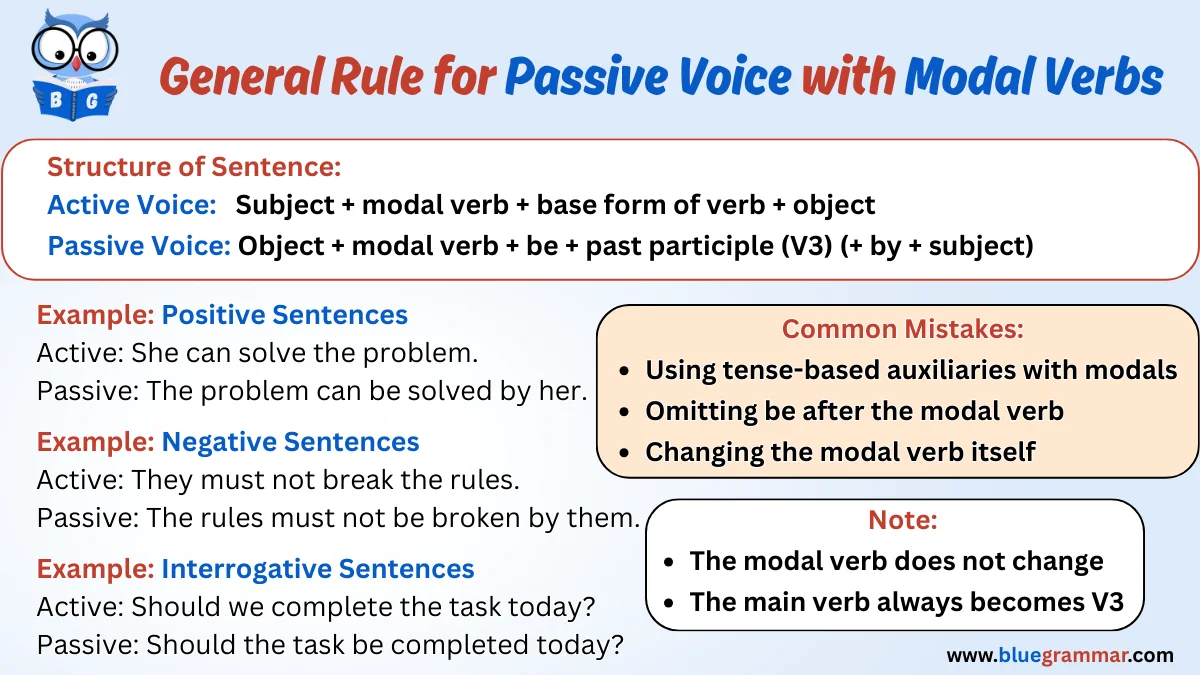
Sentences that contain modal verbs such as can, could, may, might, must, should, will, would, and ought to are converted into the passive voice using a different structure from simple or perfect tenses. In such sentences, the modal verb remains unchanged, while the main verb shifts to the past participle form (V3). This article explains the rules and patterns used to change active sentences with modal verbs into the passive voice.
What Are Modal Verbs?
Modal verbs are auxiliary verbs used to express ability, possibility, permission, obligation, advice, or necessity. Common modal verbs include: can, could, may, might, must, should, will, would, shall, and ought to. (Read a post on modal verbs vs auxiliary verbs)
General Rule for Passive Voice with Modal Verbs
Structure of Active and Passive Sentences with Modal Verbs:
- Active Voice: Subject + modal verb + base form of verb + object
- Passive Voice: Object + modal verb + be + past participle (V3) (+ by + subject)
Note:
- The modal verb does not change
- The main verb always becomes V3
Positive Sentence Examples – Modal Verbs (Active to Passive Voice)
- Active: She can solve the problem.
- Passive: The problem can be solved by her.
- Active: They must follow the rules.
- Passive: The rules must be followed by them.
- Active: We should complete the task today.
- Passive: The task should be completed today.
Negative Sentence Examples – Modal Verbs (Active to Passive Voice)
- Active: She cannot solve the problem.
- Passive: The problem cannot be solved by her.
- Active: They must not break the rules.
- Passive: The rules must not be broken by them.
- Active: We should not delay the task.
- Passive: The task should not be delayed.
Interrogative Sentence Examples – Modal Verbs (Active to Passive Voice)
- Active: Can she solve the problem?
- Passive: Can the problem be solved by her?
- Active: Must they follow the rules?
- Passive: Must the rules be followed by them?
- Active: Should we complete the task today?
- Passive: Should the task be completed today?
Passive Voice with Different Modal Meanings
Ability (can / could)
- Active: He can operate the machine.
- Passive: The machine can be operated by him.
Obligation (must)
- Active: You must submit the form.
- Passive: The form must be submitted.
Advice (should / ought to)
- Active: You should revise the lesson.
- Passive: The lesson should be revised.
Possibility (may / might)
- Active: They may announce the result tomorrow.
- Passive: The result may be announced tomorrow.
Tips to Make Passive Voice with Modals
- Modal verbs remain unchanged during voice conversion
- The verb be is always added after the modal
- The main verb changes to its past participle (V3) form
- The phrase “by + subject” is optional and often omitted
- Passive voice with modals focuses on action or result, not the doer
Common Mistakes to Avoid
Some common mistakes that students usually make when changing a sentence from active to passive are listed below.
- Using tense-based auxiliaries with modals
- Omitting be after the modal verb
- Changing the modal verb itself